SSOGEN / Datawiza Alternative: SSOGEN and Datawiza Compared
Compare
Datawiza Alternative: SSOGEN and Datawiza Compared
Sign people in to apps that cannot, pass identity in the form the app expects, apply policy and record it: each job beside the SSOGEN piece that does it.
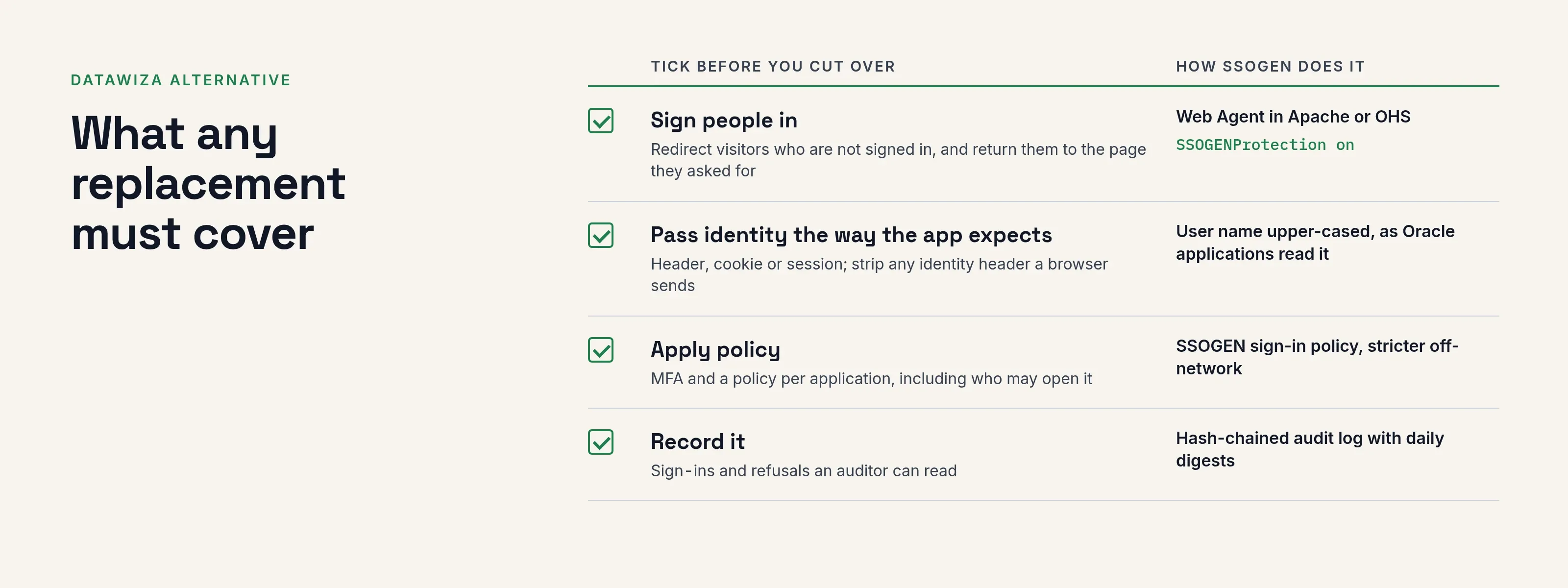
SSOGEN covers the same four jobs. It is a complete identity provider, and its Web Agent protects Oracle E-Business Suite, PeopleSoft and JD Edwards inside the web server you already run.
The page starts with what Datawiza does in your estate, per its own pages, then gives a checklist and shows how SSOGEN covers each item. For a row-by-row table, see Datawiza vs SSOGEN.
Sources, read 2026-10-09: Datawiza’s home page, Access Proxy and Agent Gateway pages, its MFA compliance hub, and its EBS and JD Edwards tutorials. Every Datawiza statement below comes from one of them.
What Datawiza is doing in your estate today
- Access Proxy. Datawiza describes its Access Proxy as a way to add MFA, SSO, OAuth and identity provider integration with no code changes, connected to an identity provider you choose (Access Proxy).
- DAP and DCMC. Its tutorials describe the Datawiza Access Proxy (DAP) as a “container-based reverse-proxy” managed from the Datawiza Cloud Management Console (DCMC) (EBS tutorial, read 2026-10-09).
- Identity to the app. In the tutorials DAP passes the user to JD Edwards in a single sign-on header that the tutorial names. For EBS, it creates the EBS session cookie from a mapped user name (JDE, EBS).
- Agent Gateway. Its Agent Gateway sits between AI agents and their tools and handles identity, credential brokering, sensitive-data inspection, approvals for bulk exports, destructive changes and privileged operations, and audit (Agent Gateway).
- Applications. Its home page lists JD Edwards, PeopleSoft, EBS, SharePoint, OWA and custom apps as applications Access Proxy protects (home).
Write down which of these you use. An alternative needs to cover only those.
What an alternative must cover
Tick each line before you cut anything over:
- Redirect unauthenticated visitors to a sign-in, and send them back to the page they asked for.
- Pass the user to the application in the exact form it expects: header name, cookie or session.
- Strip any identity header a browser sends, so nobody can impersonate a user.
- Enforce MFA and per-application policy, including who may open the app at all.
- Handle sign-out, so the application and the identity session both end.
- Run behind your existing load balancer and certificates, on the hostname people already use.
- Keep a record of sign-ins and refusals that an auditor can read.
- Stay up: know what happens when the control plane cannot be reached.
- For agents, give each one an owner, a limited scope and a way to stop it.
How SSOGEN covers each item
Sign-in, redirect and deep links (1). The Web Agent redirects visitors who are not signed in and keeps the query string through sign-in. You switch protection on per location with a directive, SSOGENProtection off|optional|on.
Identity to the app (2). By default the Web Agent upper-cases the user name and sends it the way Oracle applications already read it.
Oracle EBS (2). The Oracle EBS SSO guide covers EBS 12.2 in SAML mode, where EBS trusts a signed SAML response from your provider.
PeopleSoft and JD Edwards (2). They have their own guides.
Spoofing (3). The agent strips identity headers that come from a browser. Only the agent sets the headers the application trusts.
MFA and policy (4). SSOGEN is a complete identity provider. Each policy picks Authenticator app codes and recovery codes, with emailed and texted codes optional. A stricter rule can apply off-network.
Sign-out (5). The application’s own logout can end the agent session. A single sign-out path can end the SSOGEN, OpenID provider or SAML session.
Hostnames, certificates and balancers (6). Applications that cannot host a module go through the Gateway App Proxy: one hostname and certificate per application. A balancer needs its own client certificate before the gateway trusts a forwarded client address.
Audit (7). A tamper-evident, hash-chained log with daily digests, export and signed webhooks.
Availability (8). If the gateway cannot reach its controller, it refuses protected routes instead of leaving them open. If a feature rejects a new configuration revision, the gateway goes back to the previous one by itself.
Agents (9). Each agent is a registered identity with one to five owners and an expiry or review date. The MCP Gateway checks every tool call against granted scopes.
Terms side by side
| In Datawiza’s documents | Closest SSOGEN piece |
|---|---|
| Datawiza Access Proxy (DAP), described as a container-based reverse proxy (source, read 2026-10-09) | Web Agent in Apache or OHS, or the Gateway App Proxy |
| Datawiza Cloud Management Console (DCMC), described as a management console for DAP (same source) | Admin Console, where applications, policies and gateways are managed |
| Attribute pass, field mapped to a header | Identify the person by, in the application’s Identity sent to app step |
| Identity provider you connect | Identity provider sources in SSOGEN, or SSOGEN itself |
| Agent Gateway, MCP Gateway | Agent identity and the MCP Gateway capability of the Gateway |
What each SSOGEN component covers
Each SSOGEN component has a clear scope:
- The Web Agent is built on your server. You compile the module from a kit against your web server’s own headers, instead of installing rpm or deb packages. It signs people in through SSOGEN, which connects your LDAP directory or holds the accounts itself. The Gateway is a separate product with its own packages.
- Licensing. Protecting an application registered in SSOGEN needs no license key. The standalone SAML and OIDC modes of the Web Agent need a license key from SSOGEN.
- Agent traffic. The MCP Gateway authorizes each tool call by tool name and scope, without reading tool arguments or results. Datawiza documents sensitive-data inspection of that content for its gateways.
- MCP servers and tool lists. SSOGEN protects the MCP server you or a vendor run for Oracle EBS. Every agent proves its key with DPoP. The
tools/listanswer passes through as the server sends it, and each call is checked against scopes; Datawiza’s MCP Gateway page says its gateway filters that list. - SharePoint and OWA. Datawiza’s home page lists them among the applications Access Proxy protects. SSOGEN connects web applications through the Web Agent, the App Proxy, SAML or OpenID Connect; talk to us about your SharePoint and OWA setup.
A migration order that limits risk
- Inventory. List each application behind DAP, its hostname, header or cookie mapping and policy.
- Pick the pilot. Pick a low-risk web app. Protect it with the Web Agent or App Proxy under a test hostname.
- Match the identity. Confirm the app gets the same user it gets today. For Oracle, that is the application user name, not an email address, unless the mapping uses email.
- Parallel run. Datawiza serves the live hostname until the pilot passes.
- Move the ERP apps. EBS, then PeopleSoft and JD Edwards, in change windows, with a rollback to the previous proxy.
- Move agents last. Register each agent, set scopes and owners, and test access before real use.
- Move provisioning. If you want accounts created for you, add SCIM provisioning after sign-in is stable.
Where Datawiza fits
- Your identity provider is settled and only the legacy app needs connecting.
- You want SaaS delivery of the Access Proxy, or its documented inspection of agent requests and responses.
- Your auditors use its MFA compliance hub, which sets out MFA requirements by framework.
Questions people ask
What is a good Datawiza alternative for Oracle EBS?
SSOGEN, through the Web Agent in Apache or OHS. It passes the EBS user name in the form EBS expects and signs out cleanly, and the Oracle EBS SSO guide covers the setup.
Do I need a proxy at all?
Not with the Web Agent, which runs inside your web server. The App Proxy covers applications that do not have one.
Can I move app by app?
Yes. Each application has its own hostname and policy, so cutover is per application.
About this comparison. SSOGEN Corporation prepared this page from Datawiza Technologies Inc.’s public documentation and web pages, last read on 2026-10-09.
We took care to be accurate, but products, plans and prices change, and we may have misread or missed something, so some statements may be wrong or out of date.
This page is for general information only and comes without any warranty.
SSOGEN is not responsible for errors, omissions or decisions made from it. Check the vendor’s own pages and test the products yourself before you decide.
If you see a mistake, tell us and we will correct it.
Datawiza, Datawiza Access Proxy (DAP), Datawiza Cloud Management Console (DCMC), Datawiza Agent Gateway, Datawiza MCP Gateway, SharePoint, Oracle E-Business Suite, PeopleSoft, JD Edwards, Oracle Access Manager, Oracle HTTP Server and Apache are trademarks of their respective owners.
SSOGEN is an Oracle partner, but Oracle has not reviewed or endorsed this page. Except for Oracle, the owners named are not affiliated with, endorsed by or sponsored by SSOGEN.