SSOGEN / SSO Comparison: SSOGEN Against 19 Products, Row by Row
SSOGEN
SSO Comparison: SSOGEN Against 19 Products, Row by Row
Each page is a table built from the other vendor's own published pages, with the date we read them, and it says when that product fits better.
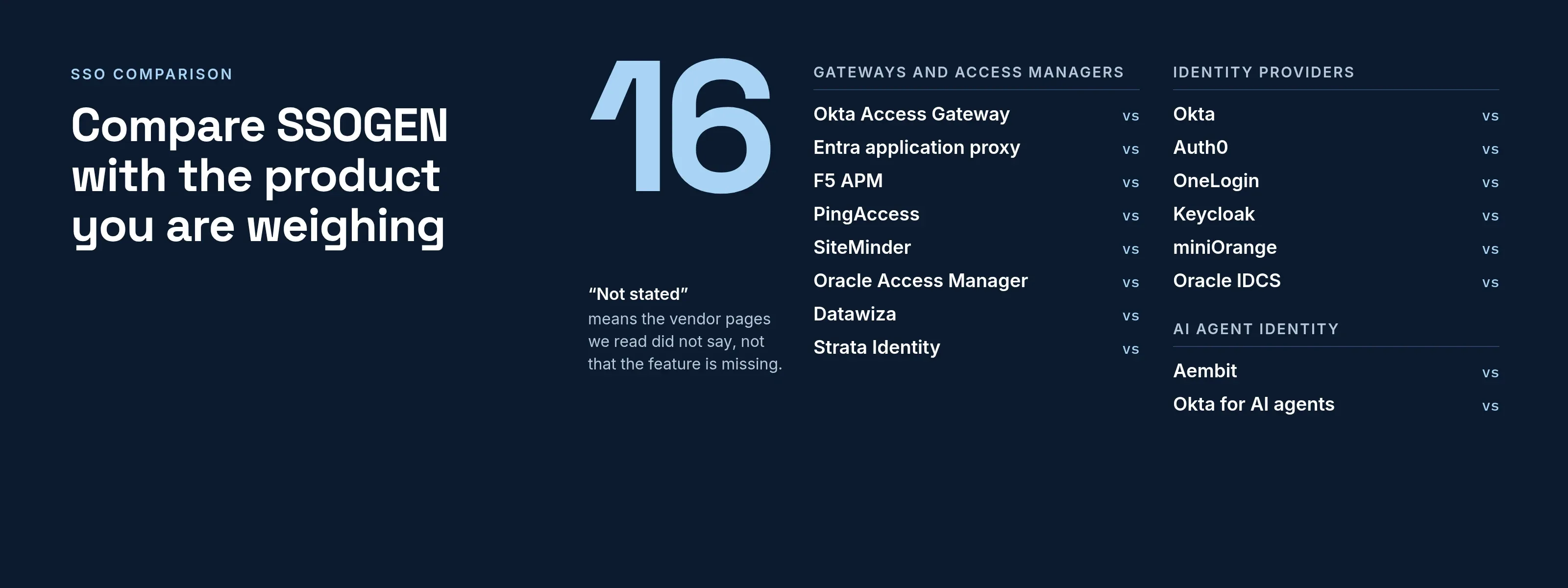
This SSO comparison sets SSOGEN beside the product you are evaluating.
SSOGEN is a complete identity provider: any application that speaks SAML 2.0 or OpenID Connect connects now. The Web Agent signs people in to Oracle E-Business Suite, PeopleSoft and JD Edwards inside the web server.
SSOGEN wrote these pages to one method:
- Sourced. Every statement about another vendor comes from that vendor’s own documentation or product page, linked and dated.
- Not stated. “Not stated” means the pages we read did not say. It does not mean the vendor lacks the feature.
- Fair fit. Where the other product fits better, the page says so. Pick yours below.
Compare SSOGEN with the product you are weighing
Each product has a comparison page (a table, with sources). Most also have an alternative page that starts from why people go looking for one.
Identity providers and platforms
| Product | What the comparison covers | Read |
|---|---|---|
| Okta | Applications, directory, SCIM, authenticators, on-premises apps, server access and AI agents | Okta vs SSOGEN and the Okta alternative |
| Auth0 | Who each is built for, enterprise connections, login, custom code, AI agent controls and ERP access | Auth0 vs SSOGEN and the Auth0 alternative |
| OneLogin | MFA, on-premises web app access, extension points, Oracle applications, server access and AI agents | OneLogin vs SSOGEN and the OneLogin alternative |
| Keycloak | Protocols, directories, upstream providers, second factors, Apache module, gateway and AI agent identity | Keycloak vs SSOGEN and the Keycloak alternative |
| miniOrange | Protocols, MFA, provisioning, ERP sign-in, audit, remote access and AI agent identity | miniOrange vs SSOGEN and the miniOrange alternative |
| Oracle IDCS | What the E-Business Suite 12.2 guide says IDCS does, identity domains and hosting | Oracle IDCS vs SSOGEN and the Oracle IDCS alternative |
| Ping Identity | PingOne, PingFederate, PingAccess and PingAM mapped to SSOGEN, AI agents and pricing | Ping Identity vs SSOGEN |
Gateways and web access management
| Product | What the comparison covers | Read |
|---|---|---|
| Okta Access Gateway | On-premises web apps, headers, Kerberos, form sign-in, policy and operations | Okta Access Gateway vs SSOGEN and the Okta Access Gateway alternative |
| Entra application proxy | Outbound-only publishing, pre-authentication, Kerberos, forms, headers and where each runs | Entra application proxy vs SSOGEN and the Entra application proxy alternative |
| F5 APM | Access types, policy model, authentication methods, endpoint checks and web app sign-in | F5 APM vs SSOGEN and the F5 APM alternative |
| PingAccess | Sites, agents, applications, rules, sessions, identity mapping and clusters | PingAccess vs SSOGEN and the PingAccess alternative |
| SiteMinder | Agent, policy model, user directories, identity headers and logout | SiteMinder vs SSOGEN, the SiteMinder alternative and what SiteMinder is |
| Oracle Access Manager | How each intercepts requests, authenticates and passes the user to E-Business Suite and PeopleSoft | Oracle Access Manager vs SSOGEN and the Oracle Access Manager alternative |
| ForgeRock AM (PingAM) | What changed under Ping, web agent against Web Agent, and a move one application at a time | ForgeRock Access Management alternative |
| Datawiza | How each protects Oracle and legacy web apps, MFA, AI agent controls and deployment | Datawiza vs SSOGEN and the Datawiza alternative |
| Strata Identity | Orchestration or identity provider, legacy app protection, MFA, SCIM, agent gateways and remote access | Strata Identity vs SSOGEN and the Strata Identity alternative |
AI agent identity
| Product | What the comparison covers | Read |
|---|---|---|
| Aembit | Workload identity, AI agent and MCP access, people sign-in, ERP apps, audit and revocation | Aembit vs SSOGEN and the Aembit alternative |
| Okta for AI agents | What each vendor documents for agent identity, MCP and approvals, and Okta’s Cross-App Access | Okta for AI agents vs SSOGEN |
| CyberArk (Idira) | Which CyberArk job SSOGEN fills: AI agent identity, non-human identities and just-in-time server access | CyberArk alternative |
How to choose between them
These products solve different problems. Start with what you need to protect.
- Cloud and SaaS apps that speak SAML or OpenID Connect. Any identity provider in the first group handles these. Compare directories, authenticators and price.
- Web apps that cannot speak a standard, like Oracle E-Business Suite, PeopleSoft or JD Edwards. Look at the gateways and access managers, and whether each signs people in with an agent or a proxy.
- Server and remote access. Check whether the product covers it or leaves it to a separate tool. SSOGEN runs SSH, RDP and VNC sessions in the browser through its Gateway.
- AI agents. Look for an identity per agent, with an owner, limited scopes and a record of what it did. SSOGEN’s AI agent identity gives each agent exactly that.
Questions people ask
Which SSO is best?
What does SSO stand for?
What is SSO vs SAML?
What are the different types of SSO?
Where to go next
- Learn. Start with what SSO is.
- Product. See how SSOGEN works as single sign-on software.
- Trial. You can also request a trial and bring the product you are weighing.
- Related. The comparisons sit beside the SSO explainers and the free tools.