SSOGEN / Aembit Alternative: Workload Identity or Identity for People, Apps and Agents
Compare
Aembit Alternative: Workload Identity or Identity for People, Apps and Agents
Aembit documents access for workloads and agents; SSOGEN covers employees, applications and agents with owners, consent and approvals.
Teams look for an Aembit alternative when people, business applications and AI agents acting for employees need access alongside workloads. Aembit and SSOGEN overlap in one place: AI agents calling tools through an MCP gateway. Elsewhere, each answers a different question.
Aembit’s documentation describes a workload identity and access product. Software proves what it is, a policy decides, and a short-lived credential arrives at the moment of access.
SSOGEN is a complete identity provider and access layer for people and applications, and it gives every AI agent an owned identity. The right choice depends on who the caller is.
Sources, read 2026-10-09: Aembit’s IAM for Agentic AI page and its core concepts documentation. Every Aembit statement below comes from one of the two. SSOGEN facts come from SSOGEN’s documentation and finished pages.
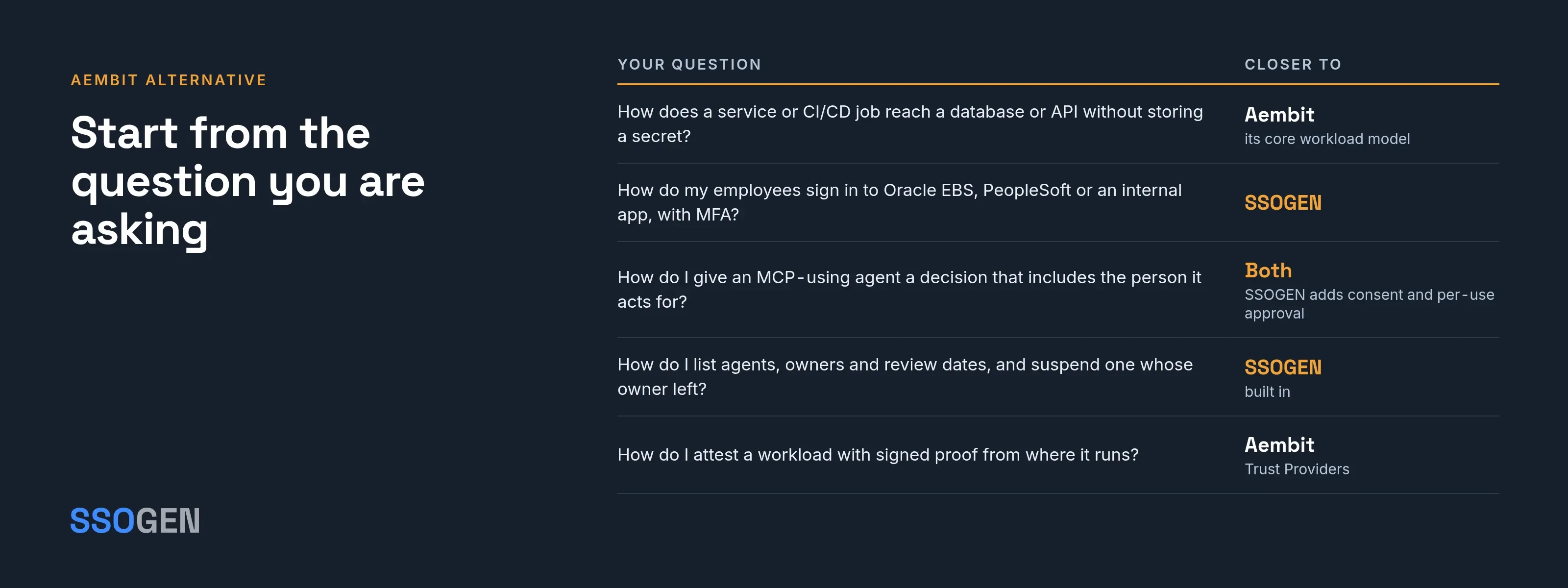
Start from the question you are asking
| Your question | Closer to |
|---|---|
| How does a service or CI/CD job get access to a database or API without storing a secret? | Aembit. This is the core of its workload model |
| How do my employees sign in to Oracle EBS, PeopleSoft or an internal app, with MFA? | SSOGEN |
| How do I give an MCP-using agent an access decision that includes the person it acts for? | Both. SSOGEN adds the person’s consent and a per-use approval; compare the details below |
| How do I list agents, owners and review dates, and suspend an agent whose owner left? | SSOGEN. Owners, review dates and automatic suspension are built in |
| How do I attest a workload using evidence from its cloud provider? | Aembit documents Trust Providers for this |
What Aembit documents
Aembit’s core concepts use a small vocabulary.
Client Workload. A non-human entity that needs a resource.
Server Workload. The resource itself: an API, database or SaaS application.
Trust Provider. It gives cryptographically signed evidence about the client from where it runs, and Aembit Cloud validates it.
Credential Provider. It gets the credential.
Access Policy. It says which client may reach which server, and under what conditions.
Aembit Cloud. The management plane.
Aembit Edge. Components that enforce policy where the workload runs, injecting credentials just in time. The client never holds a long-lived secret.
For agents, its agentic AI page describes these pieces:
- Blended identity. An agent’s identity combined with the person it acts for.
- OAuth 2.1 authorization code flow. As the MCP specification defines it.
- Credential exchange. It happens at request time, so agents never hold direct credentials for MCP servers.
- Conditional access. Factors such as time of day or geographic location.
- Revocation. Instant.
- Audit logs. Structured, and they integrate with your SIEM.
- Existing providers. A setup that works alongside Okta, Azure AD and Google through OIDC and SAML.
As of 2026-10-09, the same page describes two components:
- MCP Authorization Service. It “runs as a fully managed capability in Aembit Cloud”.
- MCP Identity Gateway. It “deploys as a Linux virtual machine in your own environment”.
Containerized and fully managed options for the gateway are listed as upcoming.
Translating the vocabulary
| Aembit term | The nearest SSOGEN idea | Where they differ |
|---|---|---|
| Client Workload | A registered AI agent, MCP client or automation | SSOGEN registers it with one to five human owners and a review date |
| Trust Provider | The agent’s own key pair, registered as a public key | SSOGEN identifies the agent by its registered key, and a named owner answers for it |
| Server Workload | An application, with scopes you define on it | SSOGEN scopes name the tool, such as invoices.read |
| Access Policy | Sign-in and access policy, plus the scopes granted to the agent | SSOGEN conditions include the kind of caller and the acting identity |
| Credential Provider and injection | A token bound to the agent’s key | SSOGEN issues the agent its own key-bound token, and the gateway passes the agent’s identity to the application in headers |
| Blended identity | Delegation: the person is the subject, the agent the actor | The act claim of RFC 8693 names the agent. The agent receives the credential after the person consents, and OAuth token exchange covers a credential for another resource |
| Revocation | Kill switch for one agent type | New credentials stop at once; credentials already issued stop working within five minutes. Turning the AI agents setting off stops all agent token issuing |
Where Aembit fits
- The callers are mostly workloads, such as services, functions and pipelines across cloud accounts, and your hard problem is getting rid of static secrets.
- You want credentials issued after workload attestation. Aembit documents Trust Providers for that. SSOGEN builds agent identity on a registered key and a named owner instead.
- Your targets are databases, cloud APIs and SaaS APIs, and you need credential injection. Aembit Edge injects credentials where the workload runs. SSOGEN protects business applications, web routes and MCP tool servers.
- Your MCP clients rely on dynamic registration. Aembit’s page says agents and MCP clients “can register dynamically”. In SSOGEN an administrator registers every agent, so each one has an owner from its first request.
Where SSOGEN fits
- People sign in too. SSOGEN is a complete identity provider with single sign-on, MFA, SCIM and an audit log for employees and contractors. Agents and people share one policy model.
- Your systems are Oracle EBS, PeopleSoft or JD Edwards. The Web Agent and Oracle EBS SSO cover these.
- Agents act for named people on business systems. An agent acts for a person only after they consent, and they can withdraw it in My Account. Sensitive scopes are never part of a delegation; each use waits for the person’s approval. Read AI agent identity and AI agent permissions.
- You need the tool-call checks inside your own network. The MCP Gateway is a capability of the SSOGEN Gateway that you run, and it records its decisions in a hash-chained audit trail.
- Internal web apps and servers need access too. The Gateway provides an App Proxy and browser SSH, RDP and VNC.
SSOGEN holds every MCP client to a strict standard:
- Proof of a key. The client proves it holds a key on every request (DPoP).
- Pushed requests. When acting for a person, the client uses a pushed authorization request (PAR).
- No bearer tokens. Plain bearer tokens are refused.
Questions people ask
Is Aembit an identity provider for employees?
Aembit’s concept pages define clients as non-human workloads. Its agent page says it works alongside the human identity providers you already run, including Okta, Azure AD and Google. Check Aembit’s current documentation for your case.
What is the difference between workload identity and non-human identity?
Non-human identity is the wider term: service accounts, keys, workloads and agents. Workload identity is one kind. Non-human identity covers all five.
Which of these jobs does SSOGEN cover?
SSOGEN covers AI agents calling MCP tools, with owners, consent and per-use approval. It also signs in people and applications under the same policy model.
Where to go next
Read AI agent identity, put tool calls behind the MCP Gateway, or draft scopes with the free AI agent permissions builder. For a row-by-row reference, see the Aembit vs SSOGEN comparison. If privileged access and server sessions are part of the question, see the CyberArk alternative.
About this comparison. SSOGEN Corporation prepared this page from Aembit’s public documentation and web pages, last read on 2026-10-09.
We took care to be accurate, but products, plans and prices change, and we may have misread or missed something, so some statements may be wrong or out of date. This page is for general information only and comes without any warranty.
SSOGEN is not responsible for errors, omissions or decisions made from it. Check the vendor’s own pages and test the products yourself before you decide. If you see a mistake, tell us and we will correct it.
Aembit, Aembit Cloud, Aembit Edge, Aembit MCP Authorization Service, Aembit MCP Identity Gateway, Okta, Azure AD, Google, Oracle E-Business Suite, PeopleSoft and JD Edwards are trademarks of their respective owners. SSOGEN is an Oracle partner, but Oracle has not reviewed or endorsed this page.
Except for Oracle, the owners named are not affiliated with, endorsed by or sponsored by SSOGEN.