SSOGEN / Learn / Non-Human Identity: Service Accounts, Keys, Workloads and Agents
Learn
Non-Human Identity: Service Accounts, Keys, Workloads and Agents
A non-human identity is any credential software signs in with, like a service account, API key or agent, and each needs an owner and an end date.
Updated
A non-human identity (NHI) belongs to software, not to a person. A nightly job reads a database, a build pipeline deploys code, an AI agent files an expense claim.
In each case the caller must prove who it is, and the credential it uses is a non-human identity: a service account, an API key, a certificate, an OAuth client or a workload identity.
These identities matter because they never answer MFA prompts and are rarely reviewed. Many were created once by someone who has since left the organization, and they still work.
The five kinds of non-human identity
Names vary by vendor, but five patterns cover most of what an inventory finds.
| Kind | What it is | How it proves itself | Typical lifetime | Typical weakness |
|---|---|---|---|---|
| Service account | A directory or database account used by a program | Password or key stored with the program | Years | Shared across systems, password never rotated, owner gone |
| API key | A string that identifies the calling application | The string itself, sent with each request | Until deleted | Copied into code, logs and chat; works for anyone who has it |
| OAuth client | A registered application that obtains tokens | Client secret, or a signed assertion | Long, with short-lived tokens | Secret leaked; scopes granted too widely |
| Workload identity | An identity issued to a running workload by the system that hosts it | Short-lived credential from the host system | Minutes to hours | Mis-scoped roles; applies only where the host system supports it |
| AI agent | Software that chooses its own actions, often for a person | Depends on setup: a key, or a person’s session | Varies | Borrows a person’s access, acts on text it read, no clear owner |
The table is a working map, not a standard. The OWASP Non-Human Identities Top 10 doesn’t define the term formally; it describes NHIs by example: service accounts and access keys, API keys, tokens, encryption keys and certificates.
Why agents are a special case
A service account does one fixed thing. An agent decides at run time what to call, often for a particular person, which raises two issues the older kinds never did:
- Authority. The call may use a person’s authority rather than the agent’s own.
- Injected instructions. Text the agent read may have prompted the call.
Give each agent its own identity, owned by a person, and record both the agent and the person when it acts for someone. The agentic AI security explainer goes deeper.
The lifecycle problems, stage by stage
Most non-human identity incidents are lifecycle failures rather than sophisticated attacks. OWASP’s list follows the lifecycle: NHI1 Improper Offboarding, NHI2 Secret Leakage, NHI5 Overprivileged NHI, NHI7 Long-Lived Secrets, NHI9 NHI Reuse and NHI10 Human Use of NHI.
| Stage | What usually goes wrong | What to require |
|---|---|---|
| Create | No record of who asked for it or why | Register it with a named owner and a stated purpose |
| Grant | Broad access “to make it work” | Smallest set of permissions, per application |
| Store | Secret in source code, config or chat | No standing secret where possible; otherwise a secrets store |
| Use | One identity shared by many jobs; people sign in with it | One identity per workload; interactive use blocked |
| Rotate | Never, because nobody dares break the job | Short-lived credentials, or rotation without downtime |
| Review | Nobody looks | A review date, with suspension if it lapses |
| Retire | The project ended, the identity did not | Disable when the owner leaves or the service ends; keep the record |
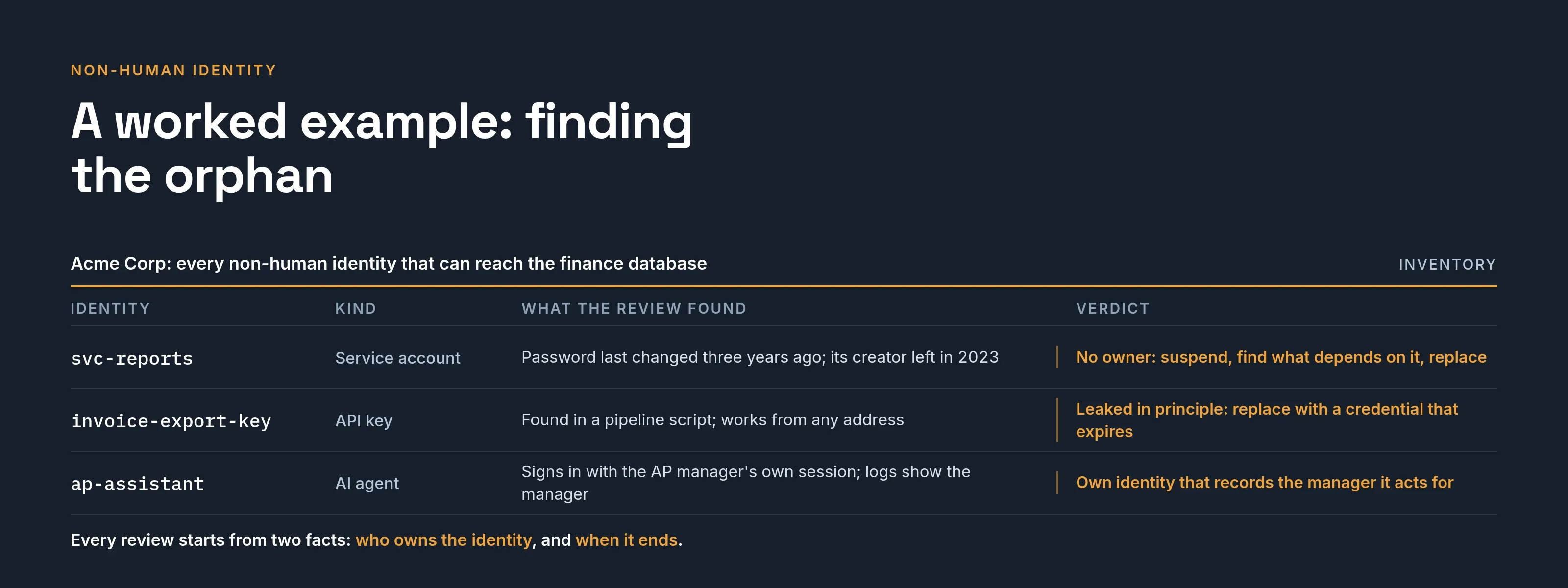
A worked example: finding the orphan
Acme Corp lists every non-human identity that can reach its finance database.
svc-reportsis a service account with a password last changed three years ago. Its creator left in 2023. Verdict: no owner, so suspend it, find what depends on it, replace it.invoice-export-keyis an API key found in a pipeline script. It works from any address. Verdict: leaked in principle, so replace it with a credential that expires.ap-assistantis an AI agent that signs in with the AP manager’s own session. Logs show the manager. Verdict: give it its own identity that records the manager as the person it acts for.
Each identity needs a different fix, and every review starts from the same two facts: who owns the identity, and when it ends.
Controls that work across all five kinds
- Inventory first. You can’t govern identities you haven’t found, so count keys in repositories and accounts in directories.
- One owner per identity, plus a backup. Owners are always people.
- Use short-lived credentials tied to the caller’s own key, not static secrets.
- Scope to the task. Review permissions when the task changes.
- Set an end date or review date on every identity.
- Log each use under the identity’s own name, never a person’s.
How SSOGEN handles AI agents as non-human identities
SSOGEN registers AI agents, MCP clients, automations and services as non-human identities. Each has a name, a permanent identifier, a type, one primary owner and up to five owners, all people.
- Credential. There is no password. The agent proves itself with a key pair, and you register only the public key; SSOGEN refuses a registration that contains a private key.
- Access. Access is granted per application and scope.
- End date. An Expires on or Review by date is required, no more than 365 days ahead. When the last owner leaves, the agent is suspended.
- Consent. When an agent works for a person, it needs that person’s consent, which the person can revoke in My Account.
Every action is audited. See AI agent identity and the registration guide.
Questions people ask
What is a non-human identity?
An identity used by software instead of a person: a service account, API key, certificate, OAuth client, workload identity or AI agent.
What is the difference between a service account and an API key?
A service account is an account in a directory or system, with its own permissions. An API key is a string that identifies the caller. Both stay static unless you rotate them.
Is an AI agent a non-human identity?
Yes. It is the newest kind, and it differs from the others because it chooses its own actions and often acts for a person.
Why are non-human identities risky?
They are numerous, long-lived, rarely reviewed and often overprivileged. OWASP puts improper offboarding and secret leakage at the top of its list.
Where to go next
- Workload identity standards. See SPIFFE and SPIRE.
- Cloud access without stored keys. See workload identity federation.
- Bots in Oracle EBS. See why RPA bots on human or shared EBS accounts are an audit finding.
- Governance. The AI agent governance checklist helps you set owners, scopes and review dates.
- Leavers. Offboarding AI agents covers what to stop or hand over when an owner leaves.
- Tool access. MCP authentication covers tool access.
- Microsoft’s approach. Microsoft’s approach to agent identity is covered in Microsoft Entra Agent ID.
- Key generation. For key formats, sizes and the hash to store, try the API key generator.
- More explainers. The Learn hub lists related explainers.
Sources, all read 2026-10-09: OWASP Non-Human Identities Top 10.