SSOGEN / miniOrange Alternative: SSOGEN and miniOrange Compared
Compare
miniOrange Alternative: SSOGEN and miniOrange Compared
List the jobs miniOrange does in your estate, see how SSOGEN covers each, and move them in an order that never leaves an application unprotected.
Teams look for a miniOrange alternative for one of two reasons:
- A contract is ending.
- A specific job, such as agent access or auditing, needs a stronger answer.
SSOGEN covers both, and none of them needs a big-bang move: jobs move one at a time.
Sources, read 2026-10-09: the miniOrange pages linked below, each linked where used. Check them again before you act. Vendors change their products.
Step 1: inventory what miniOrange does for you
miniOrange sells a suite, so start with the parts you actually use. Its IAM page lists single sign-on, multi-factor authentication, adaptive MFA, user lifecycle management, an Access Gateway and role-based access control.
Its other products include privileged access management, unified endpoint management and data loss prevention.
It comes as cloud (IDaaS), on-premise or hybrid. For each application, record which of these applies:
- Sign-in: which protocol connects it (SAML, OAuth 2.0, OpenID Connect, JWT, WS-Federation or Integrated Windows Authentication, all listed on the SSO page).
- Oracle applications: the miniOrange connector for Oracle EBS is hosted on the same domain as the EBS apps tier, and the JD Edwards page describes a reverse-proxy agent. Note the release (EBS 11i, 12.1 or 12.2.x).
- Other legacy applications: anything behind the Access Gateway, which uses a reverse proxy and header or cookie authentication.
- Second factor: which of its MFA methods your users rely on (the MFA page lists push, TOTP, biometrics, FIDO2 keys and more).
- Provisioning: which SaaS applications receive accounts through SCIM.
- Anything outside identity: PAM, endpoint or DLP. SSOGEN covers the identity jobs: sign-in, MFA, provisioning, audit and server access.
What an alternative has to cover
Use this table as your acceptance list. Each row shows how SSOGEN does the job, taken from SSOGEN’s own documentation.
| Job | SSOGEN coverage | How it works |
|---|---|---|
| Identity provider for people | Complete identity provider, or sign-in through Entra ID, Okta, Keycloak or AD FS. See single sign-on software | Users sign in once over SAML 2.0 or OpenID Connect and reach every connected application |
| SAML and OIDC applications | Register in the console; SAML metadata can be uploaded | Any SAML or OpenID Connect application connects now, with no catalog entry needed |
| Oracle EBS 12.2 | Oracle EBS SSO: Web Agent in SAML mode | No Oracle Access Manager, IDCS or OID needed. Teams on EBS 11i or 12.1 plan the web tier with SSOGEN |
| PeopleSoft, JD Edwards | PeopleSoft SSO, JD Edwards SSO via the Web Agent | The module is built on your own web server from a checksummed build kit |
| Applications that cannot host a module | Gateway App Proxy with identity headers, Kerberos and form-fill | Each route serves one exact hostname, with no wildcards; a wildcard certificate is fine |
| Active Directory and LDAP | Directory Connector and directory sync | The same people exist in both products during the move |
| MFA | TOTP, passkeys, recovery codes, email and text codes (MFA software) | Map each miniOrange method in use, such as push, RSA or biometrics, to an SSOGEN method before enrollment moves |
| Provisioning | Inbound and outbound SCIM 2.0 (guide) | PATCH and filtering; changes go one record at a time rather than in bulk operations, so test each target application |
| Audit | Tamper-evident, hash-chained log (SSO audit log) | Signed webhooks and export feed any SIEM product |
| Server access | Secure remote access from the browser | SSH, RDP and VNC, with approval and audit |
| AI agents | AI agent identity | Owned agent identities, consent, short-lived tokens and a kill switch |
Where SSOGEN goes further, and what to check in miniOrange
SSOGEN builds in the three capabilities below. The miniOrange pages read for this comparison do not describe them, so ask miniOrange how it handles each one.
- Agent access with accountability. Each agent has one to five human owners and an expiry or review date. An agent acting for a person needs that person’s consent, and sensitive scopes need approval every time. A kill switch stops a whole type of agent, and tokens already issued stop working within 5 minutes. See the AI agents guide.
- An audit trail you can prove. Records are hash-linked, sealed daily and checked from the console.
- Server access without a VPN. A contractor requests access, a named approver grants it, and the window closes on its own. Each window lasts at least 15 minutes, up to the limit shown in the request form.
Where miniOrange fits
miniOrange fits these cases:
- A large catalog matters. It states “6000+ pre-built integrations” on its integrations page.
- You rely on one of its 15+ MFA methods, such as push or RSA, or on WS-Federation.
- You run EBS 11i or 12.1.
- You want privileged access, endpoint management and DLP from one vendor.
SSOGEN answers the catalog differently. Any SAML or OpenID Connect application connects without a catalog entry, and signed App Packs supply ready-made connection recipes that SSOGEN verifies before it installs them.
A migration order that keeps everything protected
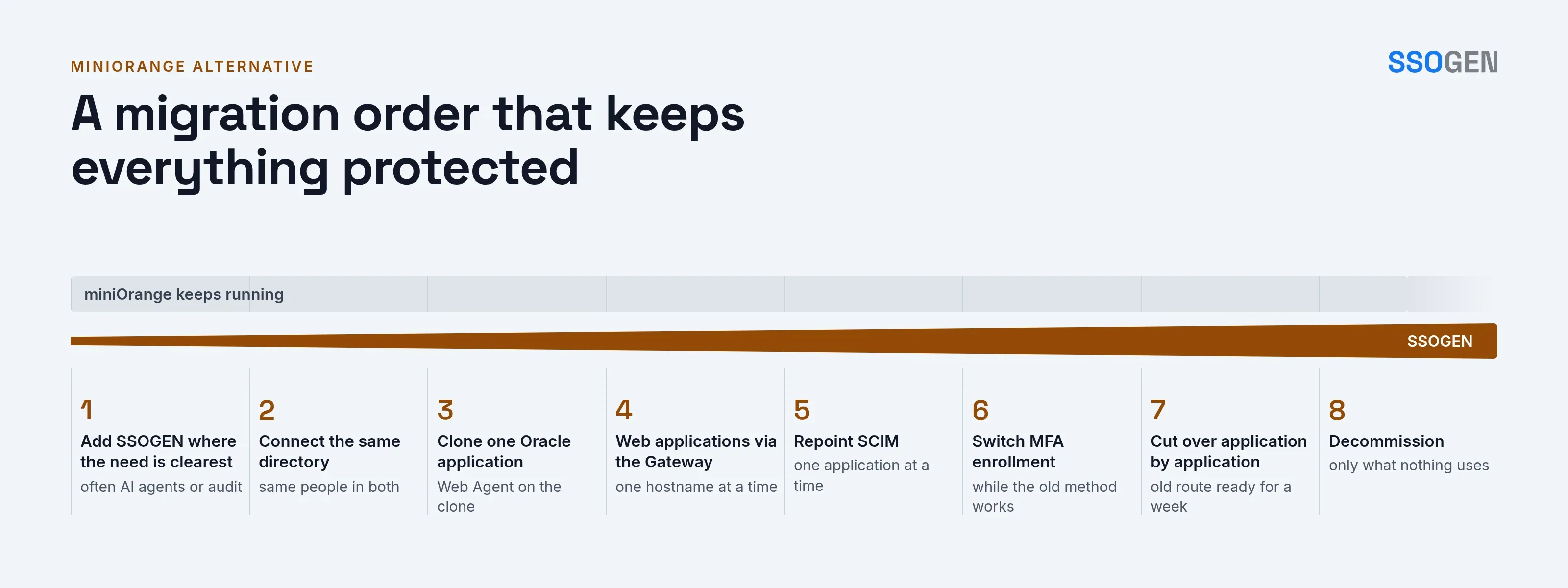
- Start with the job with the clearest need, often AI agents or auditing. The rest of the estate runs as is during this step.
- Connect SSOGEN to the same directory. Use the Directory Connector for Active Directory or LDAP, so the same people exist in both.
- Clone one Oracle application and install the Web Agent on the clone. Test sign-in, sign-out and the local administrator login.
- Move non-Oracle web applications through the Gateway, one hostname at a time.
- Repoint SCIM one application at a time. Confirm the first reconciliation before you disable the old connection.
- Switch MFA enrollment last. Users enroll in the SSOGEN Authenticator, a passkey or another SSOGEN method while the old method still works.
- Cut over one application at a time. Keep the old route ready for a week.
- The move is complete when no application uses the old connection.
Questions people ask
Does a move need a big-bang cutover?
No. SSOGEN takes over identity jobs one at a time. The table maps each job, and most estates start with one.
Does SSOGEN need Oracle Access Manager?
No. SSOGEN’s EBS guide needs no OAM, IDCS or OID. miniOrange’s Oracle EBS page says the same about OAM and OID licenses for its connector.
Where does a move usually start?
With the job that has the clearest need, often AI agents or auditing. See the side-by-side comparison.
Where to go next
SSOGEN has run in production since 2016, and Microsoft lists it in the Microsoft Entra gallery. Pick a connection method with the application guide, or read Oracle EBS SSO.
About this comparison. SSOGEN Corporation prepared this page from miniOrange Security Software Pvt Ltd’s public documentation and web pages, last read on 2026-10-09.
We took care to be accurate, but products, plans and prices change.
We may have misread or missed something, so some statements may be wrong or out of date. This page is for general information only and comes without any warranty.
SSOGEN is not responsible for errors, omissions or decisions made from it. Check the vendor’s own pages and test the products yourself before you decide.
If you see a mistake, tell us and we will correct it.
miniOrange, miniOrange Access Gateway, Microsoft Entra ID, Okta, Keycloak, AD FS, Active Directory, Oracle E-Business Suite, PeopleSoft, JD Edwards, Oracle Access Manager, Oracle Internet Directory, Apache and Oracle HTTP Server are trademarks of their respective owners.
SSOGEN is an Oracle partner, but Oracle has not reviewed or endorsed this page. Except for Oracle, the owners named are not affiliated with, endorsed by or sponsored by SSOGEN.