SSOGEN / Strata Identity Alternative: Maverics and SSOGEN Side by Side
Compare
Strata Identity Alternative: Maverics and SSOGEN Side by Side
Maverics and SSOGEN compared on one question: a layer over several providers, or one provider that protects the applications directly.
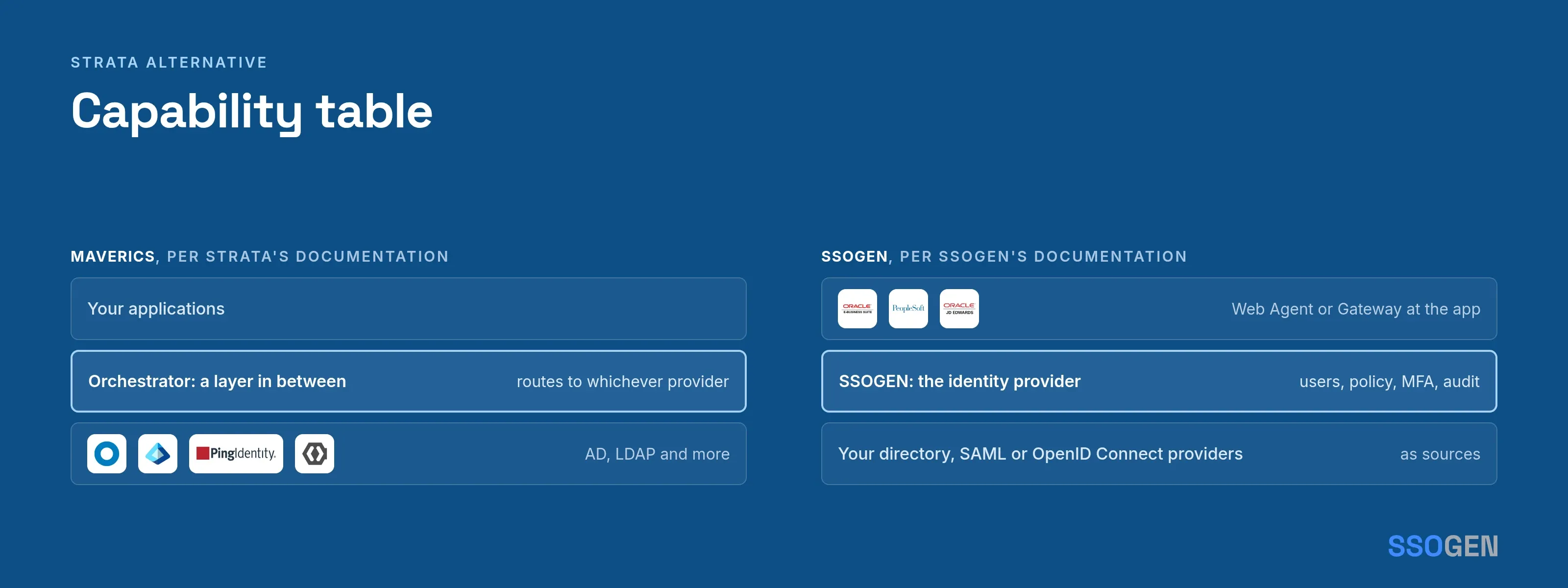
Strata Identity offers Maverics, which its documentation describes as orchestration for modern, legacy and AI identity. If you are looking for a Strata Identity alternative, compare where each product starts, not feature against feature.
- Maverics sits between your applications and whichever identity providers you have.
- SSOGEN is a complete identity provider that also protects the applications itself, through a Web Agent in the web server or a Gateway in front of the application. It connects Oracle E-Business Suite, PeopleSoft and JD Edwards, and it gives AI agents their own identities.
Some estates need one, and some the other.
Sources, read 2026-10-09: Strata’s overview, architecture, HTTP Proxy guide, AI Identity Gateway overview and page index. Everything about Strata below comes from one of them. Everything about SSOGEN comes from SSOGEN’s own documentation and pages.
How the orchestration layer is documented
The overview describes Maverics as an orchestration layer that routes authentication and authorization between your applications and any identity provider. It has two parts:
- The Orchestrator is a lightweight identity abstraction layer.
- The Console is a visual interface for connectors, policies and configuration.
The architecture page says the Orchestrator is self-hosted, the Console is a cloud service that publishes signed configuration, and identity traffic stays in your infrastructure.
The Orchestrator runs in five modes: OIDC Provider, SAML Provider, HTTP Proxy, LDAP Provider and AI Identity Gateway. Strata lists what follows from that:
- SSO and MFA for applications that lack native support
- identity provider migration
- API protection
- multi-cloud identity consolidation
- identity continuity
- service extensions with 30+ hook points
Capability table
| Item | Strata Identity documents (docs.strata.io, read 2026-10-09) | SSOGEN documents |
|---|---|---|
| Role | Orchestration; the Orchestrator routes authentication and authorization between applications and identity providers | A complete identity provider, optionally federating to yours |
| Protecting a web application | HTTP Proxy mode, an identity-aware reverse proxy that authenticates through the identity provider and passes identity to the backend | Web Agent inside Apache or Oracle HTTP Server, and the Gateway’s App Proxy for applications that cannot host a module |
| Identity providers listed | A long list that includes Okta, Microsoft Entra ID, PingFederate, Keycloak, Active Directory, LDAP, Oracle Identity Cloud Service and Oracle Universal Directory (provider index) | Local accounts, LDAP, SAML and OpenID Connect providers; see identity providers |
| Oracle E-Business Suite, PeopleSoft | Not found in the docs.strata.io page index (llms.txt), read 2026-10-09 | Dedicated guides: Oracle EBS SSO, PeopleSoft SSO |
| MFA methods | Maverics adds SSO and MFA to applications without native support (overview, read 2026-10-09); MFA methods are not itemised on the pages read | Authenticator app (TOTP), emailed and texted codes, recovery codes (MFA guide) |
| Provisioning (SCIM) | Not found in the docs.strata.io page index (llms.txt), read 2026-10-09 | Inbound SCIM endpoint (guide) |
| Extensibility | Service extensions, 30+ hook points, embedded Go runtime | Named sign-in policies with rules and conditions; signed webhooks send every audit event to your systems |
| IdP migration and continuity | Provider migration described as zero downtime, and identity continuity with failover | Identity provider failover: each policy names backup providers that take over when a primary is unavailable, without lowering the required strength |
| AI agent traffic | AI Identity Gateway with MCP Proxy and MCP Bridge modes | MCP Gateway as part of the SSOGEN Gateway |
| Agent identity model | Delegation chains with OAuth token exchange, dynamic scopes, action-level audit | Owned agent identities, consent, sensitive-scope approvals, kill switch |
| Remote access to servers | Not found in the docs.strata.io page index (llms.txt), read 2026-10-09 | SSH, RDP and VNC in the browser (guide) |
“Not found in the page index” or “not itemised on the pages read” means exactly that. It does not say Strata lacks the capability.
Where Strata Identity fits
-
You run several identity providers and want one orchestration layer in front of them. Maverics is built for that. Strata documents zero-downtime migration, which moves users from one provider to another.
-
You want to keep every identity provider you have. Strata lists many connector types. SSOGEN federates directly to SAML, OpenID Connect and LDAP providers and names backup providers for failover, so it keeps them too.
-
You need custom logic at defined points in a flow. Strata documents service extensions with an embedded Go runtime. SSOGEN covers the same decisions with sign-in policies, rules and conditions, without custom code to maintain.
Where SSOGEN fits
-
You need an identity provider, not only a layer over one. SSOGEN handles local users, your directory, SAML and OpenID Connect, with policies, MFA and an audit log.
-
The application is Oracle EBS, PeopleSoft or JD Edwards and you want sign-in inside the web server. The Web Agent runs in Apache or Oracle HTTP Server. For EBS 12.2 it works in SAML mode, where EBS verifies a signed SAML response from your provider.
-
The Web Agent is built on your server. You build the agent from a build kit, and the standalone SAML and OIDC modes take a license key from SSOGEN.
-
You want browser access to servers through the Gateway, alongside application sign-in.
-
AI agents are people-owned and need approvals. AI agent identity gives each agent one to five named owners, a review date and a key pair. Credentials last about four minutes. Sensitive scopes wait for a person. See MCP Gateway for the per-call checks.
The two designs for agents
Both products document a gateway for MCP traffic, and the designs stress different things.
Strata’s AI Identity Gateway overview describes delegation chains back to the authorizing person, scopes that change with context, and a fresh minimal token for each tool invocation, good for seconds.
SSOGEN’s gateway puts accountability on every call:
- It checks a credential bound to the agent’s key against per-tool scopes.
- It holds sensitive scopes for the person’s approval.
- It stops one type of agent, or all of them, with a kill switch.
SSOGEN requires an MCP client that sends a DPoP proof and a pushed authorization request, which binds each credential to the agent that asked for it.
What a move has to cover
- Every application the Orchestrator proxies, and the headers or claims each one expects.
- Each identity provider connection and which applications use it.
- MFA and session rules, wherever they are enforced today.
- Any service extension code, mapped to SSOGEN sign-in policies, rules and webhooks.
- Agent and MCP routes, with the identity each one passes.
- Audit needs, including where logs go.
A migration order for one application at a time
- Inventory as above and choose one low-risk application.
- Register it in SSOGEN with the connection method that fits (how to choose).
- Test in parallel on a clone, comparing the user identity the application receives.
- Switch that application’s route and keep the previous path for rollback.
- Repeat for each application.
Questions people ask
Is Maverics an identity provider?
Strata calls it an orchestration layer that works with identity providers you choose. It lists OIDC Provider and SAML Provider as Orchestrator modes. Strata’s architecture page has the details.
Can a move happen one application at a time?
Yes. Each application is registered and routed on its own, so one application moves to SSOGEN while others stay behind Maverics during the move. A pilot application proves the setup before more applications move.
Does SSOGEN protect legacy applications without code changes?
Yes. The Web Agent or the Gateway sits in front of the application. See legacy application SSO.
Where to go next
- Product guides. Read Oracle EBS SSO, the Web Agent or the Gateway.
- Agent identity. See non-human identity for how agents differ from service accounts.
- Row by row. For a row-by-row reference, see the Strata Identity vs SSOGEN comparison.
About this comparison. SSOGEN Corporation prepared this page from Strata Identity’s public documentation and web pages, last read on 2026-10-09.
We took care to be accurate, but products, plans and prices change, and we may have misread or missed something, so some statements may be wrong or out of date.
This page is for general information only and comes without any warranty.
SSOGEN is not responsible for errors, omissions or decisions made from it. Check the vendor’s own pages and test the products yourself before you decide.
If you see a mistake, tell us and we will correct it.
Strata Identity, Maverics, Maverics Orchestrator, Maverics Console, AI Identity Gateway, MCP Proxy and MCP Bridge are trademarks of their respective owners.
Okta, Microsoft Entra ID, Active Directory, PingFederate, Keycloak, Oracle Identity Cloud Service, Oracle Universal Directory, Oracle E-Business Suite, PeopleSoft, JD Edwards, Oracle HTTP Server and Apache are trademarks of their respective owners.
SSOGEN is an Oracle partner, but Oracle has not reviewed or endorsed this page. Except for Oracle, the owners named are not affiliated with, endorsed by or sponsored by SSOGEN.