SSOGEN / Learn / What Is an AI Agent? One Agent's Day, Call by Call
Learn
What Is an AI Agent? One Agent's Day, Call by Call
Software becomes an AI agent when a language model decides the next step and calls tools to carry it out. Each of those calls runs with somebody's permission.
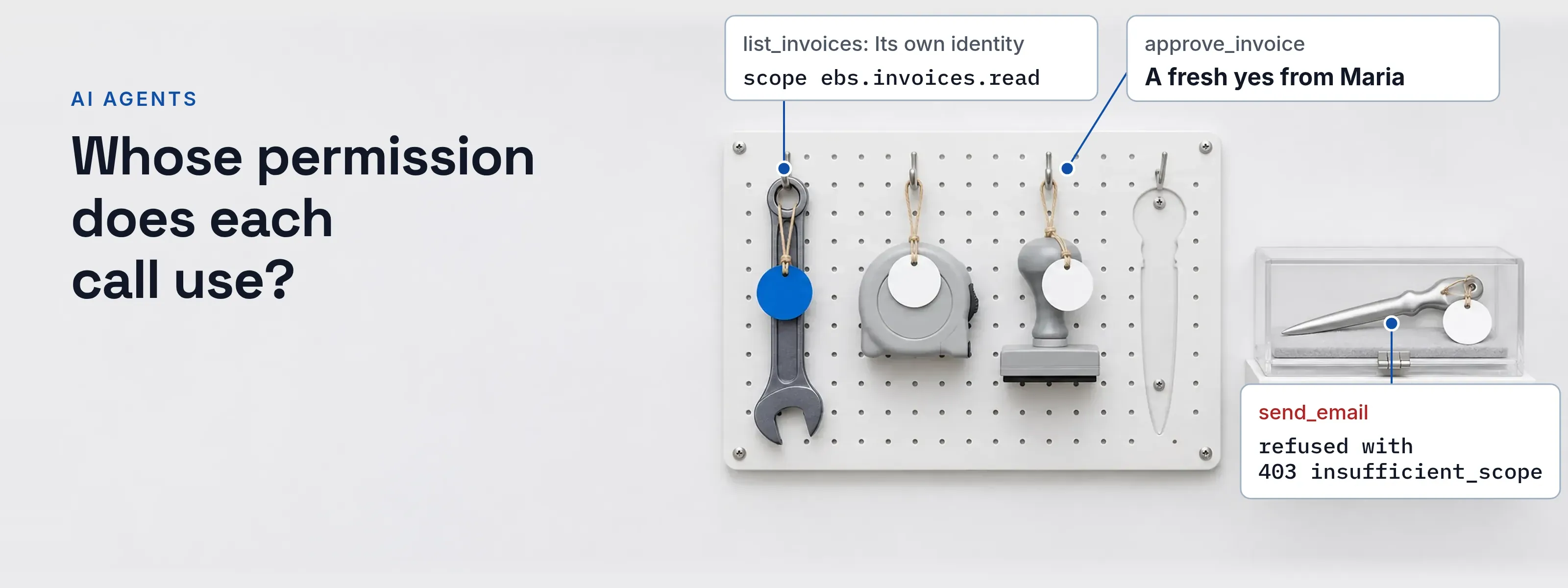
The model keeps choosing the next tool call, to an API, a database or an MCP server, until the goal is met. A chatbot answers and waits. A script runs steps fixed in advance.
One agent’s day, call by call
Every tool call runs with somebody’s permission. The table follows one agent at Acme Corp through a working day.
Example: Invoice Assistant, owned by Maria Lopez, works on Acme EBS Tools. The tool names, invoice 4471 and send_email are illustrative.
| Time | Asked by | Model decides | Tool call | Runs with |
|---|---|---|---|---|
02:00 |
A schedule: list yesterday’s invoices |
One call covers it |
list_invoices |
Its own identity, scope ebs.invoices.read |
09:05 |
Maria: why is invoice 4471 on hold? |
Read the invoice, then its purchase order |
get_invoice, then get_purchase_order |
Maria’s delegation, limited to what she approved and still has |
09:07 |
Maria: approve it |
Approval is a sensitive action |
approve_invoice |
A fresh yes from Maria on her Approvals page, where the agent says “Approve INV 4471” |
11:30 |
Nobody: the model plans to email the supplier |
Use a tool it was never granted |
send_email |
Nothing: refused with 403 insufficient_scope |
18:00 |
An administrator reviews the day |
No step |
No call |
Each token issued, approval and refusal is on the agent’s Activity tab |
Read the last column from top to bottom. The model chose every step, but it never chose its own authority.
The parts every agent has
An agent is six parts working together. Each row points back to the day above.
- Model. The language model reads the goal and each result, then picks the next step. At 09:05 it decided the purchase order mattered after reading the invoice.
- Instructions. A system prompt plus the goal of the moment: the 02:00 schedule, or Maria’s question.
- Tools. Named functions with an input schema, often listed by an MCP server:
get_invoice,approve_invoice. What is an MCP server shows how a server advertises them. - Memory. The conversation and earlier tool results. That’s how “approve it” at 09:07 means invoice 4471.
- Loop. The runtime code that executes the call the model picks and returns the result. It repeats until the model answers or a step limit stops it.
- Identity. The credential each call carries. Invoice Assistant proves itself with a key pair, and its tokens live about four minutes.
How the agent loop runs
The model plans, the runtime calls, the result comes back, and the model plans again. This is Maria’s 09:05 question.
The agent loop, one question
- Maria LopezAccounts payable
- Invoice AssistantModel and runtime
- Tool serverAcme EBS Tools
- Maria Lopez to Invoice Assistant1Why is invoice 4471 on hold?
- Invoice Assistant2Model plans: read the invoice first
- Invoice Assistant to Tool server3Call get_invoice for 4471The runtime makes the call with the agent's credential.
- Tool server to Invoice Assistant4Invoice with its hold reasonThe result goes back into the model's context.
- Invoice Assistant5Model reads it and picks get_purchase_order
- Invoice Assistant to Tool server6Call get_purchase_order
- Tool server to Invoice Assistant7Purchase order lines
- Invoice Assistant to Maria Lopez8Answer: invoice quantity does not match the orderThe model writes the answer when no further tool is needed.
Anthropic’s guide calls each returned result the agent’s “ground truth” from its environment. It also recommends stopping conditions, such as a maximum number of iterations.
Agent, chatbot or automation script?
The difference is who chooses the next step. Anthropic draws the same line: workflows follow “predefined code paths”, while agents “dynamically direct their own processes and tool usage”.
| Chatbot | Automation script | AI agent | |
|---|---|---|---|
| Who picks the next step | The person typing | A developer, in advance | The model, at run time |
| Calls tools | Sometimes, within one reply | Yes, in a fixed order | Yes, chosen step by step |
| Runs unattended | No | Yes | Yes, or alongside a person |
| Example | A chat that drafts a note to a supplier | A nightly job that exports invoices to CSV | Invoice Assistant tracing why 4471 is on hold |
A script that calls a model for one step is still a script. It becomes an agent when the model picks what happens next.
Types and examples of AI agents
The textbook types describe how an agent chooses an action. The working examples describe what teams run today.
Russell and Norvig, Artificial Intelligence: A Modern Approach, 4th edition, section 2.4. The examples are ours.
- A thermostat that heats below 19 °C: Simple reflex. Chooses by a condition-action rule on the current input.
- A robot vacuum that remembers which rooms are done: Model-based reflex. Adds an internal state of what it can’t see now.
- A route planner: Goal-based. Searches for actions that reach a goal.
- A planner that weighs travel time against cost: Utility-based. Compares outcomes on a score.
- A spam filter retrained on messages users flag: Learning. Improves any of the above from feedback.
A language model agent is closest to the goal-based type, in our reading: it searches for steps that reach the goal it was given.
- Coding assistant. Reads a repository, runs the tests and edits files for the developer at the keyboard.
- Support bot. Looks up an order and opens a ticket during a customer conversation.
- Nightly automation. Reconciles yesterday’s invoices with no person present, under its own identity.
Each of these can be misled or given too much access. Agentic AI security covers those risks and the controls.
Whose permission does an agent use?
Its own identity, a person’s delegation, or a fresh approval. SSOGEN gives each agent its own identity with up to five owners and an expiry no more than 365 days ahead.
- Acts on its own. The agent has its own authority, limited to the scopes you grant on each application. It needs a passing Test access before activation. The 02:00 run works this way.
- Acts for a person. The person signs in and approves a consent screen first. Effective access is the part of the grant that the person allowed and still has, for 30 days at most.
- Fresh approval. Scopes marked Sensitive are never part of a delegation. The person approves each use on the Approvals page after a recent strong sign-in.
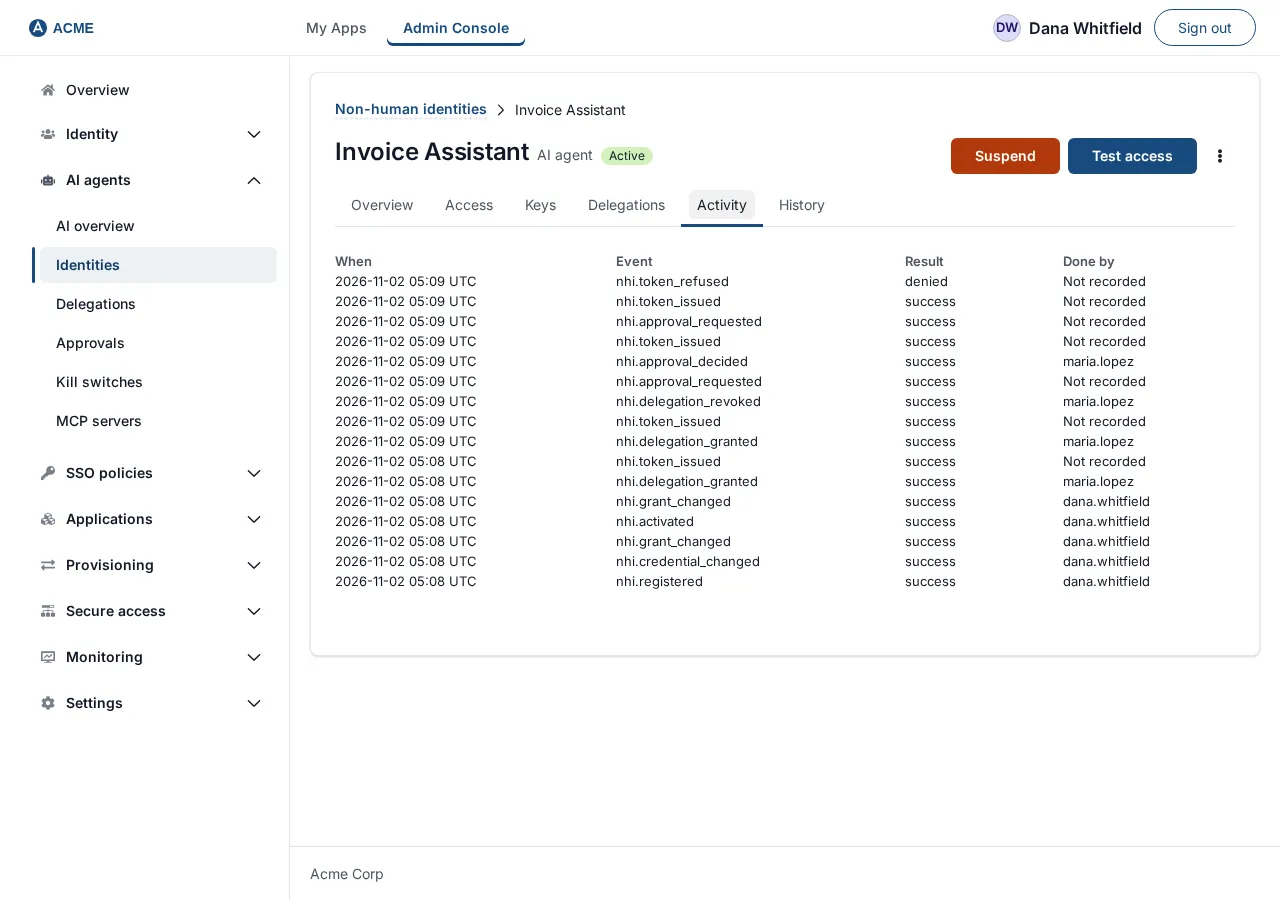
AI agent identity covers owners, keys, grants and kill switches in full. Agents are one type of non-human identity, alongside service accounts and workloads.
Questions people ask
Is ChatGPT an AI agent?
A plain ChatGPT chat isn’t an agent: it answers and waits for your next message. OpenAI’s ChatGPT Work is agentic. You give it a goal, and it gathers context, makes a plan, uses your apps, files and browser, and checks in when approval matters. The test is the same as above: who picks the next step.
What does an AI agent do exactly?
It turns a goal into a series of tool calls and stops when the goal is met. The model picks a tool, the runtime calls it, the result returns to the model, and the model picks again. In the example above, one question produced two reads and an approval request, each under Maria’s permission.
Which are the best-known AI agents?
There’s no official “big 4” or “top 3” list of AI agents; the most widely named ones come from the large model vendors. By vendor, in alphabetical order: Anthropic offers Claude Code, an agentic coding tool. Google offers Gemini for enterprise, which it calls a work agent. Microsoft offers Copilot Studio for building agents. OpenAI offers Codex and ChatGPT Work.
Sources, all read 2026-11-18:
- Building effective agents, Anthropic, published December 19, 2024.
- Artificial Intelligence: A Modern Approach, 4th US edition, contents, Russell and Norvig, chapter 2, sections 2.4.2 to 2.4.6.
- ChatGPT Work and Codex in ChatGPT, OpenAI.
- Claude Code overview, Anthropic.
- Gemini for enterprise, Google Cloud.
- Copilot Studio overview, Microsoft Learn.
Updated