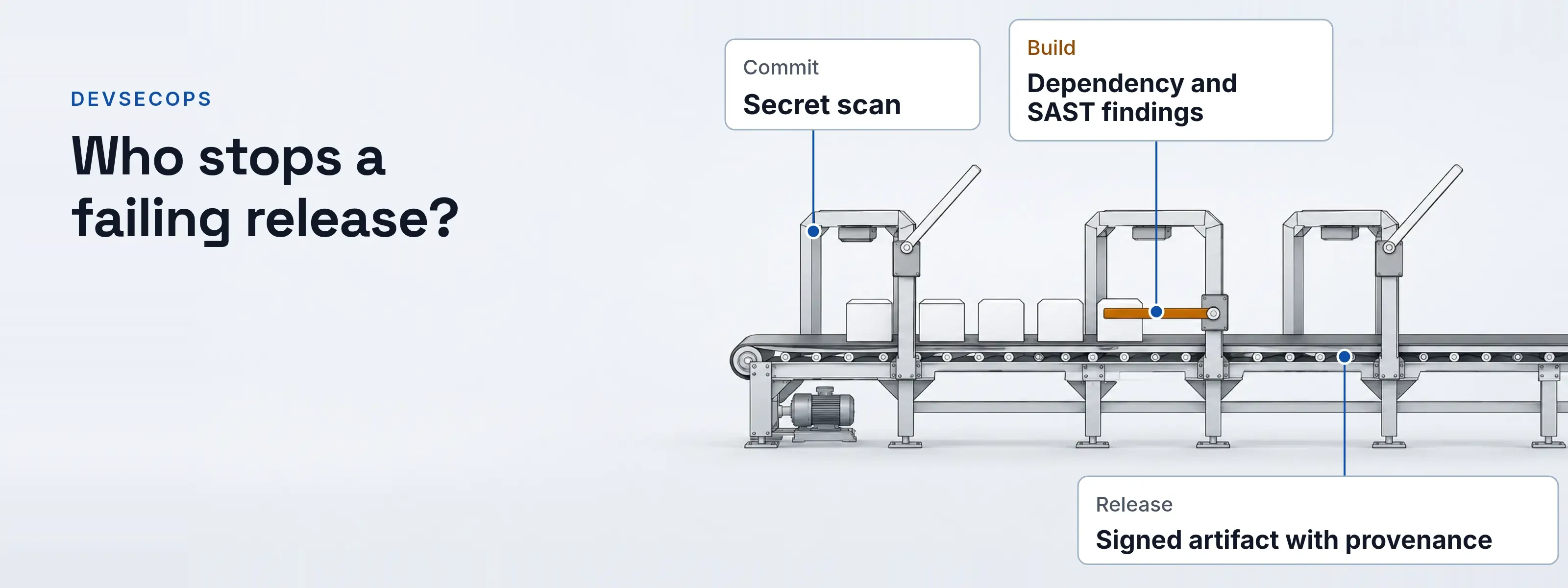
Each check is a gate. A failure blocks the merge or deploy until someone fixes the cause or a named person records a waiver.
NIST puts this first: task PO.2.1 of its Secure Software Development Framework (SSDF, SP 800-218) asks for roles that cover the whole software development life cycle.
Who owns each security gate
A common split for a team shipping from GitHub to a cloud account.
| Stage | Gate | Fails when | Responsible | Accountable | Waiver by, and where it is recorded |
|---|---|---|---|---|---|
| Plan | Threat model for a new service or trust boundary | A new external interface has no reviewed model | Developer | Security team | Security team, in the ticket |
| Commit | Secret scan, before the commit and on the server | A live credential pattern is found | Developer | Pipeline team | Security team, only after the credential is revoked |
| Pull request | Required review, code owner approval, signed commits | Too few approvals, or the author approves their own change | Reviewer | Repository owner | Nobody: this rule has no waiver |
| Build | Dependency and SAST findings | A finding at or above the agreed severity | Developer | Pipeline team | Security team, as an exception with an end date |
| Release | Signed artifact with provenance | The artifact is unsigned or has no provenance | Pipeline team | Pipeline team | Nobody |
| Deploy | Deploy by the CI identity with a short-lived credential | A long-lived key is used, or a person deploys by hand | Pipeline team | Service owner | Change manager, in the change record |
| Run | Runtime alerts routed to an owner | An alert fires with no owner | On-call engineer | Service owner | Not applicable |
| Respond | The fix ships through the same gates | A hotfix skips review | On-call engineer | Service owner | Incident commander, in the incident record |
Accountable names one role, so a failing gate never waits for a meeting. The waiver column gives every exception an author, a reason and an end date in an audited system. Why earlier is cheaper is covered in shift-left security.
DevOps vs DevSecOps: what changes
DevSecOps keeps the DevOps pipeline and makes security a release condition. DevOps joined development and operations so changes reach production quickly.
The same four questions, two pipelines
DevOps pipeline
- Who decides a release can ship: the team that owns the service.
- When security sees a change: at a scheduled review, if one exists.
- What a security finding does: opens a ticket.
- What evidence exists afterwards: pipeline logs.
DevSecOps pipeline
- Who decides a release can ship: the same team, once every gate passes or has a recorded waiver.
- When security sees a change: on every commit and pull request.
- What a security finding does: blocks the merge or fails the build above the agreed severity.
- What evidence exists afterwards: pipeline logs, scan results, approvals, signatures and waivers for each release.
Who can approve, merge and deploy
Most DevSecOps gates are identity rules: whoever can merge to main or hold a deploy credential puts code into production. Four controls decide who that is. Setting names are GitHub’s, read on November 18, 2026.
- A second person on every change.When a pull request targets a protected branch, then it needs the required approving reviews, including a code owner’s. Authors cannot approve their own pull requests, and “Require approval of the most recent reviewable push” makes someone other than the last pusher approve the final changes.
- Administrators follow the rule too.When a repository administrator pushes to a protected branch, then branch protection applies only if “Do not allow bypassing the above settings” is on. By default, administrators bypass it.
- Signed commits only.When “Require signed commits” is on, then contributors and bots can push only signed and verified commits. The SSDF lists commit signing and code owner review as examples under task PS.1.1.
- No stored deploy keys.When a GitHub Actions job deploys, then the cloud trades its one-job OIDC token for a short-lived credential, but only if the subject, such as
repo:octo-org/octo-repo:environment:prod, matches the trust rule. With required reviewers and self-review prevented onprod, whoever starts a deployment cannot approve it. See workload identity federation.
Frameworks that define DevSecOps practice
Three public bodies describe DevSecOps roles and practices. Two have revised theirs, so cite the version you assess against.
- August 2019DoD Enterprise DevSecOps Reference Design, version 1.0, dated August 12, 2019. The DoD CIO library now lists newer designs instead.
- January 2020OWASP SAMM version 2, released January 31, 2020: five business functions and 15 security practices, each with three maturity levels.
- February 2022NIST SP 800-218, SSDF version 1.1: four practice groups, Prepare the Organization (PO), Protect the Software (PS), Produce Well-Secured Software (PW) and Respond to Vulnerabilities (RV). PO.2 covers roles, PS.1 protects code from tampering, and PW.7 covers code review.
- October 2024DoD Enterprise DevSecOps Fundamentals, approved on October 16, 2024. Section 4.4 lists the roles of a software product team, from product manager to security engineer.
- December 2025NIST SP 800-218 Rev. 1 (SSDF version 1.2), initial public draft of December 17, 2025. Version 1.1 stays in force until the final is published.
How a dependency or a build is attacked, with SLSA and SBOMs, is covered in software supply chain security.
Signs the ownership model works
Four checks for your own repositories.
- Every waiver has an end date. List the open exceptions in your scanner and tracker. A waiver with no expiry is a permanent gap with a ticket number.
- Every gate names one accountable role. If two teams each say a failing check belongs to the other, that gate has no owner.
- Nobody approves their own change. Read the branch rules on each production repository: required approvals, code owner review, and administrators included.
- No long-lived deploy keys. List the secrets in each repository and CI system. A cloud access key there is a deploy path around the OIDC trust rule. Secret scanning finds keys committed by mistake.
Questions about DevSecOps roles
Does DevSecOps need coding?
Yes for most roles, at different depths. Developers write the application and fix what the gates find. Pipeline engineers write CI configuration, policy files and scripts. Security engineers write scanner rules and policies as code. A security lead who owns the threat model and signs off waivers reads code more often than writing it.
Who is responsible for security in DevSecOps?
The service owner is accountable, and each gate has its own responsible role. Developers fix what the commit and build gates find, reviewers own the pull request, the pipeline team owns release and deploy, and on-call engineers own runtime alerts. The security team writes the rules and approves waivers, as SSDF task PO.2.1 expects.
Is DevSecOps a job title or a practice?
It is a practice, and the job title names one role inside it. A DevSecOps engineer usually builds and runs the CI/CD pipelines and their security gates. The DoD Enterprise DevSecOps Fundamentals of October 2024 lists this role as DevSecOps Specialist/Site Reliability Engineer, beside developers, security engineers and test engineers on one product team.
Which framework should a DevSecOps program follow?
Use NIST SSDF for what to do and OWASP SAMM to measure how far you have come. SSDF tasks such as PO.2.1 and PW.7.1 name the practices, and the SSDF task table cites SAMM activities as references. SAMM scores each of its 15 practices on three maturity levels. US defense programs add the DoD DevSecOps Fundamentals.
Sources, all read 2026-11-18: NIST SP 800-218, SSDF version 1.1 and its task table (PDF), NIST SP 800-218 Rev. 1 initial public draft, OWASP SAMM model, OWASP SAMM version 2 release, DoD CIO library (Enterprise DevSecOps Reference Design 1.0 and DevSecOps Fundamentals), GitHub: about protected branches, GitHub: approving a pull request with required reviews, GitHub: deployments and environments, GitHub: OpenID Connect in Actions.
Updated