SSOGEN / Learn / What Is an SBOM?
Learn
What Is an SBOM?
An SBOM, or software bill of materials, is a machine-readable list of the components in a piece of software, with their versions and dependencies, written as CycloneDX or SPDX.
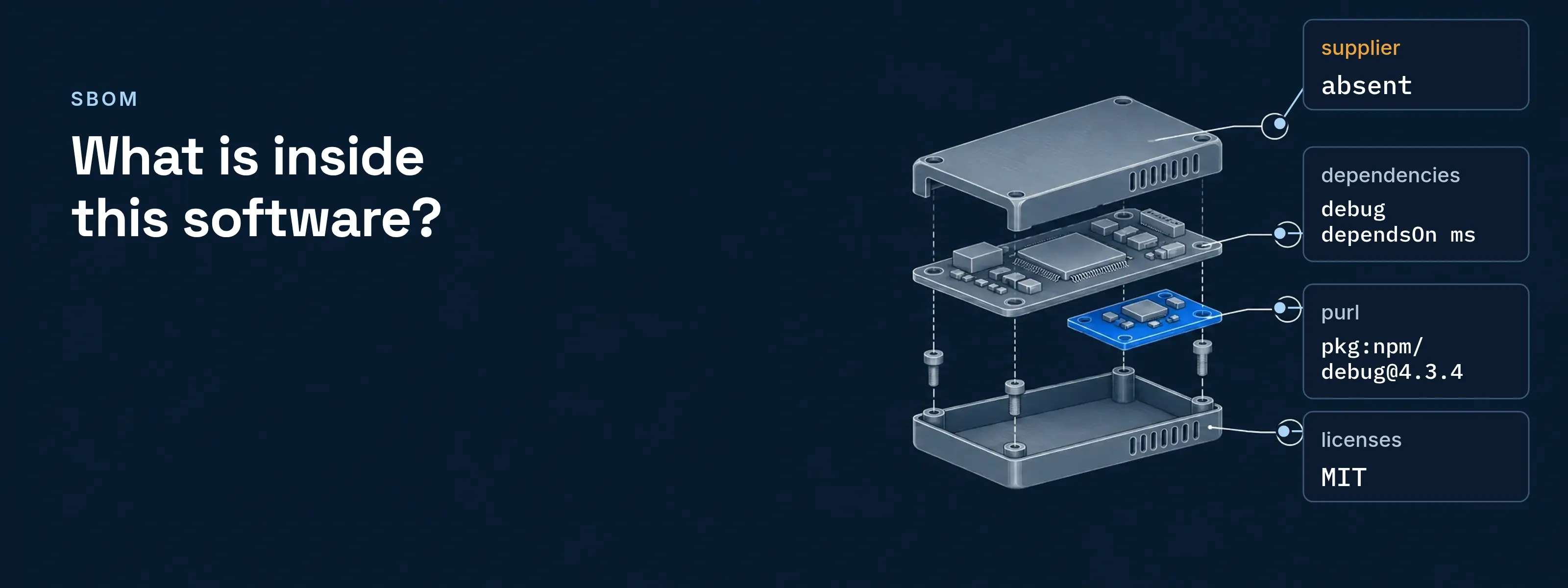
An SBOM is an inventory a program can read: every component in the software, its version, an identifier and what depends on what. Scanners use it to find known vulnerabilities and license terms. The file below is real, generated for a two-package npm project, so each field can be read in place.
- Two formats
- CycloneDX and SPDX
- NTIA minimum data fields
- 7 (July 2021)
- Example app
- demo-app, 2 dependencies
- Generated
- 2026-11-18 03:30 UTC (2026-11-17 22:30 EST), npm 11.17.0
What npm writes for demo-app in each format
demo-app depends on debug 4.3.4, which depends on ms 2.1.2. Two npm commands wrote the files below.
npm install --ignore-scriptsnpm sbom --sbom-format cyclonedxnpm sbom --sbom-format spdx{ "bomFormat": "CycloneDX", "specVersion": "1.5", "metadata": { "timestamp": "2026-11-18T03:30:04.502Z", "tools": [ { "vendor": "npm", "name": "cli", "version": "11.17.0" } ], "component": { "name": "demo-app", "version": "1.0.0", "purl": "pkg:npm/demo-app@1.0.0", ... } }, "components": [ { "bom-ref": "debug@4.3.4", "name": "debug", "version": "4.3.4", "purl": "pkg:npm/debug@4.3.4", ... "hashes": [ { "alg": "SHA-512", "content": "3d15851e...c5f91" } ], "licenses": [ { "license": { "id": "MIT" } } ] }, ... ], "dependencies": [ ... { "ref": "debug@4.3.4", "dependsOn": [ "ms@2.1.2" ] }, ... ]}{ "spdxVersion": "SPDX-2.3", "name": "demo-app@1.0.0", "creationInfo": { "created": "2026-11-18T03:30:04.955Z", "creators": [ "Tool: npm/cli-11.17.0" ] }, "packages": [ { "name": "demo-app", "versionInfo": "1.0.0", "downloadLocation": "NOASSERTION", "homepage": "NOASSERTION", "licenseDeclared": "MIT", ... }, { "name": "debug", "SPDXID": "SPDXRef-Package-debug-4.3.4", "versionInfo": "4.3.4", "licenseDeclared": "MIT", "externalRefs": [ { "referenceCategory": "PACKAGE-MANAGER", "referenceType": "purl", "referenceLocator": "pkg:npm/debug@4.3.4" } ], "checksums": [ { "algorithm": "SHA512", "checksumValue": "3d15851e...c5f91" } ] }, ... ], "relationships": [ ... { "spdxElementId": "SPDXRef-Package-debug-4.3.4", "relatedSpdxElement": "SPDXRef-Package-demo-app-1.0.0", "relationshipType": "DEPENDENCY_OF" }, { "spdxElementId": "SPDXRef-Package-ms-2.1.2", "relatedSpdxElement": "SPDXRef-Package-debug-4.3.4", "relationshipType": "DEPENDENCY_OF" } ]}Trimmed to the fields discussed. Omitted lines are marked ..., the SHA-512 values keep their first 8 and last 5 characters, and no value was changed. The third package, ms, is trimmed the same way.
Read one component, field by field
Each field answers a question a scanner or an auditor asks.
| Field | In the CycloneDX file | What it tells you |
|---|---|---|
Name and version |
name: debug, version: 4.3.4 |
Together they pin one release. SPDX calls the version versionInfo. |
purl |
purl: pkg:npm/debug@4.3.4 |
A Package URL holds the ecosystem, name and version in one string. Both files carry the same one, and vulnerability databases accept it as a lookup key. |
Hash |
hashes: SHA-512 |
SHA-512 of the published debug 4.3.4 package. It identifies exact bytes, so a rebuilt or altered package no longer matches. |
License |
licenses: MIT |
MIT, as declared by the package. SPDX writes it as licenseDeclared. |
Dependencies |
dependencies: debug dependsOn ms |
CycloneDX says debug dependsOn ms. SPDX says ms DEPENDENCY_OF debug. The fact is the same; the SPDX arrow points the other way. |
Not known |
SPDX root package: NOASSERTION |
The SPDX root package has downloadLocation and homepage set to NOASSERTION. The tool states that it does not know, instead of leaving the field out. |
Supplier |
supplier: absent |
None. CycloneDX holds a free-text author for debug, copied from package metadata, but neither file has a supplier. |
The official @cyclonedx/cyclonedx-npm tool 7.0.1 writes spec 1.7 by default. Its file carries the same pkg:npm/debug@4.3.4 and the same SHA-512.
ECMA-424 and ISO/IEC 5962 behind CycloneDX and SPDX
| CycloneDX | SPDX | |
|---|---|---|
| Developed by | OWASP Foundation | Linux Foundation |
| Standard | ECMA-424 (2nd edition, December 2025) | ISO/IEC 5962:2021 |
| Current version | 1.7, released 2025-10-21 | 3.0 series |
| Written by npm as | 1.5 | 2.3 |
Either format satisfies the NTIA list. Pick the one your consumers or tools already read.
NTIA’s seven fields, mapped to both formats
NTIA published its minimum elements on 12 July 2021, under Executive Order 14028 of 12 May 2021. The last column is what the npm file above contains.
| NTIA data field | CycloneDX | SPDX | In the npm output |
|---|---|---|---|
| Supplier name | supplier |
supplier |
No |
| Component name | name |
name |
Yes |
| Version of the component | version |
versionInfo |
Yes |
| Other unique identifiers | purl, cpe, swid |
externalRefs |
Yes (purl) |
| Dependency relationship | dependencies |
relationships |
Yes |
| Author of SBOM data | metadata.tools, metadata.authors |
creationInfo.creators |
Tool name only |
| Timestamp | metadata.timestamp |
creationInfo.created |
Yes |
The empty supplier row is the practical gap in this output. Add the supplier name from your own build data.
How a scanner turns the list into findings
| Stage | What happens |
|---|---|
| Read the identifiers | The scanner takes each purl and version from the SBOM, here pkg:npm/debug@4.3.4 and pkg:npm/ms@2.1.2. |
| Query an advisory database | It looks the purl up in a source such as OSV. The two commands below are real queries. |
| Rank the matches | A match that appears in CISA’s Known Exploited Vulnerabilities list goes first. The KEV catalog explains the list. |
| Report or fail the build | The result is a report, or a failed build above a severity you set. OWASP Dependency-Check does this for Java builds. |
$ curl -s -X POST -d '{"package":{"purl":"pkg:npm/debug@4.3.4"}}' https://api.osv.dev/v1/query{}
$ curl -s -X POST -d '{"package":{"purl":"pkg:npm/debug@2.6.8"}}' https://api.osv.dev/v1/query | jq -r '.vulns[] | "\(.id)  \(.aliases[0])"'GHSA-9vvw-cc9w-f27h  CVE-2017-20165GHSA-gxpj-cx7g-858c  CVE-2017-16137
The empty answer for 4.3.4 means OSV listed no advisory for it on that day. The older 2.6.8 returns two. A container scanner runs the same match for every layer of an image; container image scanning traces each finding to the layer that added it.
VEX says which listed flaws do not apply to you
A match is not always a risk. A Vulnerability Exploitability eXchange (VEX) statement records whether a flaw in a component can be exploited in your product. CISA’s minimum requirements, published April 2023, define four statuses.
- not_affected. The vulnerability does not affect the listed product. No action is needed.
- affected. The product is affected. The statement carries an action to remediate or mitigate.
- fixed. The listed product contains fixes for the vulnerability.
- under_investigation. The author is still investigating and has not declared a final status.
CycloneDX also records this inside the BOM, with its own state names such as exploitable, in_triage and not_affected.
Questions people ask
Can you provide an example of a software bill of materials?
The CycloneDX and SPDX files above are real examples. They list demo-app 1.0.0, debug 4.3.4 and ms 2.1.2, each with a name, version, purl, SHA-512 hash and MIT license, plus the dependency chain. They also show the one NTIA field npm leaves empty, the supplier.
What is the difference between SBOM and Sca?
An SBOM is the inventory; software composition analysis (SCA) is the analysis. An SCA tool either reads an SBOM or builds its own component list, then matches it to advisories and licenses. OWASP Dependency-Check is an SCA tool that builds its own list from the jars.
How to generate the SBOM?
Generate it in the build, from the lockfile, not afterwards. For npm, run npm sbom --sbom-format cyclonedx or --sbom-format spdx, or use @cyclonedx/cyclonedx-npm. Other ecosystems have their own CycloneDX or SPDX tools. Store the file with each release, and add the supplier name the tool leaves out.
What is Cbom and SBOM?
An SBOM inventories software components; a CBOM, or cryptography bill of materials, inventories cryptographic assets. CycloneDX describes both: a CBOM lists algorithms, keys and certificates and their relationships to software components, so deprecated algorithms or expired certificates can be found the same way as vulnerable libraries.
From list to findings
Turn the list into findings with OWASP Dependency-Check, then rank them with the KEV catalog. Fixing them before a policy deadline and proving each fix is the rest of vulnerability management. Supply chain failures are A03 in the OWASP Top 10. The controls around the list, from source to registry, are mapped to six real attacks on software supply chain security. More explainers are in Learn.
Sources, all read 2026-11-17:
- NTIA, The Minimum Elements For a Software Bill of Materials, 12 July 2021
- CISA, 2025 Minimum Elements for a Software Bill of Materials (draft), 22 August 2025
- Federal Register, Executive Order 14028, signed 12 May 2021
- CycloneDX specification overview and ECMA-424
- SPDX specifications
- CISA, Minimum Requirements for VEX, April 2023
- CycloneDX, Cryptography Bill of Materials
- OSV API
Updated