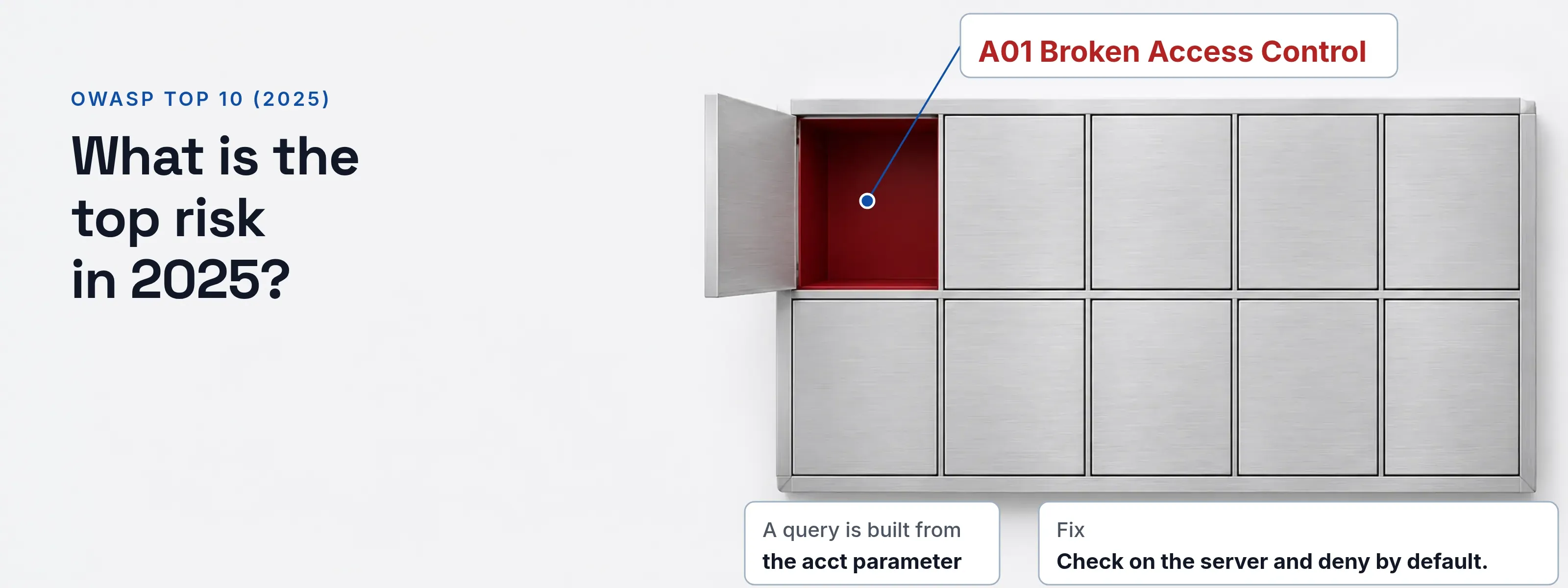
The current OWASP Top 10 is the 2025 edition, ranked A01 to A10, with Broken Access Control first. The table names all ten.
Each risk has a sourced case and a fix. A01, A07, A09 and A10 are decided partly in the identity layer.
The 2025 list at a glance
The last column is our reading, not OWASP’s.
| Rank | Risk | Against 2021 | Fix lives in |
|---|---|---|---|
A01 |
#1; SSRF folded in |
Code, identity layer |
|
A02 |
Up from #5 |
Configuration |
|
A03 |
Widened from A06:2021 |
Build pipeline |
|
A04 |
Down from #2 |
Code |
|
A05 |
Down from #3 |
Code |
|
A06 |
Down from #4 |
Design |
|
A07 |
#7; renamed |
Identity layer |
|
A08 |
#8; renamed |
Pipeline, code |
|
A09 |
#9; renamed |
Operations |
|
A10 |
New |
Code, fail-closed design |
What changed since 2021
| Change | Detail |
|---|---|
| Two new categories, one merge | A03 widens to the whole build chain, A10 is new, and SSRF now sits inside A01. |
| Data plus a survey | Eight categories were ranked from data on over 2.8 million applications; two came from a survey. |
A01: Broken access control
Users act outside their permissions because a check is missing. OWASP’s data shows 40 CWEs and 32,654 CVEs here.
| Case and fix | Detail |
|---|---|
| Case, OWASP’s scenario | A query is built from the acct parameter. The attacker edits it and opens another customer’s account. |
| Fix | Check on the server and deny by default. |
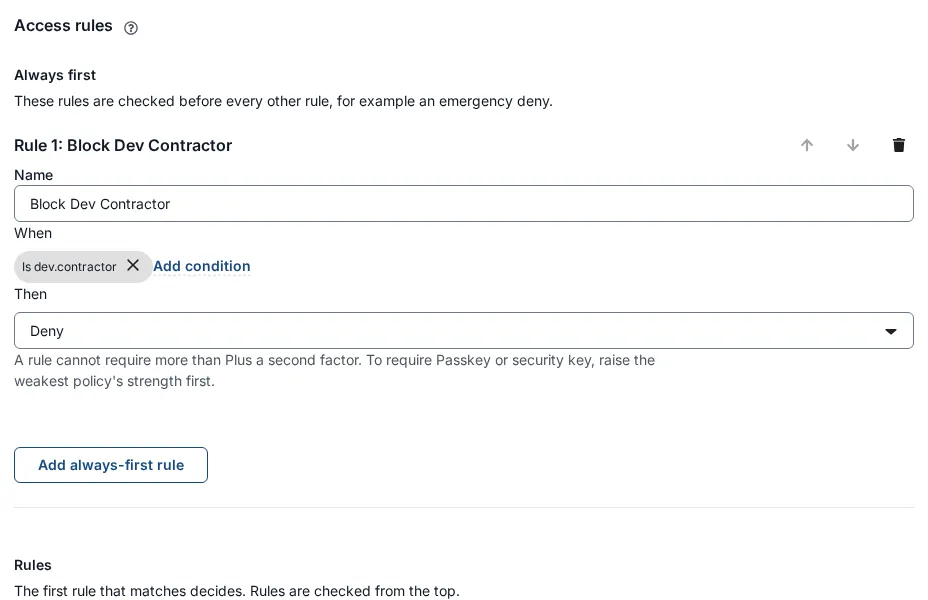
- Below rule 1: three allow rules, then the default. Rule 2 allows Employees any time, rule 3 Contractors in office hours, rule 4 Registered AI agents. When no rule matches, the default is Deny (recommended).
| Where identity helps | What it does |
|---|---|
| Who may open an application | SSOGEN checks assignment, application state, the access rules and the policy in a fixed order. A Deny refuses. |
| Where it stops | Whether invoice 1042 belongs to this user is checked in the application’s code. See authentication vs authorization. |
A07: Authentication failures
Weak sign-in lets an attacker become a user.
- Case, Uber, 2022. Uber says an attacker likely bought a contractor’s password, then sent repeated approval requests until the contractor accepted one. See MFA fatigue attacks.
- Fix. Enforce multi-factor authentication, delay repeated attempts, and alert on failures.
Where identity helps
- Password rules. The default password policy sets a minimum length of 12, no expiry and a 15-minute lock after 5 wrong passwords.
- Second factor on risk. A rule can read the risk score, 0 to 100, and ask for a second factor when a sign-in looks risky.
- Sessions that end. Defaults: 30 minutes idle, 720 minutes in all.
A09: Security logging and alerting failures
OWASP says logging without alerting has minimal value. The Senate report on Target shows it.
| Date | What happened at Target |
|---|---|
30 Nov 2013 |
Intrusion detection raises urgent alerts as malware is installed. The security team does not react. |
2 Dec 2013 |
The malware sends stolen data out. More alerts follow. |
19 Dec 2013 |
Target confirms some 40 million card records were stolen. |
| Where identity helps | What it does |
|---|---|
| A record of every decision | The audit log holds sign-ins, refusals such as application.access_refused and administrator changes, each with who, when, where from and the result. |
| Proof it is intact | Each event carries a fingerprint that depends on the one before it. A full check runs nightly. |
A10: Mishandling of exceptional conditions
The system must fail closed when something unexpected happens. OWASP maps 24 CWEs here.
| Case, fix and identity | Detail |
|---|---|
| Case, OWASP’s scenario | A transfer debits one account, then the network breaks before the credit. Without rollback, the books are wrong. |
| Fix | Catch errors where they occur and roll back the whole transaction. |
| Where identity helps | If SSOGEN cannot read a rule list, or a rule names a missing group, it refuses until the rule is fixed. |
The other six risks: a case and a fix each
These six are decided in code, configuration, design or the pipeline, not in the identity layer.
| Risk | Case | Source | Fix |
|---|---|---|---|
A02 Security misconfigurationThe flaw is in the settings. OWASP maps 16 CWEs here, including XXE (CWE-611). |
Mirai, 2016. The malware tried 62 default username and password pairs on routers and cameras. |
CISA alert TA16-288A |
Ship no default credentials and remove unused samples. |
A03 Software supply chain failuresA dependency you did not write is attack surface. Survey respondents ranked it a top concern. |
xz, 2024. The National Vulnerability Database records malicious code in the xz upstream tarballs from version 5.6.0. |
NVD CVE-2024-3094 |
Keep a software bill of materials, prefer signed packages and stage rollouts. |
A04 Cryptographic failuresWeak cryptography turns a stolen file into exposed data. |
LinkedIn, 2012 theft. In May 2016 LinkedIn said released data claimed to hold hashed passwords of over 100 million members. |
Hash passwords with a slow, salted function such as Argon2. |
|
A05 InjectionUntrusted input reaches an interpreter. Cross-site scripting (CWE-79) and SQL injection (CWE-89) live here. |
MOVEit, 2023. From 27 May 2023 the CL0P gang exploited an SQL injection flaw (CVE-2023-34362) in MOVEit Transfer before it was publicly known, and stole data from its databases. |
CISA AA23-158A |
Parameterized queries first. |
A06 Insecure designSome flaws exist in the plan, before any code. |
OWASP’s scenario. A cinema chain requires a deposit above fifteen attendees. Attackers book six hundred seats in every cinema in a few requests. |
Threat-model each flow and limit what one request can do. |
|
A08 Software or data integrity failuresCode or data is trusted without proof of origin, such as unsigned serialized data. |
SolarWinds Orion, 2020. On 13 December 2020 CISA ordered agencies to disconnect Orion versions 2019.4 through 2020.2.1 HF1, then under exploitation. |
CISA ED 21-01 |
Verify signatures, use trusted repositories and review pipeline changes. |
A05 in code: one input, two queries
One input against a three-row sqlite3 table: the concatenated query returns all three rows, the parameterized one none. SAST vs DAST shows how each testing method finds this flaw in a web route, and the requests a DAST scanner sends confirm it from outside the application.
name = "x' OR '1'='1"q = "SELECT name FROM users WHERE name = '" + name + "'"db.execute(q).fetchall()SELECT name FROM users WHERE name = 'x' OR '1'='1'[('maria',), ('drew',), ('li',)]name = "x' OR '1'='1"q = "SELECT name FROM users WHERE name = ?"db.execute(q, (name,)).fetchall()SELECT name FROM users WHERE name = ?[]Questions people ask
Which of the following are OWASP Top 10 web application security risks?
The 2025 edition lists ten: Broken Access Control, Security Misconfiguration, Software Supply Chain Failures, Cryptographic Failures, Injection, Insecure Design, Authentication Failures, Software or Data Integrity Failures, Logging and Alerting Failures, and Mishandling of Exceptional Conditions. Each groups many CWEs.
What does OWASP stand for?
OWASP stands for the Open Worldwide Application Security Project. It is a 501(c)(3) nonprofit that works to improve software security. The project launched on 1 December 2001 and incorporated in the United States on 21 April 2004.
Is the list still relevant in 2026?
Yes. The 2025 edition is the eighth, and Broken Access Control still ranks first. OWASP calls it an awareness document built on contributed data and a survey. Use it to set priorities for training and review.
Is there a 2026 edition?
There is no 2026 edition: the 2025 list is the current release. OWASP’s project page, read on 17 November 2026, names the 2025 edition as the most current version and shows no 2026 release.
Related lists and next reads
- Cross-site scripting. A flaw class filed under A05.
- Path traversal. A file-path flaw filed under A01.
- XXE attack. The parser setting behind CWE-611.
- Remote code execution. Where injection can lead.
- OWASP LLM Top 10. The list for language-model applications.
Every explainer: Learn hub.
Sources read 2026-11-17:
Updated