SSOGEN / Learn / Remote Code Execution (RCE)
Learn
Remote Code Execution (RCE)
Remote code execution (RCE) lets an outsider run commands on your server without signing in. Four famous cases share a score of 9.8 or 10.0 and have four different causes.
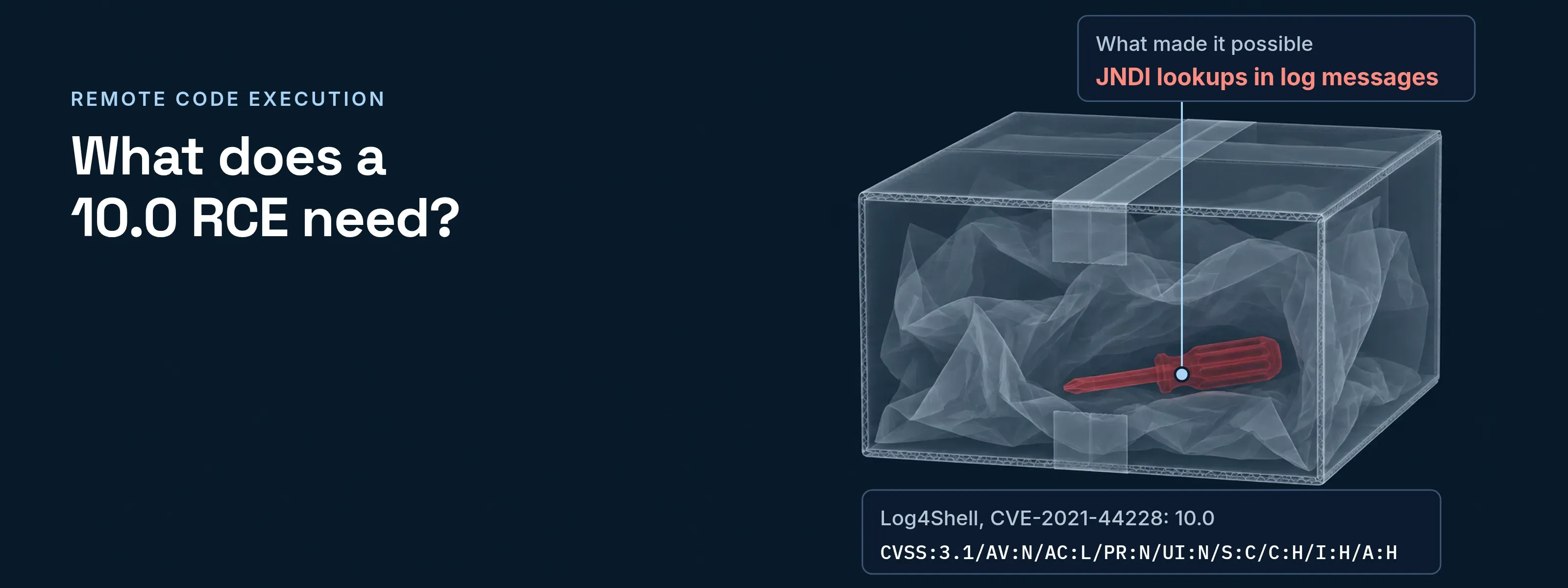
Remote code execution (RCE) means a request that arrives over the network makes a server run code the attacker chose. The National Vulnerability Database (NVD) words it as “execute arbitrary commands” or “execute arbitrary code”.
In the four cases below, the attacker needs no account. Each one scores 9.8 or 10.0 on CVSS 3.1, and the bug behind each one is different.
- Attack vector
- Network (AV:N)
- Complexity
- Low (AC:L)
- Privileges needed
- None (PR:N)
- User interaction
- None (UI:N)
- Impact
- High on all three (C:H/I:H/A:H)
Known exploited cases and the flaw behind each
All four are in the CISA Known Exploited Vulnerabilities (KEV) catalog. Scores, weaknesses and dates below come from NVD and the KEV feed, read 2026-11-17. The CISA KEV page explains the date column.
| Case | CVE | What made it possible | Weakness (CWE) | CVSS 3.1 | KEV added | Fixed in |
|---|---|---|---|---|---|---|
| Log4Shell | CVE-2021-44228 | JNDI lookups in log messages could load code from an LDAP server | CWE-917 | 10.0 | 2021-12-10 | Log4j 2.15.0 on Java 8 and later; 2.16.0 removes the feature |
| Spring4Shell | CVE-2022-22965 | Data binding in Spring MVC or WebFlux on JDK 9+; the known exploit needs a Tomcat WAR deployment | CWE-94 | 9.8 | 2022-04-04 | Spring Framework 5.3.18 and 5.2.20 |
| WebLogic | CVE-2015-4852 | A crafted serialized Java object in T3 traffic to TCP port 7001 | CWE-502 | 9.8 | 2021-11-03 | Patches in Oracle’s Security Alert |
| Struts 2 | CVE-2017-5638 | Faulty exception handling in the Jakarta Multipart parser, reached through a crafted Content-Type header | CWE-755 | 9.8 | 2021-11-03 | Struts 2.3.32 and 2.5.10.1 |
Two details change how to read the table.
- NVD states that a Spring Boot executable jar, the default, is not vulnerable to the known Spring4Shell exploit.
- 287 catalog entries carry the date 2021-11-03, the earliest in the feed. For WebLogic and Struts that date marks the start of the catalog, not the start of attacks.
Where the code comes from
RCE is a result. The table shows three causes already, and a fourth, command injection, is common enough to add. In its 2025 list, OWASP puts injection at A05, deserialization under A08 (Software or Data Integrity Failures) and file upload under A06 (Insecure Design). The OWASP Top 10 page covers the full list.
| Where the code comes from | What happens |
|---|---|
| Input reaches a command interpreter (CWE-78) | When a value from outside ends up in text that a shell parses, then the shell runs it. Example: GNU Bash, CVE-2014-6271, score 9.8, where trailing text in an environment variable was processed. |
| Input is evaluated as code or an expression (CWE-94, CWE-917) | The application’s own runtime evaluates text taken from a request or a log message, so that text runs with the application’s rights. Examples: Spring4Shell and Log4Shell. The Log4j fix removes the lookup feature. |
| Bytes become objects (CWE-502) | A server deserializes data from a caller it does not trust. Classes already on its classpath can then be driven to run commands. Example: WebLogic, where NVD names an Apache Commons Collections jar. |
| An upload lands where it can run (CWE-434) | Requesting a file runs it once a server has accepted a dangerous file type into a path it executes. Example: Apache Tomcat, CVE-2017-12617, score 8.1, only with HTTP PUT enabled. |
Struts fits none of these four. NVD files it under CWE-755, improper handling of exceptional conditions: the error path for a bad header made the server run a command.
Read the CVSS vector before the score
The score is one number, and the vector says why. This is the Log4Shell vector, read field by field against the FIRST CVSS 3.1 specification.
CVSS:3.1/AV:N/AC:L/PR:N/UI:N/S:C/C:H/I:H/A:HCVSS:3.1/AV:N/AC:L/PR:N/UI:N/S:U/C:H/I:H/A:H| Field | Meaning |
|---|---|
| AV:N | Network. The attacker only needs a network path to the service, up to the whole internet. |
| AC:L | Low complexity. No special conditions apply, so the attack can be repeated at will. |
| PR:N | No privileges. The attacker is unauthorized before the attack. |
| UI:N | No user interaction. Nobody has to click or open anything. |
| S:C | Scope changed. The flaw can affect resources beyond the component that contains it. |
| C:H, I:H, A:H | High impact on confidentiality, integrity and availability. |
Spring4Shell, WebLogic and Struts have the same vector except S:U, scope unchanged, which is the only reason Log4Shell scores 10.0 and the others 9.8. RCE does not always mean 9.8. The Tomcat case above is rated AC:H, high complexity, and scores 8.1.
How to tell whether an RCE is being exploited
Search for the CVE ID in the CISA KEV catalog. A listed CVE has evidence of active exploitation. Each entry shows the date CISA added it and a federal due date, for example 2021-12-24 for Log4Shell. The catalog is also a JSON feed you can load into your own tooling.
When an advisory names your library
- Find the library in your build. OWASP Dependency-Check matches the libraries in your build to published CVEs and can fail the build above a CVSS score you choose. To know which libraries a build contains in the first place, read what an SBOM lists.
- Look the CVE up in KEV before you rank it. A CVE in the KEV catalog has confirmed exploitation. Put it ahead of unlisted CVEs with the same score.
- Upgrade to the fixed version in the vendor advisory. Where an upgrade must wait, the advisory lists interim steps. The Struts bulletin S2-045 describes a servlet filter that validates the Content-Type value. When no fixed version exists yet, the steps for that window are in what a zero-day exploit is.
Questions people ask
What does “remote code” mean?
Remote code is code that runs on a machine because someone elsewhere on a network caused it to run. “Remote” describes the attacker’s position: a network path is enough, with no local or physical access. In CVSS this is the attack vector Network (AV:N). The code can be a command, a script or a loaded class.
What are the top 5 CVE vulnerabilities?
Four widely cited RCE CVEs: Log4Shell (CVSS 10.0), Spring4Shell, WebLogic and Struts 2 (each 9.8). Their IDs are CVE-2021-44228 (expression lookup, CWE-917), CVE-2022-22965 (data binding, CWE-94), CVE-2015-4852 (deserialization, CWE-502) and CVE-2017-5638 (exception handling, CWE-755). All four are in CISA’s KEV catalog.
Is zero day possible?
Yes. NIST defines a zero-day attack as one that exploits a vulnerability nobody had identified before. CISA added Log4Shell (CVE-2021-44228) to the KEV catalog on 2021-12-10, the same day NVD published it, so exploitation was already on record when the flaw became public. A flaw with no fix yet cannot be patched at all.
Neighbouring bug class: path traversal. Every explainer: Learn hub.
Sources, all read 2026-11-17:
- NVD API records: CVE-2021-44228, CVE-2022-22965, CVE-2015-4852, CVE-2017-5638, CVE-2014-6271 and CVE-2017-12617.
- CISA Known Exploited Vulnerabilities feed, catalog version 2026.11.17.
- Vendor advisories: Apache Log4j security page, Spring advisory CVE-2022-22965, Oracle Security Alert for CVE-2015-4852 and Apache Struts S2-045.
- OWASP Top 10:2025, A05 Injection, FIRST CVSS v3.1 specification and the NIST glossary entry for zero-day attack.
Updated