SSOGEN / Learn / CISA KEV Catalog
Learn
CISA KEV Catalog
CISA KEV is the Known Exploited Vulnerabilities catalog: CISA's list of CVEs with reliable evidence of attack, 1,782 entries on 2026-11-17, each with a remediation due date for US federal agencies.
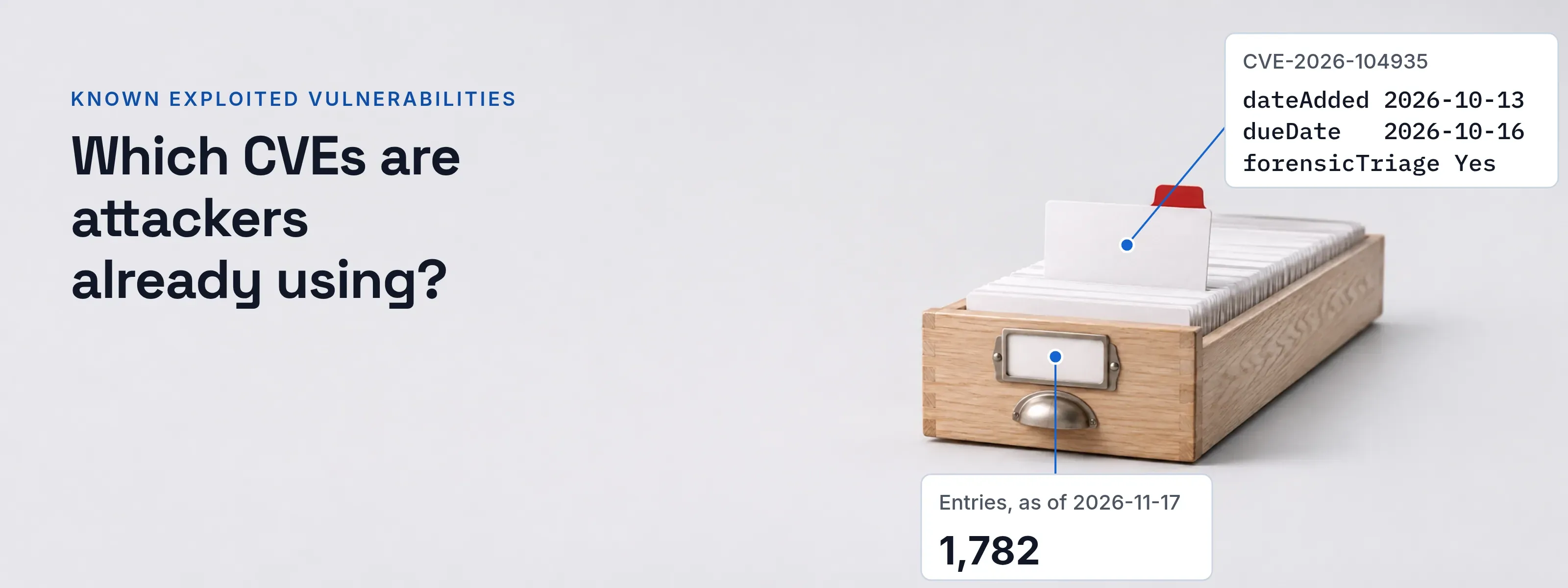
CISA KEV, the Known Exploited Vulnerabilities catalog, is CISA’s list of CVEs that attackers are already using. On 2026-11-17 it held 1,782 entries. US federal civilian agencies must fix each one by a due date. Everyone else can use the list as the first sort key of a patch queue.
The due dates now come from BOD 26-04, issued on June 10, 2026. It replaced BOD 22-01, which created the catalog in 2021, and kept the same three entry criteria.
- Entries, as of 2026-11-17
- 1,782
- Added 2026-10-18 to 2026-11-17
- 34
- Ransomware use marked Known
- 361, about 20%
Two entries from the same feed, four years apart
Every entry has the same twelve fields. Here are an Oracle Access Manager flaw from 2022 and an Ivanti VPN flaw from 2026.
- vendorProject, product
- Oracle, Fusion Middleware
- vulnerabilityName
- Oracle Fusion Middleware Unspecified Vulnerability
- shortDescription
- Oracle Fusion Middleware Access Manager allows an unauthenticated attacker with network access via HTTP to takeover the Access Manager product.
- dateAdded
- 2022-11-28
- dueDate
- 2022-12-19
- requiredAction
- Apply updates per vendor instructions.
- forensicTriage
- No
- cwes
- CWE-502, CWE-790
| Field | How to read it |
|---|---|
| dueDate | 21 days after dateAdded |
| requiredAction | One sentence: apply the vendor update |
- vendorProject, product
- Ivanti, Connect Secure
- vulnerabilityName
- Ivanti Connect Secure Authentication Bypass by Spoofing Vulnerability
- shortDescription
- Ivanti Connect Secure contains an authentication bypass by spoofing vulnerability that allows a remote unauthenticated attacker to execute arbitrary commands.
- dateAdded
- 2026-10-13
- dueDate
- 2026-10-16
- requiredAction
- Apply mitigations in accordance with vendor instructions, ensuring compliance with CISA’s BOD 26-04 Prioritizing Security Updates Based on Risk (see URL in Notes) guidance and CISA’s “Forensics Triage Requirements” (see URL in Notes). ...
- forensicTriage
- Yes
- cwes
- CWE-290
| Field | How to read it |
|---|---|
| dueDate | 3 days after dateAdded |
| requiredAction, forensicTriage | Cites BOD 26-04 and CISA’s forensic triage requirements. Yes: fix and triage within the 3 days |
The field values are quoted from the feed, and neither entry has knownRansomwareCampaignUse set to Known. Their records in the National Vulnerability Database are CVE-2021-35587 and CVE-2026-104935.
Which CVEs count as known-exploited
BOD 26-04 carries these criteria forward from BOD 22-01 unchanged. A CVE needs all three.
| Criterion | What counts |
|---|---|
| An assigned CVE ID | A CVE Numbering Authority, such as a vendor or an open-source project, assigns it. CISA sponsors the CVE Program, which MITRE runs. |
| Reliable evidence of active exploitation | Attempted exploitation counts, including code run against a honeypot. Scanning, security research and a public proof of concept do not count, and a proof of concept is not required. |
| A clear remediation action | Usually a vendor update. When a product is end of life or cannot be updated, the federal action is to remove it from the network. |
Anyone with evidence of an exploited CVE that is not listed can send it through CISA’s KEV nomination form. A listing can come before any patch: CISA added CVE-2024-3400 on the day of its advisory, two days before the first hotfix, as a zero-day exploit counted in days shows.
BOD 26-04 sets the deadlines for federal agencies
The directive binds federal civilian executive branch agencies, and contractors where a contract says so. CISA strongly recommends that every other organization prioritize KEV entries too.
| Date | What happened |
|---|---|
2021-11-03 |
BOD 22-01 creates the catalog. Agencies fix a listed CVE within six months if its ID was assigned before 2021, within two weeks otherwise. |
2026-06-10 |
BOD 26-04 is issued. It revokes BOD 22-01 and BOD 19-02. Since then 165 new entries cite BOD 26-04 in requiredAction. Each is due 3 or 14 days after it is added: 128 in 3 days, 37 in 14. |
Four facts set the timeline: public exposure, KEV listing, whether an adversary can automate the exploit, and whether it gives partial or total control.
Table 1 of the directive has 16 rows. These are the eight for a CVE on the KEV, as read on CISA’s page on 2026-11-17.
| Publicly exposed | Automatable | Technical impact | Timeline |
|---|---|---|---|
| Yes | Yes | Total control | 3 days and forensic triage |
| Yes | Yes | Partial control | 3 days |
| Yes | No | Total control | 3 days and forensic triage |
| Yes | No | Partial control | 14 days |
| No | Yes | Total control | 3 days and forensic triage |
| No | Yes | Partial control | 14 days |
| No | No | Total control | 14 days |
| No | No | Partial control | 14 days |
The clock starts when CISA adds the CVE or when the agency first finds it on an asset, whichever comes first. In the feed, 105 entries carry forensicTriage Yes, and every one is due in 3 days.
KEV records history, EPSS predicts, CVSS rates severity
FIRST’s EPSS FAQ says KEV takes precedence when a CVE is listed, and a low EPSS score on a listed CVE is no contradiction.
| Metric | Question it answers | Published by | Blind spot |
|---|---|---|---|
| KEV | Have attackers used this CVE? | CISA | A record of history; an exploited CVE can be missing until someone reports it |
| EPSS | How likely is exploitation in the next 30 days? A probability from 0 to 1, updated daily | FIRST’s EPSS group | Not a complete risk score: it ignores damage and your environment |
| CVSS | How severe is the flaw? | FIRST | An expert rating, not calibrated against exploitation outcomes |
FIRST also warns against multiplying EPSS by CVSS: one is a calibrated probability, the other an ordinal rank. A build gate on CVSS alone, like the one in OWASP Dependency-Check, judges severity only. KEV adds the fact that the CVE is under attack. Ranking is one stage of vulnerability management, which also covers discovery, the fix and its verification.
A scanner flags the CVE on your host; KEV tells you attackers are already using it, as the vulnerability scanning example on one Ubuntu server shows.
Where the 1,782 entries cluster
Counts are as of 2026-11-17.
- Remote code execution: 197. Names containing “Remote Code Execution”. See remote code execution for four cases compared.
- Path traversal: 62. By name; 82 entries list CWE-22. See path traversal.
- Authentication bypass: 61. By name; 14 of them were added in 2026.
- Identity and access products: 46. By our own product filter, stated below; it is not a CISA category.
- Microsoft: 391. The most entries of any vendor. Cisco has 103, Apple 96, Adobe 83, Google 77 and Oracle 46, out of 296 vendors.
Download the feed and filter it
The catalog is a static JSON and CSV file. No key or sign-in is needed; both downloaded without credentials on 2026-11-17, and the output below is from that run.
curl -sS -O https://www.cisa.gov/sites/default/files/feeds/known_exploited_vulnerabilities.json
jq '{catalogVersion, count}' known_exploited_vulnerabilities.json# { "catalogVersion": "2026.11.17", "count": 1782 }
jq '[.vulnerabilities[] | select(.dateAdded >= "2026-10-18")] | length' known_exploited_vulnerabilities.json# 34
jq '[.vulnerabilities[] | select(.knownRansomwareCampaignUse == "Known")] | length' known_exploited_vulnerabilities.json# 361
jq -r '.vulnerabilities[] | select(.cveID == "CVE-2021-35587" or .cveID == "CVE-2026-104935") | [.cveID, .dateAdded, .dueDate] | @tsv' known_exploited_vulnerabilities.json# CVE-2026-104935  2026-10-13  2026-10-16# CVE-2021-35587  2022-11-28  2022-12-19
Each entry has cveID, vendorProject, product, vulnerabilityName, dateAdded, shortDescription, requiredAction, dueDate, knownRansomwareCampaignUse, forensicTriage, notes and cwes. The CSV has the same twelve columns, and CISA publishes a JSON Schema. For alerts, the catalog page offers an email subscription.
Questions people ask
What is a CISA KEV?
A CISA KEV is an entry in the Known Exploited Vulnerabilities catalog, CISA’s authoritative list of CVEs with reliable evidence of exploitation in the wild. Each entry has a clear remediation action, usually a vendor update, and a federal due date.
What is the CISA KEV list?
The CISA KEV list is the catalog itself, published as a web table and as JSON and CSV files, one record per CVE. It held 1,782 entries on 2026-11-17. Other organizations use it to set patch priority, as CISA strongly recommends.
What does CISA stand for?
CISA stands for the Cybersecurity and Infrastructure Security Agency, a US federal agency within the Department of Homeland Security. It maintains the KEV catalog, sponsors the CVE Program and issues binding operational directives, such as BOD 26-04, that federal civilian agencies must follow.
What is the difference between CVE and KEV?
A CVE is an identifier for any publicly disclosed vulnerability; KEV is the small subset with evidence of exploitation. On 2026-11-17 the NVD listed 408,357 CVE records, rejected ones excluded; 1,782 of them, about 0.4%, were in the KEV. Each entry also carries a due date for federal agencies.
Sources, all read 2026-11-17:
- CISA, Reducing the Significant Risk of Known Exploited Vulnerabilities, CISA KEV catalog and its JSON feed, BOD 26-04 including Table 1, BOD 22-01 (revoked), About CISA, FIRST EPSS FAQ, FIRST CVSS and the NVD CVE API
Updated