SSOGEN / Learn / Vulnerability Management
Learn
Vulnerability Management
Each known flaw on your assets goes through vulnerability management: found, ranked by exploitation and severity, fixed, and confirmed fixed before a policy deadline.
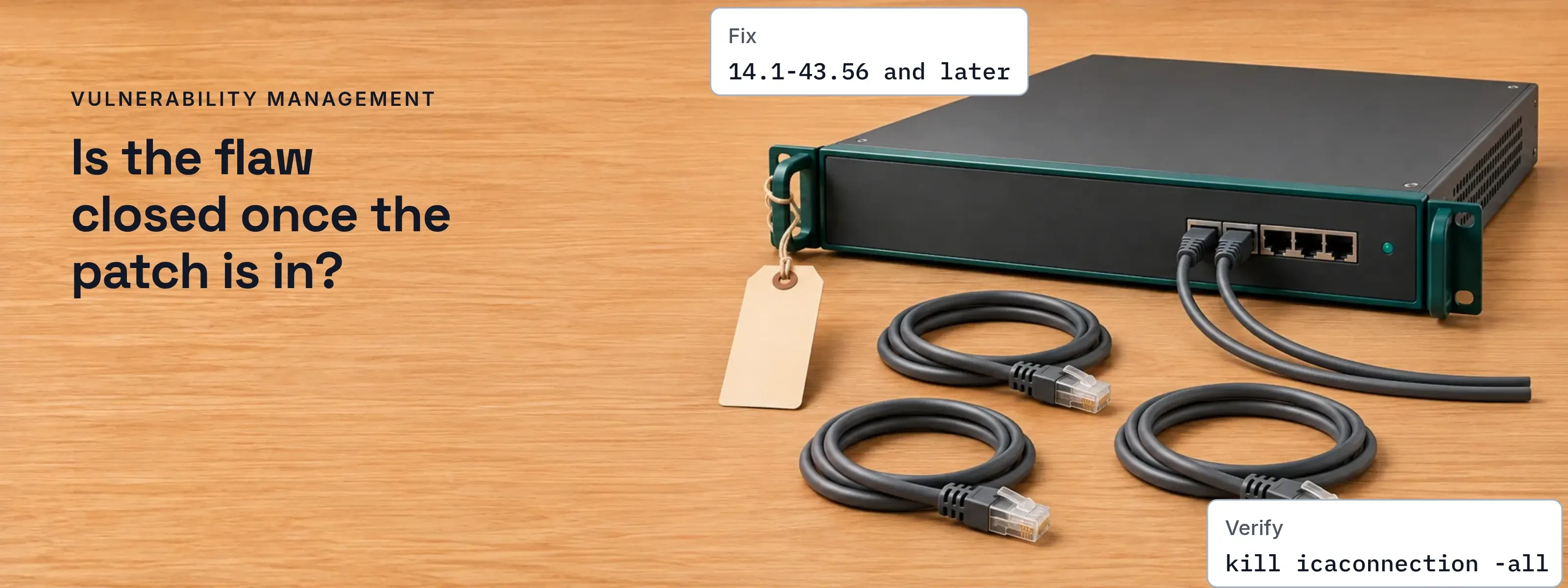
Vulnerability management runs as a loop of four stages: discover, prioritize, fix and verify. A scan feeds the first stage; how a vulnerability scan finds flaws covers that part. Public policy sets the clock. Under CISA’s BOD 26-04, an exploited flaw on an internet-facing asset can be due in 3 days.
The record each stage leaves for an auditor
Each stage leaves a record that an auditor can ask for.
| Stage | What goes in | Record it produces | Clock |
|---|---|---|---|
| Discover | Asset inventory, with internet-facing hosts found by attack surface management, an SBOM for each application, scanner output, vendor advisories | One finding per asset and CVE ID, with the version found | Under BOD 26-04, the clock can start here: the agency first identifies the CVE on an asset |
| Prioritize | KEV status, EPSS probability, CVSS v4.0 score, internet exposure | A ranked queue with a due date on every finding | The due date comes from the policy that applies (deadlines below) |
| Fix | A vendor update, a configuration change or removal of the asset | A change ticket, or a risk exception with an owner and an expiry date | Runs until the change ships |
| Verify | A rescan, a build or version check, the vendor’s post-fix steps | A closed ticket with its evidence: the scan result or the build number | Stops when the evidence is attached |
Many guides list a separate reporting stage. Here the records are the report: the third column is what goes to the auditor.
CitrixBleed 2, carried through the cycle
The patch closed the flaw. Ending the sessions closed what was already open.
CVE-2025-5777, known as CitrixBleed 2, affects NetScaler ADC and NetScaler Gateway, the appliances that sit in front of VPN and remote application sign-in. Every value below comes from the Citrix bulletin, NVD, the KEV feed or the EPSS API.
- June 17, 2025Discover. Citrix publishes bulletin CTX693420: insufficient input validation leading to memory overread, on appliances configured as a Gateway (VPN virtual server, ICA Proxy, CVPN, RDP Proxy) or AAA virtual server.
- June 17, 2025Prioritize. Citrix scores it CVSS v4.0 9.3, Critical. NVD’s own score is CVSS v3.1 7.5, High, so the band depends on which source your scanner reads.
- June 17, 2025Fix. The fixed builds are 14.1-43.56 and later, and 13.1-58.32 and later. The bulletin lists separate FIPS and NDcPP builds.
- June 26, 2025Prioritize. Citrix states it has no evidence of exploitation of CVE-2025-5777.
- July 10, 2025Prioritize. CISA adds the CVE to KEV with a due date of July 11, 2025, one day later. The current entry marks known ransomware campaign use as Known.
- After the upgradeVerify. Once every appliance in the HA pair or cluster runs a fixed build, Citrix tells customers to run
kill icaconnection -allandkill pcoipConnection -all. - November 17, 2026Prioritize. EPSS 0.99919, in the 99.969th percentile (fetched November 18, 2026).
A rescan shows the fixed build. It cannot show which sessions were opened before the fix, so the vendor adds a step that ends all of them.
A session that is already open needs no password and no new MFA prompt; session hijacking explains how a stolen session is used and detected. Short-lived credentials limit what a stolen token is worth, as the SSOGEN session and token controls show.
The CVSS rank alone would have put this CVE at High by NVD’s score. The KEV listing turned it into a one-day deadline.
Rank by exploitation, then severity
A CVE that attackers already use outranks a higher CVSS score.
- Listed in CISA KEV: first. CISA has reliable evidence of exploitation. FIRST’s EPSS FAQ says KEV takes precedence when a CVE is listed. The CISA KEV catalog explains the entry criteria and the feed.
- EPSS probability: second. A daily estimate, from 0 to 1, that the CVE will be exploited in the next 30 days. Sort the findings outside KEV by it.
- CVSS v4.0 score: third. Severity from 0.0 to 10.0; Critical starts at 9.0. A vendor or NVD score uses Base metrics only and is written CVSS-B. Add Threat and Environmental metrics for your site and it becomes CVSS-BTE.
- Internet exposure: sets the window. Under BOD 26-04 the same CVE on a publicly exposed asset gets a shorter deadline than on an internal one.
Deadlines written into public policy
The shortest window below is 2 days; the longest waits for the next system upgrade. Each clock starts at a different event.
| Policy | Who it binds | Window | Clock starts |
|---|---|---|---|
BOD 26-04, CVEs in KEV |
US federal civilian agencies |
3 days, plus forensic triage where the exploit gives total control; otherwise 14 days |
CISA adds the CVE to KEV or the agency first finds it on an asset, whichever comes first |
BOD 26-04, CVEs not in KEV |
The same agencies |
3, 14 or 60 days, or the next scheduled major upgrade of the asset |
The same two events |
BOD 22-01, revoked June 10, 2026 |
Federal agencies, 2021 to 2026 |
2 weeks; 6 months for CVE IDs assigned before 2021 |
The due date in each KEV entry |
FedRAMP 2026 rules, Rev5, Class C |
Providers with a FedRAMP Class C certification |
2 days to 192 days, by impact rating (PAIN), internet reachability and likely exploitability |
The provider’s evaluation of the vulnerability |
BOD 26-04 deadlines move when facts change. Taking an asset off the internet changes Publicly exposed from Yes to No, and the window gets longer. A new KEV listing shortens it.
FedRAMP’s 2026 vulnerability rules apply to ongoing certification from December 7, 2026, with a grace period to March 7, 2027. They also tell providers to meet the KEV due dates set under BOD 26-04.
Questions people ask
What are the 5 steps of vulnerability management?
Five-step lists usually name discover, assess, prioritize, remediate and verify, and some swap one of them for report. The table above folds assessment into prioritization and treats reporting as the records each stage leaves. The work is the same in both forms: find the flaw on an asset, rank it, fix it and prove the fix.
How fast must an exploited vulnerability be fixed?
Under BOD 26-04, a US federal civilian agency has 3 or 14 days to fix a CVE listed in CISA KEV, set by the asset’s exposure and the exploit’s impact. The clock starts when CISA adds the CVE to KEV or the agency first finds it on an asset, whichever comes first. FedRAMP Class C providers get 2 to 192 days.
What is the difference between vulnerability management and vulnerability scanning?
Scanning is one input to vulnerability management. A scanner compares installed software and configuration against known CVEs and writes findings. Vulnerability management takes those findings, ranks them, assigns an owner and a due date to each, gets them fixed and confirms every fix with a rescan or a version check.
Sources for every date on this page
Sources, all read 2026-11-18 unless marked:
- CISA BOD 26-04, including Table 1 and Appendix A; BOD 22-01 (revoked; read November 17, 2026)
- CISA KEV JSON feed, catalogVersion 2026.11.17
- FedRAMP Consolidated Rules for 2026: Vulnerability Detection and Response, Rev5
- Citrix security bulletin CTX693420 and NetScaler’s CVE-2025-5777 update
- NVD, CVE-2025-5777 and the FIRST EPSS API
- FIRST CVSS v4.0 specification and the FIRST EPSS FAQ (read November 17, 2026)
Updated