SSOGEN / Learn / Attack Surface Management
Learn
Attack Surface Management
Attackers find every asset of yours that the internet can reach; attack surface management (ASM) finds them the same way, continuously, and gives each one an owner and a fix.
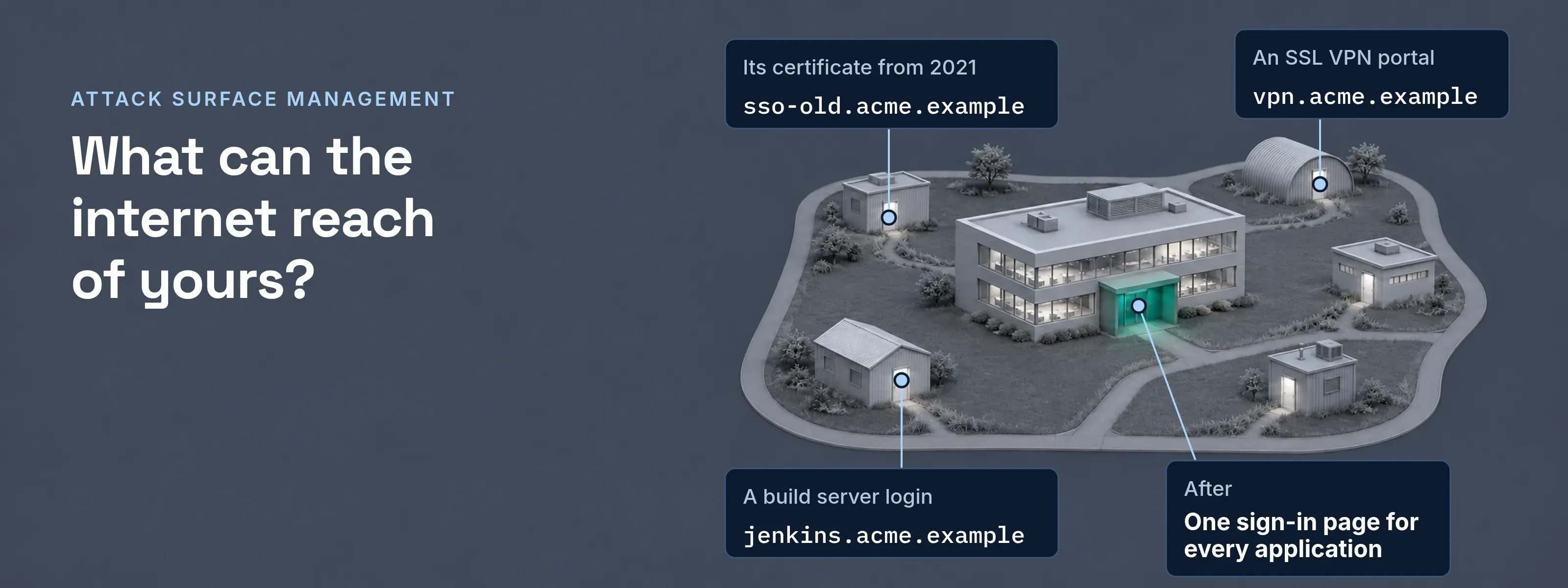
Teams add internet-facing hosts faster than they retire them, so the asset register falls behind what an outsider can see. An acquisition brings a second domain. A migration leaves the old sign-in page running. The inventory below is one fictional company, mapped from the outside.
acme.example, as an attacker sees it
Example company: Acme Corp and every name below are fictional. Seven assets it forgot it owned, each with the record that gave it away.
| Asset | Found by | What it exposes | Fix |
|---|---|---|---|
acme-legacy., the domain of a brand bought in 2019, still resolving |
RDAP registration data that matches acme.example, and the acquisition records |
A second domain with its own DNS and mail that nobody monitors | Assign an owner, or retire the domain |
vpn., an SSL VPN portal that prints its firmware version on the login page |
A Certificate Transparency (CT) log entry, then the login page over HTTPS on TCP 443 | A network-level login on the internet, and a version an attacker can match to a known exploit | Patch first if the version matches an entry in the CISA KEV catalog; move users to application-level access without a VPN |
sso-old., the sign-in page of an identity provider replaced in a migration |
Its certificate from 2021, still in the CT logs | A password-only login that still checks real accounts | Shut it down and delete the DNS record; revoke the certificate if it has not expired |
jenkins., a build server login |
A CT log entry, then the HTML title of the page | An admin panel with deploy rights, open to anyone who finds it | Take it off the internet, or put access control in front of it |
acme-backups, a cloud storage bucket |
A naming guess, confirmed by the CNAME record files.acme.example that points at it |
Listable objects, stored outside the company’s own domain | Block public access, the default for new S3 buckets; delete any CNAME that points at storage nobody owns |
api-staging./swagger. |
A CT log entry, then a request for a common path | A full API description and test endpoints with no authentication | Require authentication, then remove the staging host |
mail., a webmail login |
The MX and A records of acme.example |
One more password prompt for spraying | Put it behind the central sign-in page, or retire it |
Five of the seven rows are entry points that check a password or skip the check. Each sits outside the company’s main sign-in policy.
Public records name your hosts before any scan runs
Certificate Transparency logs come first. Chrome accepts a publicly trusted TLS certificate only if it is CT compliant, so the hostnames in such a certificate end up in public logs. The logs are append-only (RFC 6962), so a host retired years ago stays findable. The query below is real; the results are a sample for the fictional domain.
$ curl -s 'https://crt.sh/?q=%25.acme.example&output=json' \    | jq -r '.[] | "\(.not_before)  \(.name_value)"' | sort -u
2021-03-08T00:00:00  sso-old.acme.example2024-05-13T00:00:00  jenkins.acme.example2026-09-30T00:00:00  api-staging.acme.example
%25 is the URL-encoded %, the crt.sh wildcard. Each JSON record also carries issuer_name, common_name, not_after and serial_number. The details of SCTs and log checks are in how certificate authorities and CT logs work.
Four public sources build most of the list:
- CT logs. Every hostname in a publicly trusted certificate, searchable on crt.sh, which Sectigo runs.
- DNS records. MX, CNAME and A records of known domains point to further hosts, including names at cloud providers.
- RDAP. Registrar, name servers and dates for each domain; shared name servers point to sibling domains such as acme-legacy.example.
- Internet scan data. Services that probe the IPv4 space record which ports answer and what each service returns.
Every sign-in page is attack surface
Fewer sign-in endpoints leave fewer places to spray passwords. Here is the same company before and after it consolidates sign-in.
Before: five entry points, five separate rules. The VPN portal, the old identity provider, Jenkins and webmail each check a password from anyone on the internet; the staging API asks for nothing. Each login applies its own lockout rules, or none, so a password spray spread across four endpoints stays under every per-host threshold.
After: one sign-in page for every application. Jenkins, the staging API and webmail stay on the internal network. The App Proxy in the SSOGEN Gateway publishes each one behind that page with no change to the application.
SSOGEN serves that page at sso.acme.example for My Apps, My Account, the Admin Console and every protected application.
The old identity provider host and its DNS record are deleted. Servers at a branch office connect through an Outbound Connector that dials out and opens no inbound port. A connector reaches only the destinations SSOGEN published to it, so the branch network adds no new entry point.
ASM finds the hosts; other practices test and fix them
Four practices share the work. Each starts where the previous one stops.
- Attack surface management. Finds what is reachable from the internet, who owns it and what each asset exposes. The output is the asset list.
- Vulnerability scanning. Checks hosts you already know for known flaws. How a vulnerability scan works shows one host scanned with and without credentials.
- Vulnerability management. Ranks each finding, assigns a due date, gets it fixed and confirms the fix. The vulnerability management cycle covers its steps and deadlines.
- Identity security posture management. Reviews how accounts, roles and sign-in policies are configured inside the identity provider, a view from the inside rather than from the internet.
A scan lists the flaws on those hosts; a penetration test proves which ones an attacker can chain. Vulnerability assessment vs penetration testing follows one finding through both reports.
Attack surface questions
What does attack surface refer to?
Attack surface refers to every point where an attacker can try to get in, cause an effect or take data out. NIST SP 800-53 Rev. 5 defines it as “the set of points on the boundary of a system … where an attacker can try to enter, cause an effect on, or extract data from” it.
How often should asset discovery run?
Continuously, and no less than weekly. CISA’s BOD 23-01, issued on October 3, 2022, requires US federal civilian agencies to run automated asset discovery every 7 days, covering their entire IPv4 space. It also requires vulnerability enumeration across all discovered assets every 14 days. For everyone else, the 7-day figure is a useful floor.
Is attack surface management the same as vulnerability scanning?
No: ASM finds what exists, and a vulnerability scan checks known hosts for known flaws. The asset list from ASM becomes the target list for the scanner. A host that nobody knows about is never scanned, so discovery has to run first. A scan then reports versions, missing patches and weak settings on each host.
How do you reduce an attack surface?
Remove what nobody needs, then put access control in front of what stays. Delete stale DNS records, retire unused domains and route logins through one sign-in page with MFA. For network devices, CISA’s BOD 23-02 (2023) gives federal agencies 14 days to take a management interface off the internet or put a separate access-control point in front of it.
Where each fact comes from
Sources, all read 2026-11-18:
- NIST CSRC glossary, attack surface (from NIST SP 800-53 Rev. 5)
- IETF, RFC 6962 (Certificate Transparency, June 2013) and RFC 9162 (version 2.0, December 2021, obsoletes RFC 6962)
- Chrome, Certificate Transparency policy
- crt.sh, Sectigo; JSON field names taken from a live query
- CISA, BOD 23-01 and BOD 23-02; both in force on the read date
- AWS, Blocking public access to your Amazon S3 storage
Updated