SSOGEN / Learn / What Is a Certificate Authority?
Learn
What Is a Certificate Authority?
A certificate authority (CA) signs certificates after checking that the requester controls the name in them. Browsers trust a short list of CAs, and every publicly trusted certificate is logged in public.
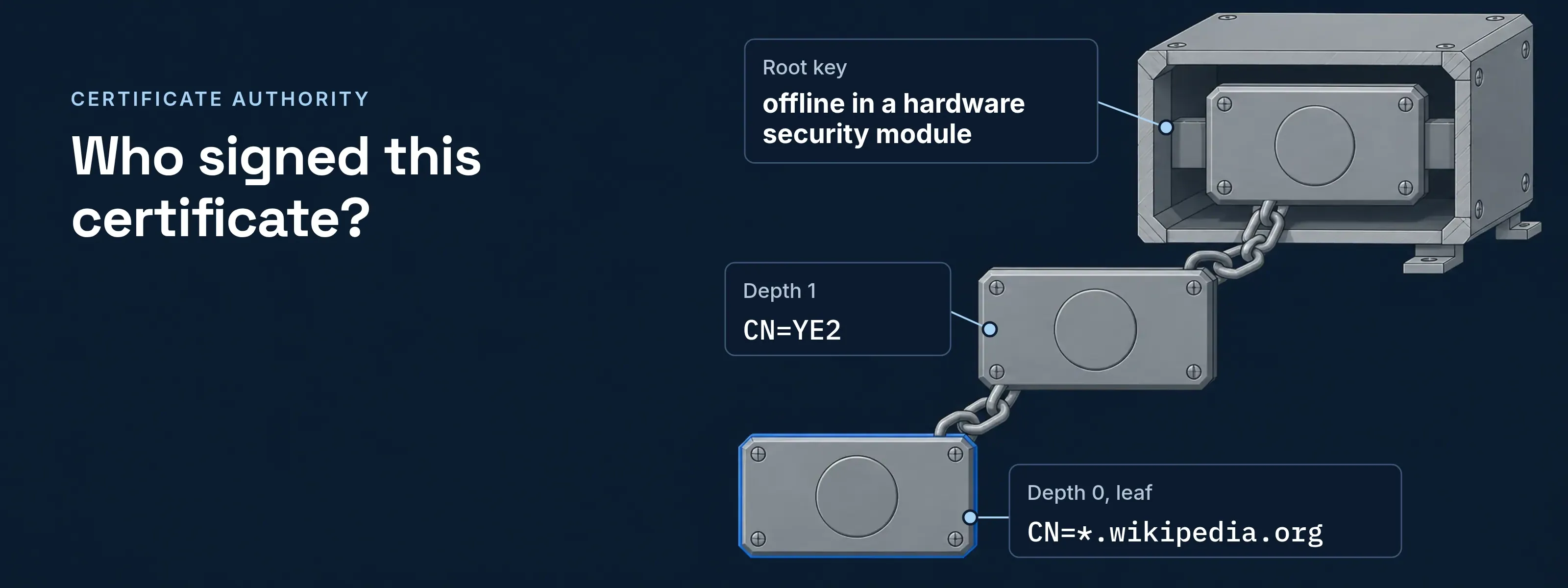
Every publicly trusted TLS certificate was signed by a certificate authority (CA) that first checked the requester controls the name in it. Browsers and operating systems trust a short list of CAs, and each certificate those CAs issue is also written to public logs. What is PKI covers how CAs fit into the wider trust system.
- A CA signs
- A public key bound to a name
- Mozilla root store
- 112 roots trusted for websites
- Rule book
- Baseline Requirements 2.3.1
- Maximum lifetime
- 200 days now, 47 from 2029
The root signs intermediates, and an intermediate signs your certificate
A CA keeps its root key offline in a hardware security module and uses it only to sign intermediates. This is the chain www.wikipedia.org sent on 17 November 2026, from openssl s_client -connect www.wikipedia.org:443 -servername www.wikipedia.org (OpenSSL 3.5.8, trimmed to the chain).
- Depth 0, leaf
s: CN=*.wikipedia.orgi: C=US, O=Let's Encrypt, CN=YE2v: Oct 4 18:34:51 2026 GMT to Jan 2 18:34:50 2027 GMT- The leaf, issued by the intermediate YE2. It is valid for 90 days, from 4 October 2026 to 2 January 2027.
- Depth 1
s: C=US, O=Let's Encrypt, CN=YE2i: C=US, O=ISRG, CN=Root YEv: Sep 3 00:00:00 2025 GMT to Sep 2 23:59:59 2028 GMT- The intermediate YE2 holds the key that signed the leaf, and runs until September 2028.
- Depth 2
s: C=US, O=ISRG, CN=Root YEi: C=US, O=Internet Security Research Group, CN=ISRG Root X2v: May 13 00:00:00 2026 GMT to Sep 2 23:59:59 2032 GMT- Root YE is issued by ISRG Root X2.
- Depth 3
s: C=US, O=Internet Security Research Group, CN=ISRG Root X2i: C=US, O=Internet Security Research Group, CN=ISRG Root X1v: May 13 00:00:00 2026 GMT to Sep 2 23:59:59 2032 GMT- ISRG Root X2 is issued by ISRG Root X1. None of the four is self-signed. The client builds a path to a root it already trusts.
Fields, extensions and path building are in what is an X.509 certificate.
What a CA checks before it signs depends on the validation level
The encryption is the same at every level; the level decides how much the CA proves about the owner. The certificate decoder shows any certificate’s policy identifier.
| Domain validated (DV) | Organization validated (OV) | Extended validation (EV) | |
|---|---|---|---|
| Policy identifier | 2.23.140.1.2.1 | 2.23.140.1.2.2 | 2.23.140.1.1 |
| What the CA checks | Control of the domain name | Domain control, and the identity and address of the organization | Domain control, and the legal, physical and operational existence of the organization |
| Subject in the certificate (fictional) | No organization; the name is in the SAN, DNS:www.acme.example |
O=Acme Corp, L=Springfield, ST=Illinois, C=US |
O=Acme Corp, business category, jurisdiction, registration number |
ACME proves control of a name with a challenge, no human
ACME (RFC 8555, March 2019) lets software ask a CA for a certificate and prove control of the name by answering a challenge.
Register an account key
The client registers a key pair with the CA’s ACME server.
Place an order
The client asks for
www.acme.example. The server returns a challenge with a random token of at least 128 bits.Publish the proof
The client combines the token with its account key and publishes the result by HTTP or DNS.
The CA checks it
The CA fetches the file or reads the TXT record. It also reads the domain’s CAA records (RFC 8659), such as
acme.example. CAA 0 issue "ca.example.net", which name the CAs allowed to issue.Finalize with a CSR
The client sends a certificate signing request and downloads the certificate. Build and read one in the CSR decoder.
GET /.well-known/acme-challenge/LoqXcYV8...jxAjEuX0Host: example.org
HTTP/1.1 200 OKLoqXcYV8...jxAjEuX0.9jg46WB3...fm21mqTI_acme-challenge.www.example.org. 300 IN TXT "gfj9Xq...Rg85nM"Both examples are from RFC 8555 sections 8.3 and 8.4, values shortened by the RFC.
Maximum certificate lifetime falls to 47 days on a fixed schedule
Ballot SC-081v3 (11 April 2025) set this schedule, and Baseline Requirements 2.3.1 carry the dates.
- Before 15 March 2026
- Up to 398 days. Validation reuse: 398 days.
- 15 March 2026
- Up to 200 days. Validation reuse: 200 days.
- 15 March 2027
- Up to 100 days. Validation reuse: 100 days.
- 15 March 2029
- Up to 47 days. Validation reuse: 10 days.
At 47 days a certificate renews about eight times a year, so renewal must be automated.
Every publicly trusted certificate is logged where anyone can read it
Certificate Transparency (RFC 6962, revised as RFC 9162) puts each certificate into append-only public logs. Each log answers with a signed certificate timestamp (SCT). The www.wikipedia.org certificate carries two.
CT Precertificate SCTs: Signed Certificate Timestamp: Version : v1 (0x0) Log ID : 1C:9F:68:2C:E9:FA:F0:45:69:50:F8:1B:96:8A:87:DD: DB:32:10:D8:4C:E6:C8:B2:E3:82:52:4A:C4:CF:59:9F Timestamp : Oct 4 19:33:21.276 2026 GMT Signed Certificate Timestamp: Version : v1 (0x0) Log ID : 1A:8B:9D:6B:8D:D7:91:D1:CD:05:49:ED:B6:03:55:D6: 06:B6:4F:AD:30:DB:71:FE:78:8F:0F:C7:C8:FB:C4:B1 Timestamp : Oct 4 19:33:22.579 2026 GMT- What a browser requires. Chrome requires two SCTs from distinct logs for a certificate valid 180 days or less, and three for a longer one.
- Who reads the logs. Domain owners search them for certificates issued for their names, which exposes one nobody asked for. Attackers search them too, and a hostname stays logged after its server is gone, so attack surface management starts with the same search.
Revocation runs on CRLs, and OCSP is now optional
A certificate can be revoked before it expires. Ballot SC-063 made OCSP optional and CRLs mandatory in the Baseline Requirements (adopted 17 August 2023, effective 15 March 2024).
| CRL | OCSP | |
|---|---|---|
| How it works | The CA publishes a signed list of revoked serial numbers | The client asks a responder about one certificate |
| What the CA learns | Nothing about which sites a visitor opens | Which site a visitor opens, from which IP address |
| Baseline Requirements 2.3.1 | A new CRL at least every 4 days (7 if every certificate has an OCSP pointer), and within 24 hours of a revocation | Optional; where offered, an answer within 15 minutes of issuance |
| Let’s Encrypt | Revocation information through CRLs only | OCSP URLs dropped from certificates on 7 May 2025; responders turned off on 6 August 2025 |
www.wikipedia.org today |
A CRL URL, http://ye2.c.lencr.org/51.crl |
No OCSP URL in the certificate |
A private CA signs only for systems you tell to trust it
A public CA is one that root programs list: Mozilla’s report has 112 roots trusted for websites, owned by 45 organizations. A private CA is yours, and only your systems trust its root.
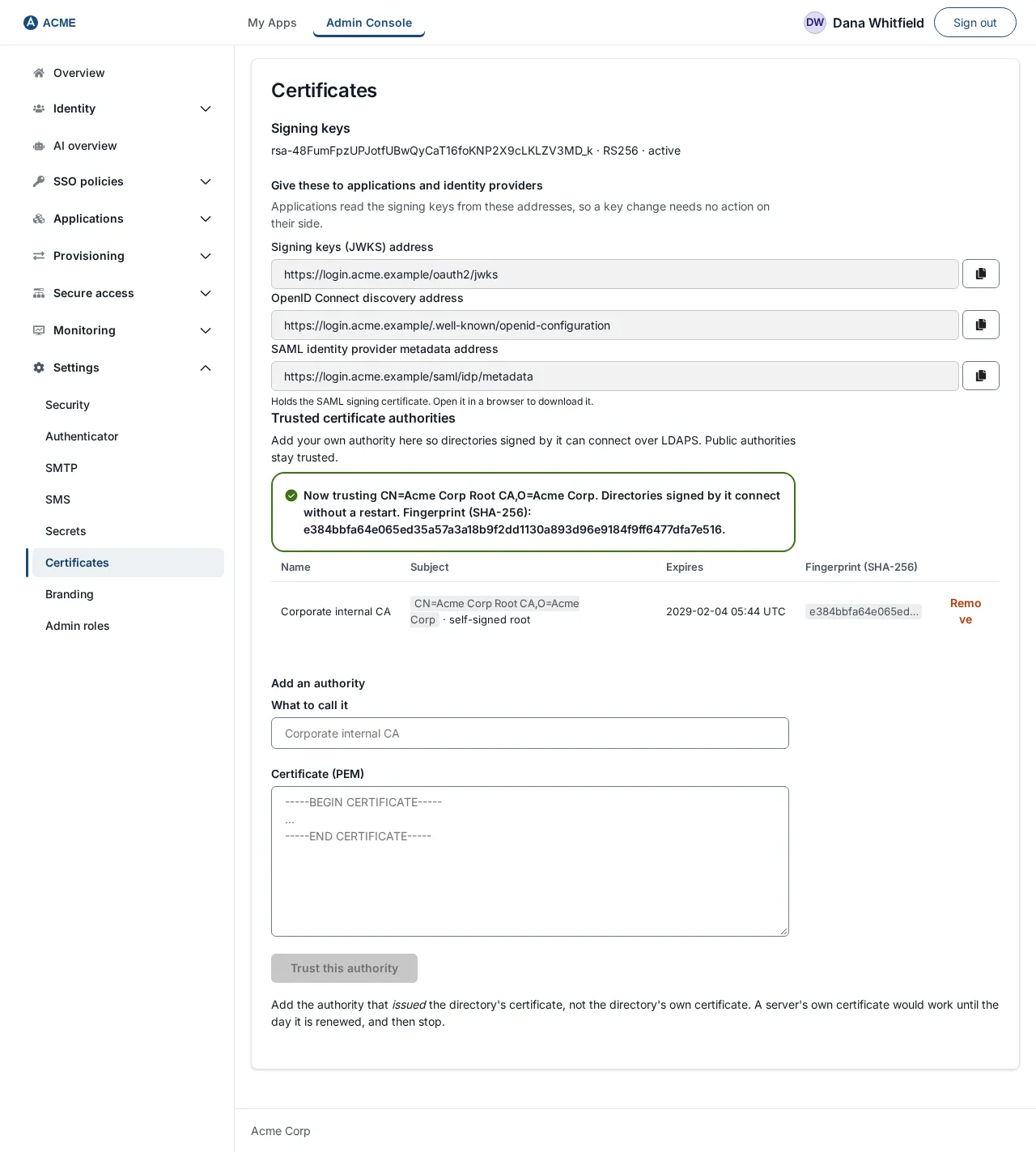
- SSOGEN trusts the public certificate authorities by default. For LDAPS directories signed by your own CA, add it under Settings, Certificates, Trusted certificate authorities as a PEM certificate.
- Add the CA that issued the directory’s certificate, not the directory’s own. SSOGEN refuses a certificate that is not a CA, and the change applies without a restart.
- An amber N days left badge appears from 90 days before expiry. A Super admin or Authentication admin adds or removes authorities (only a Super admin while the console relies on a directory), and the audit log records both.
The steps are in LDAPS certificate: trust your internal CA.
Questions people ask
What is meant by certificate authority?
A certificate authority is an organization that signs digital certificates. Each one binds a public key to a name after the CA checks the request. Clients hold lists of CAs they trust.
Can I create my own certificate?
Yes, in two ways. A self-signed certificate signs itself, so a client accepts it only when told to trust that exact certificate. A private CA signs many, and clients trust them all once they trust its root. A public site needs a publicly trusted CA.
What is certificate pinning?
Certificate pinning makes a client accept only a specific certificate or public key for a host, not any certificate a trusted CA signed. Chrome removed HTTP header pinning (HPKP) in version 72. A pin on the leaf certificate breaks at every renewal, and lifetimes are falling to 47 days.
Is DigiCert a certificate authority?
Yes, DigiCert is a publicly trusted certificate authority. Mozilla’s root store report, read on 17 November 2026, lists DigiCert as the owner of 17 roots, seven of them trusted for websites. A CA stays publicly trusted only while root programs keep its roots in their stores.
Sources, all read 2026-11-17:
- CA/Browser Forum, Baseline Requirements 2.3.1 (4 October 2026) and EV Guidelines 2.0.4 (13 August 2026).
- IETF, RFC 8555 (ACME), RFC 8659 (CAA), RFC 6962 and RFC 9162 (Certificate Transparency).
- Chrome, Certificate Transparency policy and HPKP removal.
- Let’s Encrypt, Ending OCSP Support in 2025 and OCSP Service Has Reached End of Life.
- Mozilla, CCADB included CA certificates report.
The chain and SCT output were captured on 17 November 2026 with OpenSSL 3.5.8.
Updated