SSOGEN / Learn / What Is an X.509 Certificate?
Learn
What Is an X.509 Certificate?
An X.509 certificate is a signed record that binds a name to a public key. This page reads a real one, issued with OpenSSL, field by field.
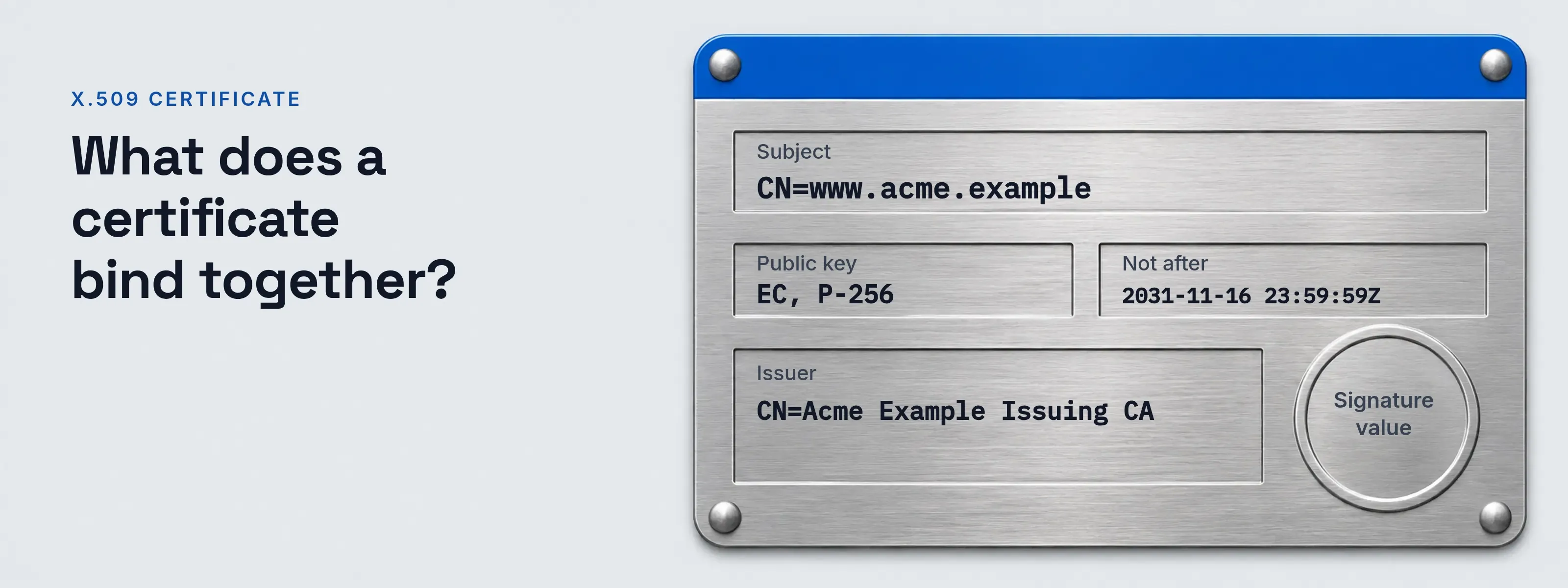
A .crt or .pem file holds one X.509 certificate. This one belongs to www.acme.example. A private test CA signed it with OpenSSL 3.5.8 on 2026-11-17. It is 729 bytes of binary data, or 1,042 bytes as the text below. Every value on this page comes from it.
A real certificate, field by field
The CA signed the first 640 bytes, the tbsCertificate. The last 73 bytes hold the signature. The rows below follow the order of RFC 5280 section 4.1 and then the extensions of section 4.2.
- Version
- 3 (stored as
0x2) - Declares that extensions follow. RFC 5280 requires 3 when a certificate has extensions (4.1.2.1).
- Serial number
4D:9B:2C:1E:7A:30:F5- Tells this certificate apart from every other one the issuer signed. At most 20 octets (4.1.2.2).
- Signature algorithm
ecdsa-with-SHA256- Names how the CA signed. The same identifier must appear inside the signed body and outside it (4.1.2.3).
- Issuer
C=US, O=Acme Example Inc, CN=Acme Example Issuing CA- Names the CA that signed.
- Not before
2026-11-17 00:00:00Z- First moment the certificate is valid. The period includes both end dates (4.1.2.5).
- Not after
2031-11-16 23:59:59Z- Last moment. Five years is this private test CA’s choice. Dates through 2049 use UTCTime, later ones GeneralizedTime.
- Subject
C=US, O=Acme Example Inc, CN=www.acme.example- Names the holder of the key.
- Public key
- EC, P-256 (
prime256v1), a 65-byte point - The key being certified. The matching private key stays on the server.
- Basic constraints (critical)
CA:FALSE- This key may not sign other certificates (4.2.1.9).
- Key usage (critical)
digitalSignature- Limits what the key may do (4.2.1.3).
- Extended key usage
serverAuth,clientAuth- Lists the purposes. If the extension is present, the certificate may only be used for one of them (4.2.1.12).
- Subject alternative name
DNS:www.acme.example,DNS:acme.example- The names the certificate answers for (4.2.1.6).
- Subject key identifier
11:81:CC:D5:5D:86:74:05:85:AC:13:BC:E9:AA:AE:48:56:C9:75:48- A label for this key (4.2.1.2).
- Authority key identifier
0B:61:DF:69:B3:52:99:0E:DD:B5:D5:94:49:FB:E0:C1:BF:45:06:47- A label for the signing key. It equals the CA certificate’s subject key identifier (4.2.1.1).
- Authority information access
- OCSP at
http://ocsp.ca.acme.example; CA Issuers athttp://pki.acme.example/issuing-ca.crt - Where to ask about status and where to fetch the issuer’s certificate (4.2.2.1).
- CRL distribution points
http://crl.acme.example/issuing-ca.crl- Where the CA publishes revocations (4.2.1.13).
- Signature value
- 70 bytes of ECDSA output
- The CA’s signature over the
tbsCertificate(4.1.1.3).
The SHA-256 fingerprint is not a field. It is a hash of all 729 bytes, so two files that differ by one bit have different fingerprints:
DC:2F:EA:4F:C7:41:E4:80:AF:E1:29:A1:06:CF:91:30:AC:B2:F3:B6:B1:B9:B8:33:B4:59:37:C5:9D:8B:87:DF
OpenSSL prints the two extensions that point outward with -ext:
Authority Information Access: OCSP - URI:http://ocsp.ca.acme.example CA Issuers - URI:http://pki.acme.example/issuing-ca.crtX509v3 CRL Distribution Points: Full Name: URI:http://crl.acme.example/issuing-ca.crl-----BEGIN CERTIFICATE-----MIIC1TCCAnygAwIBAgIHTZssHnow9TAKBggqhkjOPQQDAjBKMQswCQYDVQQGEwJVUzEZMBcGA1UECgwQQWNtZSBFeGFtcGxlIEluYzEgMB4GA1UEAwwXQWNtZSBFeGFtcGxlIElzc3VpbmcgQ0EwHhcNMjYxMTE3MDAwMDAwWhcNMzExMTE2MjM1OTU5WjBDMQswCQYDVQQGEwJVUzEZMBcGA1UECgwQQWNtZSBFeGFtcGxlIEluYzEZMBcGA1UEAwwQd3d3LmFjbWUuZXhhbXBsZTBZMBMGByqGSM49AgEGCCqGSM49AwEHA0IABOUfQFkKwfniLRQ0xgIudns3pnSOhtrZMre89qIW/BOaCvD0tBK8/vrRJriHZK4SiAm91H0NbyeYfSmIDSfcuryjggFSMIIBTjAMBgNVHRMBAf8EAjAAMA4GA1UdDwEB/wQEAwIHgDAdBgNVHSUEFjAUBggrBgEFBQcDAQYIKwYBBQUHAwIwKQYDVR0RBCIwIIIQd3d3LmFjbWUuZXhhbXBsZYIMYWNtZS5leGFtcGxlMB0GA1UdDgQWBBQRgczVXYZ0BYWsE7zpqq5IVsl1SDAfBgNVHSMEGDAWgBQLYd9ps1KZDt211ZRJ++DBv0UGRzBrBggrBgEFBQcBAQRfMF0wJwYIKwYBBQUHMAGGG2h0dHA6Ly9vY3NwLmNhLmFjbWUuZXhhbXBsZTAyBggrBgEFBQcwAoYmaHR0cDovL3BraS5hY21lLmV4YW1wbGUvaXNzdWluZy1jYS5jcnQwNwYDVR0fBDAwLjAsoCqgKIYmaHR0cDovL2NybC5hY21lLmV4YW1wbGUvaXNzdWluZy1jYS5jcmwwCgYIKoZIzj0EAwIDRwAwRAIgLnUOoPihOrAl30ktkT+NjRtWHVazI6BBQGnnTkIGDSECIApyVJWlb+v63JrwhVCPGVwUU+9Az4qUWq5q7IMnfbgT-----END CERTIFICATE-----Paste it into the certificate decoder to see the same fields in your browser.
Four checks that decide whether a client accepts it
A client does not read the subject to find a hostname. It tests names, purpose and the CA flag, and each test is a field above.
| Extension | What the client checks | What fails |
|---|---|---|
| Subject alternative name | The hostname it dialed is in the list. RFC 9525 (2023, section 2) says the Common Name must not be used to identify a service. | ftp.acme.example is not in the sample’s list, so the sample is wrong for it even though the subject names the same organization. |
| Key usage | The key is allowed to do the operation, here a signature. | A key limited to digitalSignature may not be used for key encipherment. |
| Extended key usage | The purpose it needs is listed. RFC 5280 lets an application require a particular purpose. | A client that needs clientAuth refuses a certificate that lists only serverAuth. |
| Basic constraints | The certificate is a CA before its key is used to verify another certificate’s signature. | With CA:FALSE, the sample’s key cannot vouch for any other certificate. |
Chain and trust failures belong to the wider system in what is PKI. PKIX path building failed walks through them.
The same certificate in four files
All four formats carry the sample’s data. They differ in encoding, in what else fits, and in whether a private key can be inside.
| Format | Usual extensions | Encoding | Can hold |
|---|---|---|---|
| DER | .der, .cer |
Binary ASN.1 | One certificate |
| PEM | .pem, .crt |
Base64 of the DER between BEGIN and END lines (RFC 7468) |
One or more certificates, and other labeled blocks |
| PKCS#7 | .p7b |
A signed-data structure with no signer (RFC 2315, RFC 5652) | Certificates and CRLs, no private key |
| PKCS#12 | .p12, .pfx |
Binary, password-protected (RFC 7292) | Private key and certificates |
openssl x509 -in leaf.pem -outform DER -out leaf.deropenssl x509 -in leaf.der -inform DER -out leaf.pemopenssl crl2pkcs7 -nocrl -certfile leaf-chain.pem -out chain.p7bopenssl pkcs12 -export -nokeys -in leaf-chain.pem -out chain.p12The .p12 is the form Java tools read.
Reading a certificate from a file or a live server
A certificate holds only public data, so you can read it anywhere. Where you find it depends on its job.
- On a server. A PEM or PKCS#12 file that the web server or gateway loads, usually next to a separate private key file.
- In a Java program. A keystore holds a private key with its certificate. A truststore holds certificates only. The default truststore is the JDK cacerts file.
- In an operating system. A trust store of CA certificates that browsers and other programs consult.
To read the certificate a live server presents, and print only its subject, dates and names:
openssl s_client -connect www.acme.example:443 -servername www.acme.example </dev/null \ | openssl x509 -noout -subject -dates -ext subjectAltNameTo read the same fields from many servers at once, the Nmap script ssl-cert prints the subject, names and validity dates of each server’s certificate, as shown in these Nmap commands.
Questions people ask
How can I obtain an X.509 certificate?
Ask a certificate authority for one. Generate a key pair, check the request, and send it to a CA. It signs a certificate after confirming you control the name. Issuance itself is covered in certificate authority.
What is a digital signature and a digital certificate?
A digital signature proves who signed data; a digital certificate is signed data that binds a name to a key. In the sample, the CA signed the first 640 bytes and stored the 70-byte result as the last field. Anyone holding the CA’s public key can check it.
Is X509 the same as SSL?
No. X.509 is the certificate format. SSL and its successor TLS are protocols that send a certificate during the handshake. An “SSL certificate” is an X.509 certificate used for TLS. The same format also appears in SAML signing and, in mutual TLS, on the client.
Where are X509 certificates stored?
In files, keystores and trust stores. A server keeps its certificate in a PEM or PKCS#12 file or a keystore, with its private key. Programs keep CA certificates in a trust store, such as the JDK’s cacerts. A certificate holds no secret, so copying it is safe. Guard the private key.
Sources, all read 2026-11-17: RFC 5280 (May 2008), sections 4.1 and 4.2; RFC 9525 (November 2023), section 2; RFC 7468 (April 2015), sections 5 and 8; RFC 2315 (March 1998); RFC 5652 (September 2009); RFC 7292 (July 2014). Values in the sample come from openssl x509 -text on the file above.
Updated