SSOGEN / Learn / Password Spraying
Learn
Password Spraying
Password spraying tries one password, or a short list of common ones, on many accounts, so no single account collects enough failures to lock. Here is how it looks in a sign-in log and what stops it.
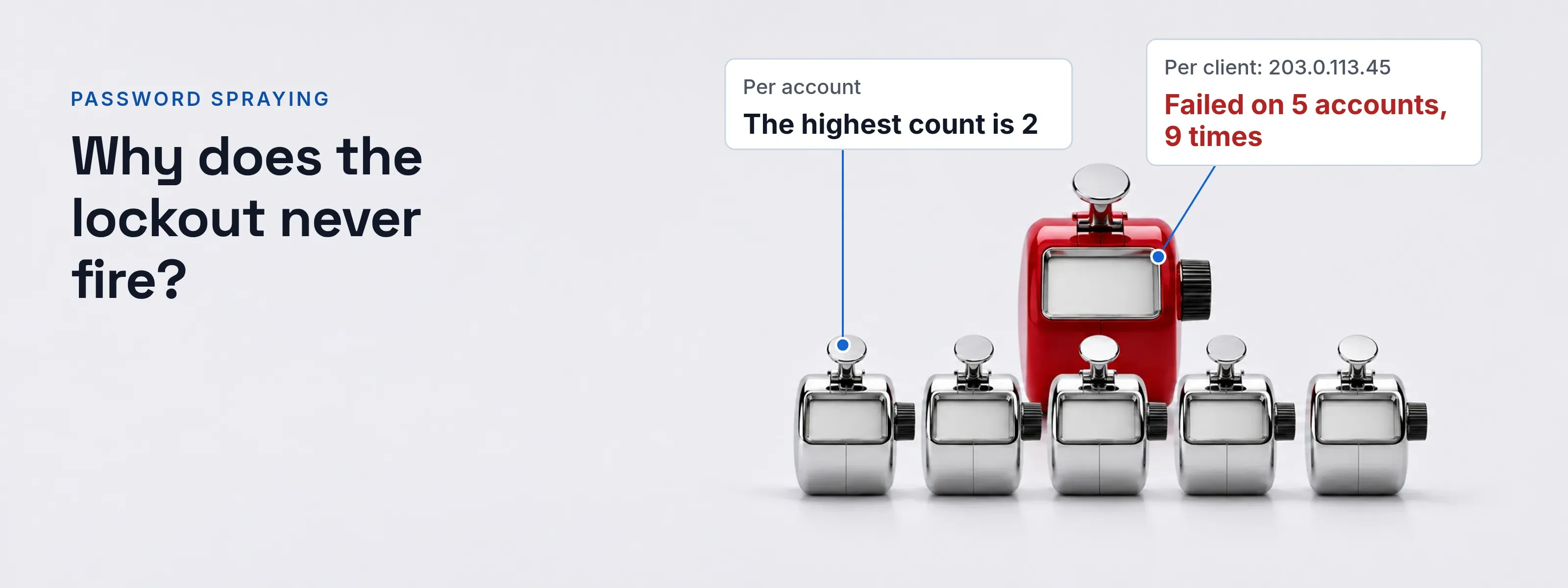
One password, tried once on each of many accounts, stays under every per-account lockout. That is password spraying. MITRE ATT&CK describes it as one password, or a small list of commonly used ones, against many different accounts. The attacker holds account names, not leaked passwords.
- MITRE ATT&CK ID
- T1110.003, under Brute Force (T1110)
- Tactic
- Credential Access
- Spray signal in the log
- 50126: invalid username or password (Microsoft Entra)
Spray, stuffing and brute force in one sign-in log
Count accounts per source and attempts per account to tell the three apart.
| Pattern | Accounts per source | Attempts per account | Timing | Attacker holds | In the log |
|---|---|---|---|---|---|
| Brute force, guessing (T1110.001) | One or a few | Many | Fast burst | An account name | One account with a long run of failures |
| Password spraying (T1110.003) | Many | One or very few per round | Paced, with a pause between rounds | Account names and a short list of common passwords | Many accounts, one failure each, from one client |
| Credential stuffing (T1110.004) | Many | One or two | Automated, often spread over many addresses | Leaked username and password pairs | Many accounts, each tried once; see credential stuffing |
One spray, line by line
This excerpt is fictional: Acme (acme.example), with a client address from the 203.0.113.0/24 documentation range. Codes are Microsoft Entra errors; AADSTS50126 is an invalid username or password.
All from 203.0.113.45
| Time (UTC) | Client | Account | Result | Reading |
|---|---|---|---|---|
| 09:00:04 | 203.0.113.45 | emily.carter@acme.example |
Failure 50126 | First failure |
| 09:00:09 | 203.0.113.45 | james.nguyen@acme.example |
Failure 50126 | New account |
| 09:00:15 | 203.0.113.45 | olivia.brooks@acme.example |
Failure 50126 | One failure each |
| 09:00:21 | 203.0.113.45 | david.kim@acme.example |
Failure 50126 | Steady pace |
| 09:00:26 | 203.0.113.45 | sarah.mitchell@acme.example |
Failure 50126 | Round one ends |
| 09:30:03 | 203.0.113.45 | emily.carter@acme.example |
Failure 50126 | 30 minutes later, same order |
| 09:30:08 | 203.0.113.45 | james.nguyen@acme.example |
Failure 50126 | Second failure |
| 09:30:14 | 203.0.113.45 | olivia.brooks@acme.example |
Success | The one success |
| 09:30:19 | 203.0.113.45 | david.kim@acme.example |
Failure 50126 | Round two |
| 09:30:25 | 203.0.113.45 | sarah.mitchell@acme.example |
Failure 50126 | Round two ends |
The log records the account and the result, not the password tried. You infer one password per round from the shape.
Why the lockout never fires
A lockout counts failures per account, and a spray gives each account almost none. MITRE notes attackers may also throttle on purpose:
- Feb 26, 2024CISA advisory AA24-057A describes a spray campaign using residential proxies, which makes address-based indicators less effective.
- May 28, 2024The US Treasury sanctions the operators of 911 S5, a residential proxy botnet of about 19 million compromised IP addresses. Paying customers routed their traffic through those infected home computers, so it looked residential.
- Jun 2026Microsoft’s smart lockout locks an account after 10 failed attempts by default (three in Azure US Government). The longest run in the log above is two.
- Nov 4, 2026MITRE T1110.003 records one tool at about four attempts per hour per account for days or weeks, and another actor at a single attempt per 24 hours.
In a scan report, a sign-in form without attempt limits appears as CWE-307. One lockout finding in a vulnerability assessment and a penetration test shows a tester turning it into an admin takeover with a spray.
Find it by distinct accounts
Alert on distinct accounts failing from one client, never on failures per account. Both counts on the rows above:
Per account: the highest count is 2, so a threshold of 10 stays silent.
Per client: 203.0.113.45 failed on 5 accounts, 9 times, within one hour. The alert fires.
SELECT client, COUNT(DISTINCT account) AS accounts_failed, COUNT(*) AS failuresFROM signin_logWHERE result = 'failure' AND time > now() - interval '1 hour'GROUP BY clientHAVING COUNT(DISTINCT account) >= 5;Set the threshold from your own normal traffic. Four signals feed the query:
| Event | Where it is written | What it tells you |
|---|---|---|
| 50126 | Entra | Invalid username or password. Many accounts with this code is the spray signal. |
| 50053 | Entra | Account locked (IdsLocked). A spray raises few of these, so a lockout alert alone misses it. |
| 4625 | The computer that was reached | Windows failed logon. |
| 4771 | Domain controllers | Kerberos pre-authentication failure. MITRE notes that LDAP and Kerberos attempts are less likely to raise 4625. |
Seven controls and what each leaves open
Each control stops some sprays; the third column is the gap to close next.
| Control | What it stops | What it leaves open | Source and date |
|---|---|---|---|
| Multi-factor authentication | A sprayed password alone; Microsoft says MFA can block over 99.9 percent of account compromise attacks (not split by attack type) | A user who approves a prompt, as in how attackers bypass MFA | CISA fact sheet, Oct 2022; Microsoft, Aug 20, 2019 |
| Phishing-resistant MFA | Phishing and push bombing | Service accounts, which cannot easily use MFA | CISA fact sheet, Oct 2022; CISA AA24-057A, Feb 26, 2024 |
| Block legacy authentication | Protocols with no second step; Microsoft’s analysis puts over 99 percent of sprays on them | Clients not yet migrated | Microsoft Learn, Mar 2026 |
| Smart lockout | Guessing at the threshold, with separate counters for familiar and unfamiliar locations | A spray paced below the threshold | Microsoft Learn, Jun 2026 |
| Banned-password lists | The weak passwords a spray submits; Microsoft’s global list is always on, a custom list holds 1,000 terms | Passwords set before the check, until changed | Microsoft Learn, Feb 2026; NIST SP 800-63B-4 section 3.1.1.2, Aug 26, 2025 |
| Conditional access and network limits | Non-compliant devices and outside IP ranges, as in what is conditional access | Residential proxies, which weaken IP-based rules | MITRE M1036, Nov 2026; CISA AA24-057A |
| Retire dormant and service accounts | Targets nobody watches | Active accounts that still need strong unique passwords | CISA AA24-057A, Feb 26, 2024 |
What you can set in SSOGEN
SSOGEN limits attempts per client and per account, locks the second step and feeds failed attempts into a risk score. You set each value on Settings > Security or the Password policy page.
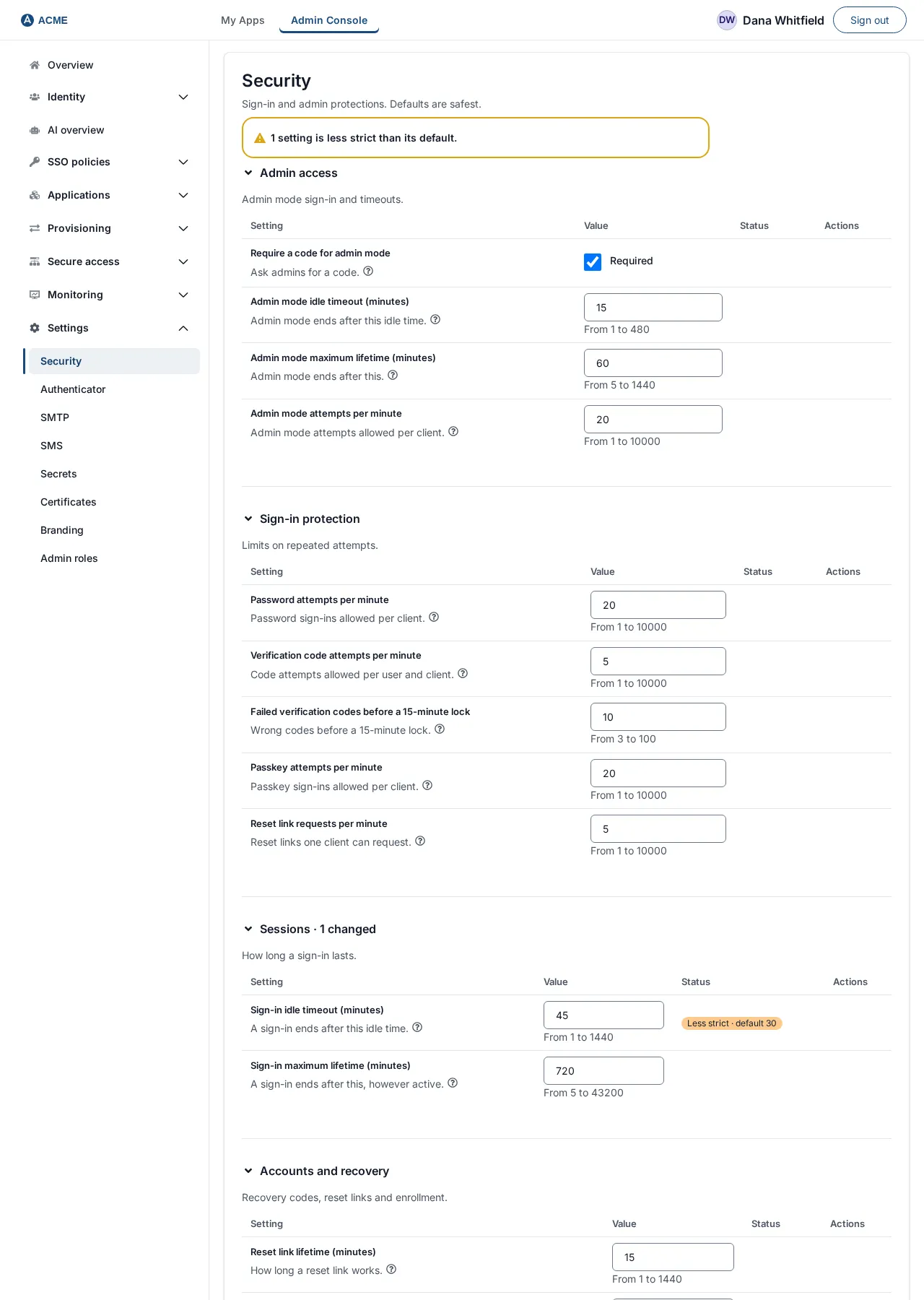
- Attempt limits per client. A client is one network address. Password sign-in allows 20 attempts a minute, second-step codes 5 per person and client, passkey sign-in 20. Each runs from 1 to 10,000. See security settings.
- Second-step lock. 10 failed codes in a row, across every method, lock the second step for 15 minutes. The lock ends on its own; the count range is 3 to 100.
- Password lockout. The default preset follows NIST SP 800-63B: 5 wrong passwords lock the account for 15 minutes. The range is 3 to 100 attempts and 1 to 1,440 minutes, set in password policy.
- Always-on password checks. Repeated characters, runs such as
abcdefghand passwords that contain the username are refused. - Risk score. A sign-in score from 0 to 100 reads recent failed attempts on the account, and a rule such as “Risk score is at least 30, require a second factor” acts on it.
- Audit log. Filter by result and from address to run the per-client count above.
Questions people ask
Is a spray a form of brute force?
Yes. MITRE ATT&CK files it as a sub-technique of Brute Force (T1110). The family also holds guessing, cracking and stuffing. Spraying runs the other way: one password across many accounts, not many passwords against one.
Why does a per-account lockout miss a spray?
A lockout counts failures per account, and a spray gives each account only one or two. No account reaches the threshold, which is 10 by default in Microsoft smart lockout, and MITRE records tools pacing attempts at about four per hour per account.
How do you detect password spraying?
Count distinct accounts failing from one client in a time window, not failures per account. Group failed sign-ins by source over an hour. The log shows no password, so you infer one from the shape. Proxies can split a spray, so also watch the whole tenant.
Which password attacks hit a live sign-in page?
Password spraying, credential stuffing and password guessing. MITRE ATT&CK files all three under Brute Force (T1110) as T1110.003, T1110.004 and T1110.001, and CISA advisory AA24-057A describes spraying in the field. Password cracking (T1110.002) works on stolen hashes offline.
Sources, all read 2026-11-17: MITRE ATT&CK T1110.003; CISA AA24-057A; CISA phishing-resistant MFA fact sheet; Entra smart lockout; Entra banned passwords; Entra error codes; Microsoft, block legacy authentication; Microsoft Security blog, August 20, 2019; NIST SP 800-63B-4; US Treasury, sanctions on the 911 S5 botnet network, May 28, 2024 (read 2026-11-18).
Updated