SSOGEN / Learn / Vulnerability Assessment vs Penetration Testing, Side by Side
Learn
Vulnerability Assessment vs Penetration Testing, Side by Side
The difference between a vulnerability assessment and a penetration test is breadth against proof: the assessment scans a defined scope and ranks known weaknesses, and the test has a tester exploit them to show how far an attacker gets.
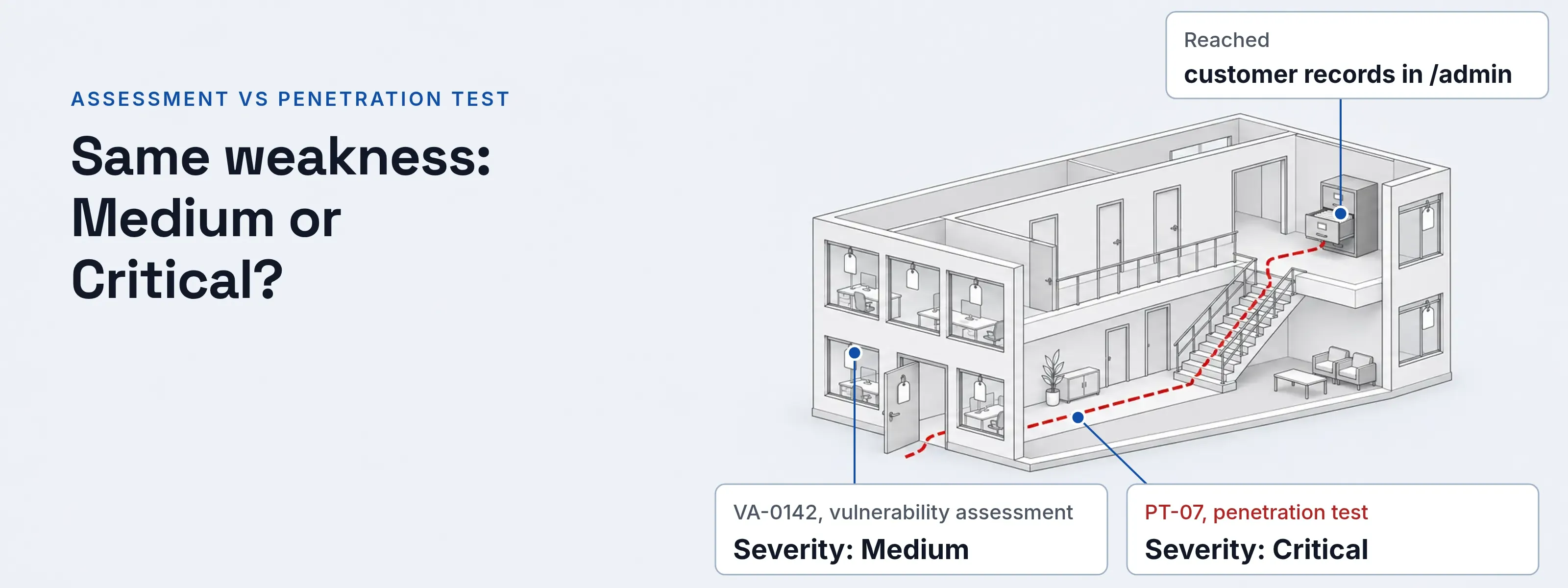
Both tests on this page run against one fictional target, portal.acme.example: a customer portal with a sign-in page and an /admin area. The weakness is the same in both. Only the test changes.
How an assessment and a pen test differ on the same portal
Same target and the same weakness. Scope, method and output differ.
| Vulnerability assessment | Penetration test | |
|---|---|---|
| Scope | Every host, application and service in range. Breadth first. | Agreed targets and a goal, such as reaching customer data in /admin. Depth first. |
| Method | Mostly automated vulnerability scanning against known signatures, then an analyst removes false positives | A tester exploits findings by hand, chains them and stops at agreed limits |
| Output | A list of findings with CVE or CWE IDs, CVSS scores and standard fixes | An attack narrative with evidence, business impact, fixes and a retest result |
| Frequency | Recurring on a fixed cycle, and again after significant changes | Periodic, and before a launch or after a major change |
| Who runs it | An internal team or a service provider; external PCI DSS scans need an Approved Scanning Vendor | A qualified tester, internal or third party, independent of the team that runs the system |
| Cost driver | Number of assets and scanner licenses | Tester days, scope and complexity |
The same finding in both reports
A scanner rates the weakness Medium. A tester proves it Critical.
The weakness is CWE-307, Improper Restriction of Excessive Authentication Attempts: the sign-in form accepts unlimited failed passwords. Both excerpts are samples. The address comes from the 198.51.100.0/24 documentation range.
- Finding
- VA-0142
- Host
- portal.acme.example (198.51.100.24)
- Path
- POST /login
- Weakness
- CWE-307 Improper Restriction of Excessive Authentication Attempts
- CVSS v3.1
- 5.3 (sample score)
- Severity
- Medium
- Evidence
- 50 failed sign-ins accepted, no delay or lockout
- Fix
- Limit failed attempts per account and per source
- Finding
- PT-07, account takeover through the sign-in form
- Tried
- A slow password spray: a few common passwords across usernames gathered from public pages
- Worked
- One valid password, on an account without MFA
- Reached
- The account held an admin role. The tester read customer records in /admin
- Severity
- Critical
- Evidence
- Session screenshots and request log, appendix B
- Fix
- Require MFA on every account, limit failed attempts, review admin role grants
- Retest
- Spray repeated after the fix; no session issued
| Field | Why it differs from the scan |
|---|---|
| Severity | The scan scores the flaw alone. The test shows what one admin account reaches. |
| Fix | MFA comes first, because the whole chain ran through a single password |
The attack in the penetration test excerpt is password spraying. It tries each account rarely, so a per-account lockout alone would not have stopped it.
What NIST and PCI DSS say, with dates
Both standards keep scanning and penetration testing apart, with separate purposes and schedules.
- NIST SP 800-115, September 2008. Places vulnerability scanning (section 4.3) under target identification and analysis. Places penetration testing (section 5.2) under target vulnerability validation, the techniques that corroborate a vulnerability exists. It also warns that scanners can have a high false positive error rate. The test method itself is covered in what penetration testing is.
- NIST glossary, read November 18, 2026. A vulnerability assessment is a systematic examination to identify security deficiencies. In a penetration test, assessors attempt to circumvent or defeat the security features (CNSSI 4009-2022, SP 800-53 Rev. 5).
- PCI DSS v4.0.1, June 2024. Requirement 11.3 sets internal and external vulnerability scans at least once every three months, plus scans after significant changes. External scans go to a PCI SSC Approved Scanning Vendor (11.3.2). Requirement 11.4 covers penetration testing. Service providers that rely on segmentation test those controls at least once every six months (11.4.6).
- PCI DSS v4.0, retired December 31, 2024. Since then, v4.0.1 is the only active version. It is a limited revision of v4.0, which was published in March 2022.
Which one, when
Pick by the question you need answered.
- First inventory of a new estate: Assessment. You need the full list of known weaknesses before anyone spends tester days on depth.
- Before launch or after a major change: Penetration test. A new sign-in flow or admin area needs proof that its controls hold against a real attempt.
- Systems in PCI DSS scope: Both. Scans and penetration tests sit in separate requirements with separate schedules. One does not stand in for the other.
- A quote says VAPT: Both reports. Ask for the finding list and the attack narrative as separate deliverables, each with its own scope.
Questions people ask
What is VAPT security testing?
VAPT is a combined engagement: a vulnerability assessment for breadth, then a penetration test for depth. The assessment lists the known weaknesses across the scope. The test exploits the ones that matter and shows the impact. Check that the quote names both deliverables: the finding list and the attack narrative.
Does a vulnerability scan count as a penetration test?
No. PCI DSS keeps them in separate requirements: scans in 11.3, penetration testing in 11.4. PCI SSC also states that an Approved Scanning Vendor scan report does not show that any other requirement is in place. A scan reports that a weakness exists. Only a test shows whether an attacker can use it.
How often should each be done?
For PCI DSS, scan internally and externally at least once every three months and after significant changes. PCI SSC treats 90 days as the longest gap between scans. Penetration testing follows its own schedule under requirement 11.4. Outside PCI DSS scope, base both on risk and on how often the system changes.
Should the assessment come before the penetration test?
Usually, yes. An assessment gives the tester a map of known weaknesses and clears the easy findings first. Tester days then go to chaining weaknesses and proving impact, which a scanner cannot do. The sample above follows that order: the scan found CWE-307, the test showed where it led.
Sources, read 2026-11-18
The sample chain ran through a single password. See how SSOGEN protects sign-in, with MFA available everywhere.
- NIST SP 800-115
- NIST glossary, vulnerability assessment
- NIST glossary, penetration testing
- PCI SSC, Just Published: PCI DSS v4.0.1 (June 11, 2024)
- PCI SSC FAQ, scans at least once every three months
- PCI SSC FAQ, ASV scan reports
- PCI SSC FAQ, segmentation penetration tests
- PCI SSC, Approved Scanning Vendors
- MITRE CWE-307
Updated