SSOGEN / Learn / What Is Penetration Testing?
Learn
What Is Penetration Testing?
An authorized attack on your own systems, inside a written scope, is called penetration testing. Each finding in its report carries steps, evidence, a fix and a retest result.
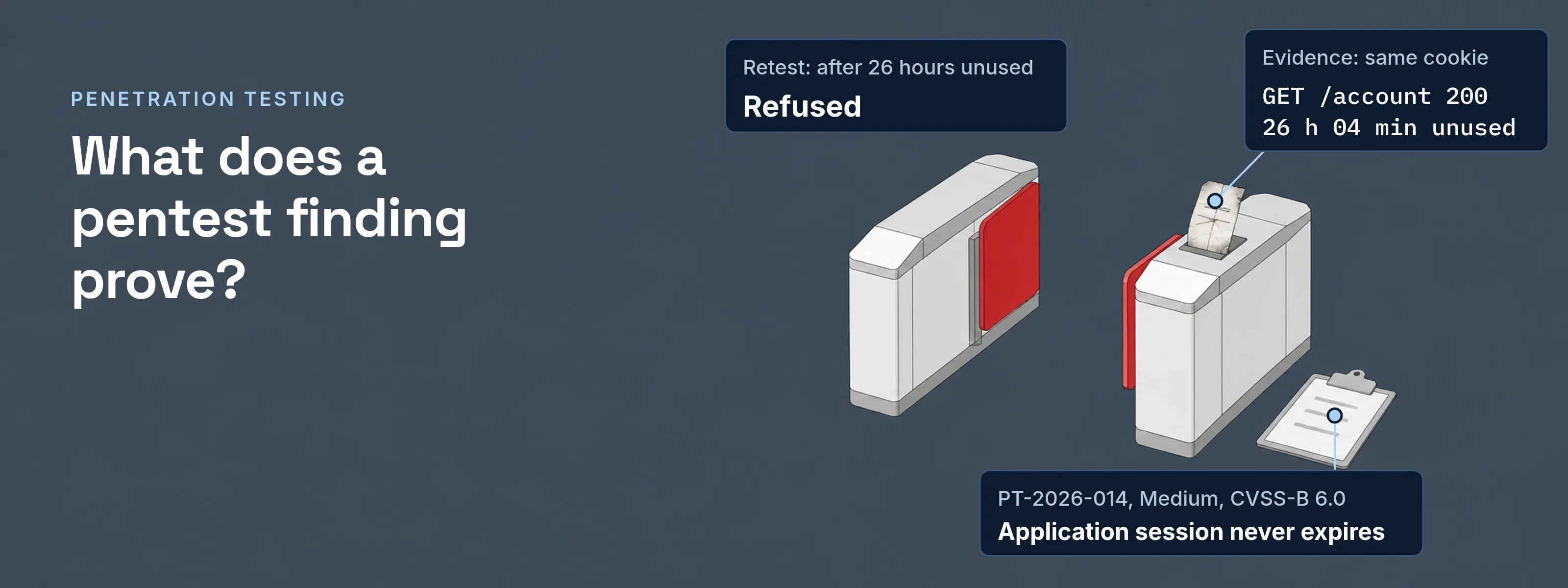
Testers you authorize in writing attack your systems inside an agreed scope and time window. They try what a real attacker would try and stop at agreed limits. Every weakness they manage to use becomes a finding you can reproduce, fix and retest.
A sample finding, as the report states it
This finding is a sample. portal.acme.example is fictional and the test never took place. The fields and IDs are the ones a real report uses.
- Asset
- https://portal.acme.example, customer portal, production
- Severity
- Medium, CVSS-B 6.0
- Vector
- CVSS:4.0/AV:N/AC:L/AT:P/PR:N/UI:P/VC:H/VI:L/VA:N/SC:N/SI:N/SA:N
- Maps to
- OWASP WSTG-SESS-07 Testing Session Timeout; CWE-1463 Insufficient Session Timeout Value
- Steps
- 1. Sign in as test user pt-user-02 and record the session cookie. 2. Leave the session unused. 3. Send GET /account with the recorded cookie from a second host.
- Expected
- A redirect to the sign-in page once the idle limit has passed
- Evidence
- Sample: 2026-11-09T07:10:31Z sign-in pt-user-02; 2026-11-10T09:14:02Z GET /account 200, same cookie, 26 h 04 min unused
- Fix
- Enforce an idle timeout of 15 minutes and an absolute lifetime of 8 hours, both on the server
- Retest
- November 17, 2026 (sample date), closed
The vector says the attacker needs a cookie the victim already created (AT:P, UI:P). With it, they read the account (VC:H) and change a little of it (VI:L).
| Replay of the recorded cookie | Required | Test Nov 10 | Retest Nov 17 |
|---|---|---|---|
| After 10 minutes unused | Accept | Accepted, meets the requirement | Accepted, meets the requirement |
| After 16 minutes unused | Refuse | Accepted, fails the requirement | Refused, meets the requirement |
| After 9 hours of steady use | Refuse | Accepted, fails the requirement | Refused, meets the requirement |
| After 26 hours unused | Refuse | Accepted, fails the requirement | Refused, meets the requirement |
The third row matters most. An idle timeout alone never fires while an attacker keeps the stolen session busy; only the absolute lifetime ends it. Session hijacking shows how such cookies get stolen in the first place.
Six phases, from scope to retest
Each phase hands you something. The last two columns show where the two public methods place it.
| Phase | What the tester does | What you receive | PTES section | NIST SP 800-115 |
|---|---|---|---|---|
| Scoping and rules of engagement | Agrees targets, dates, accounts and stop conditions | A signed rules-of-engagement document | Pre-engagement interactions | Planning |
| Reconnaissance | Maps hosts, ports, services and versions, then matches them to known weaknesses | An asset list and candidate weaknesses | Intelligence gathering, threat modeling, vulnerability analysis | Discovery |
| Exploitation | Tries each candidate weakness to prove it can be used | Confirmed findings with evidence | Exploitation | Attack |
| Post-exploitation | Escalates privileges and reaches further systems to measure real impact | The attack path and the impact per finding | Post exploitation | Attack, looping back to discovery |
| Reporting | Writes each finding with severity, steps, evidence and fix | The report | Reporting | Reporting |
| Retest | Repeats each finding’s steps after your fix | A result per finding, with its date | No separate section | No separate phase |
Targets and box level decide what a test can find
A test only covers what the scope names. Common targets:
- External network. Internet-facing hosts and services, attacked from outside with no foothold.
- Internal network. Run from a laptop or virtual machine on the corporate network: directory services, file shares, movement between hosts.
- Web application and API. Sign-in, sessions, access control and input handling, usually against the OWASP WSTG v4.2 test list. The sample finding comes from its session tests.
- Cloud configuration. Identity policies, storage permissions and exposed management endpoints in the provider account.
- Wireless. Office Wi-Fi: encryption, guest network separation, rogue access points.
- People and physical. Phishing, phone pretexts and badge access, in scope only when the rules of engagement name them.
The box level sets how much the tester knows at the start:
- Black box. Starts with a company name or a URL. Closest to an outside attacker; most of the time goes to discovery.
- Grey box. Starts with test accounts and some documentation. Reaches the authenticated parts of an application within the same test window.
- White box. Starts with source code, architecture and admin access. Deepest coverage per day; least like a real attack.
Is pentesting illegal?
Penetration testing is legal when the system owner authorizes it in writing. Without that authorization, the same actions can be an offense. In the United States, 18 U.S.C. 1030 covers accessing a computer without authorization or beyond authorized access. In the United Kingdom, section 1 of the Computer Misuse Act 1990 makes unauthorized access to computer material an offense.
The authorization lives in the rules of engagement. A typical one for the sample test:
| Item | Example value |
|---|---|
| In scope | portal.acme.example, api.acme.example, 203.0.113.0/28 |
| Excluded | payments.acme.example and every third-party service |
| Window | November 9 to 13, 2026 (sample dates), 07:00 to 19:00 UTC |
| Test accounts | pt-user-01 to pt-user-04 (standard role), pt-admin-01 |
| Stop conditions | Service degradation, real customer data in view, signs of an earlier compromise |
| Emergency contact | The on-call engineer, reachable by phone for the whole window |
| Data handling | Evidence encrypted at rest, deleted 90 days after the final report |
| Signed by | The system owner at Acme and the test lead |
Standards and their dates
The methods are public and free to read. Cite the version a test followed.
- September 2008NIST SP 800-115 published. It splits a penetration test into four phases: planning, discovery, attack and reporting.
- 2009Work on PTES starts, according to its FAQ. Seven sections, from pre-engagement interactions to reporting; technique detail sits in separate technical guidelines.
- December 2020OWASP WSTG v4.2 released. It is still the current stable version, with v5.0 in development. Test IDs such as WSTG-SESS-07 come from it.
- November 2023CVSS v4.0 published by FIRST on November 1. It asks that every score name the metrics behind it: CVSS-B for base only, then CVSS-BT, CVSS-BE and CVSS-BTE.
- June 2024PCI DSS v4.0.1 published on June 11. Requirement 11.4 covers penetration testing; 11.4.6 makes service providers that rely on segmentation test it at least once every six months.
- October 2026CWE 5.0 deprecates CWE-613 Insufficient Session Expiration and prohibits it for mapping. Session timeout findings now map to CWE-1463, as in the sample.
Short answers to three more questions
What is a penetration tester?
A penetration tester is a security engineer who attacks systems under a signed scope and reports how they got in. Testers work for a consultancy or an internal team, independent of the people who run the system. The work is reconnaissance, manual testing of sign-in, sessions and access control, writing findings with evidence, then retesting the fixes.
Why do hackers use Kali Linux?
Kali Linux comes with the testing tools already installed. It is an open-source, Debian-based distribution, formerly BackTrack Linux, and an OffSec community project. Its documentation counts several hundred tools, configurations and scripts. Authorized testers and attackers use the same distribution. What separates a test from an attack is the signed scope.
What are the 5 steps of pentesting?
The usual five steps are reconnaissance, scanning, exploitation, maintaining access and reporting. They fit the six phases above: scanning sits inside reconnaissance, and maintaining access is part of post-exploitation. The five-step version leaves out two phases a buyer depends on: the signed scope before testing and the retest after the fixes.
Next reads
- Scan or test. A scanner lists possible weaknesses; a test proves which ones work. The difference, with PCI DSS requirement numbers: vulnerability assessment vs penetration testing.
- AI systems. Models and agents get their own adversarial test and record format: AI red teaming.
- Sign-in sessions. Idle and absolute session limits are part of the security model behind SSOGEN sign-in.
Sources, read 2026-11-18
- NIST SP 800-115
- PTES main page and PTES FAQ (live site timed out, read in the Internet Archive copy of October 1, 2026)
- OWASP WSTG project
- WSTG v4.2 release
- WSTG-SESS-07
- CVSS v4.0 specification
- FIRST CVSS v4.0 calculator
- CWE-613
- CWE-1463
- CWE news, CWE Version 5.0 and Schema 8.0 Now Available (October 28, 2026)
- PCI SSC, Just Published: PCI DSS v4.0.1
- PCI SSC FAQ on requirement 11.4.6
- Kali Linux documentation
- 18 U.S.C. 1030
- Computer Misuse Act 1990, section 1
Updated