SSOGEN / Learn / Vulnerability Scanning: What a Scan Sees and Misses
Learn
Vulnerability Scanning: What a Scan Sees and Misses
A scanner compares what it can observe on a host, such as open ports, service banners, installed packages and settings, with published CVE records and vendor advisories: that check is vulnerability scanning, run on a schedule or on demand. Each match comes with a severity and the evidence behind it.
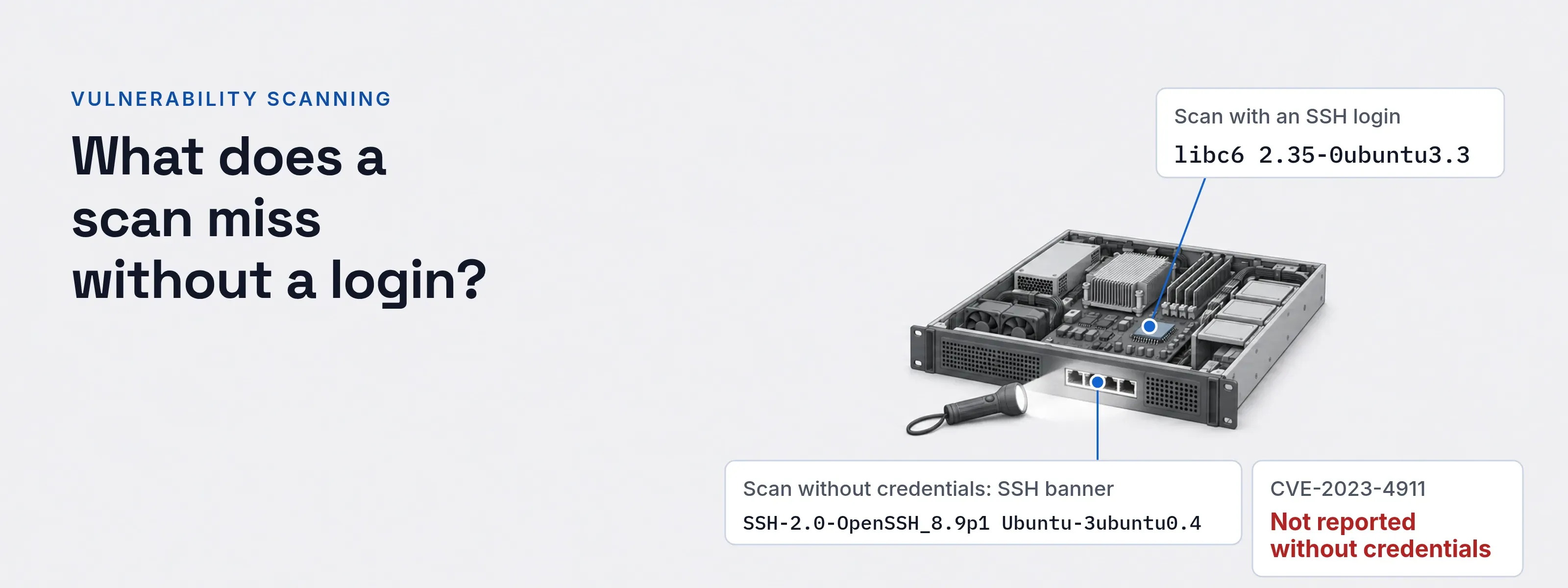
How much a scanner sees depends on its access. Below, one Ubuntu server is scanned twice: once from the network, once over an SSH login. Only the second scan finds the flaw that CISA lists as exploited.
One Ubuntu host, scanned twice
Credentials turn guesses into confirmed findings and expose local flaws.
Lab host, as its package database reports it: Ubuntu 22.04 LTS, last updated in late September 2023 · openssh-server 1:8.9p1-3ubuntu0.4 · libc6 2.35-0ubuntu3.3 · SSH banner SSH-2.0-OpenSSH_8.9p1 Ubuntu-3ubuntu0.4 · sshd_config PasswordAuthentication yes
| Finding | Scan without credentials | Scan with an SSH login |
|---|---|---|
| CVE-2023-48795, SSH prefix truncation (Terrapin) | Reported. The server offers ChaCha20-Poly1305 and does not support strict key exchange | Reported. openssh-server is below 1:8.9p1-3ubuntu0.5, the fix in USN-6560-1 |
| CVE-2024-6387, sshd signal handler race (regreSSHion) | Inferred from the banner. Correct only if the check maps Ubuntu package revisions | Reported. openssh-server is below 1:8.9p1-3ubuntu0.10, the fix in USN-6859-1 |
| CVE-2023-4911, glibc GLIBC_TUNABLES overflow (Looking Glass) | Not reported. A local flaw has no network surface | Reported. libc6 is below 2.35-0ubuntu3.4, the fix in USN-6409-1 |
| SSH password authentication enabled | Reported. The server lists password among the methods it accepts | Reported, with the sshd_config line as evidence |
These records are built from NVD, Ubuntu, CISA and FIRST data for a host at this patch level. They aren’t the output of a named scanner. Both package versions were current in Ubuntu’s jammy-updates pocket in late September 2023.
The banner carries Ubuntu’s revision because Ubuntu’s OpenSSH build appends it, unless DebianBanner no is set. The upstream part, OpenSSH_8.9p1, is the same on fixed builds. A check that reads only the upstream version will flag the patched host too, since the CVE record lists OpenSSH 8.5p1 to 9.7p1 as affected.
What a scan does, step by step
Discover, fingerprint, match, report. Each step can miss something.
Find live hosts
ICMP, ARP or TCP probes sweep the target range. Misses: hosts that drop probes, and assets nobody added to the range.
Detect ports and services
The scanner connects to TCP and UDP ports and names each service from its replies. Misses: ports that a firewall filters for the scanner’s address.
Collect versions or packages
Without credentials, it reads banners and protocol behavior. With credentials, it reads the package database over SSH, or the patch level and installed software over SMB on Windows. Misses: software installed outside the package manager.
Match against vulnerability data
Versions are compared with CVE data from NVD, vendor notices such as Ubuntu Security Notices, and OVAL definitions. Ubuntu publishes OVAL so that SCAP tools can decide whether a notice applies. Misses: flaws without a CVE yet.
Report with evidence
Each finding lists the CVE, a severity and the line that proves it, such as a package version or a banner. Misses: business context. The scanner doesn’t know which host matters most.
Authenticated vs unauthenticated scans
Run both: the outside view shows exposure, the inside view gives coverage.
- Unauthenticated scan. Needs network reach only. Sees what an attacker on that network sees: open ports, banners, TLS and SSH settings. Misses local flaws such as the glibc row above. Its false positives come from banner guesses. Use it on internet-facing hosts.
- Authenticated scan. Needs an account on the target: SSH for Linux and Unix, SMB for Windows, and credentials for VMware ESXi or SNMP devices. Reads package versions and configuration files, so it sees Ubuntu’s backported fixes. Use it for full coverage of servers you own.
Greenbone’s manual describes the authenticated mode as scanning from outside over the network and from inside with a valid login. A scan reports candidates; it doesn’t exploit them. Proving impact is the job of a penetration test.
Types of vulnerability scanners
Each scanner type reads a different target, so pick by asset.
| Scanner type | What it reads | Examples |
|---|---|---|
| Network and host | Ports and banners from the network; packages and settings over SSH or SMB | OpenVAS (Greenbone), Nmap with NSE scripts, Nessus, Qualys VMDR, Rapid7 InsightVM |
| Agent | Package and configuration data, collected by a small program on each host | Agent options in the commercial suites above |
| Web application (DAST) | The HTTP responses of a running application | OWASP ZAP |
| Dependency (SCA) | Library manifests and bundled JAR files in a build | OWASP Dependency-Check in a Maven or Gradle build |
| Container image | OS packages and libraries in each image layer | Trivy; see scanning container images before deployment |
| Infrastructure as code | Terraform files, Kubernetes manifests and similar templates | Trivy’s misconfiguration scanner; see infrastructure as code scanning |
| Secrets | Keys and tokens in source code and Git history | Gitleaks, TruffleHog, Trivy |
The commercial names are examples, not a ranking. Nmap’s own documentation says it isn’t a comprehensive vulnerability scanner, though NSE scripts handle targeted checks.
Reading a finding before you fix it
Sort by KEV status first, then EPSS, then CVSS and exposure.
| CVE | CVSS v3.1 (NVD) | EPSS on November 17, 2026 | CISA KEV, catalog 2026.11.17 |
|---|---|---|---|
CVE-2024-6387 |
8.1 High, network |
0.995 |
Not listed |
CVE-2023-4911 |
7.8 High, local |
0.638 |
Listed November 21, 2023, federal due date December 12, 2023 |
CVE-2023-48795 |
5.9 Medium, network |
0.935 |
Not listed |
The same three findings land in a different order under each sort key.
- CVSS only. regreSSHion, glibc, Terrapin. Severity is an expert rating of the flaw, not of attacker interest.
- EPSS only. regreSSHion, Terrapin, glibc. A daily probability of exploitation in the next 30 days.
- KEV, then EPSS. glibc, regreSSHion, Terrapin. The top item is the one the network-only scan never saw.
A CVE listed in the CISA catalog of known exploited vulnerabilities (KEV) outranks one with a higher score. Before you open a ticket, check the evidence line: a banner match on a distribution package is the most common false positive. Assigning owners, fixing and re-scanning are part of the vulnerability management lifecycle.
The scan account is a privileged identity
An authenticated scan logs in to every target, so its credential opens every host it scans.
Questions people ask
What does a vulnerability scanner do?
A vulnerability scanner inventories hosts, services and installed software, matches versions and settings against CVE data and vendor advisories, and reports each finding with evidence and a severity. With credentials it reads the package list directly. Without them it infers versions from banners and protocol responses, which misses local flaws.
What are the top 5 CVE vulnerabilities?
No single official top five exists; the closest is the joint advisory AA24-317A from CISA and partner agencies, published November 12, 2024. Its table of 15 for 2023 starts with CVE-2023-3519 and CVE-2023-4966 (Citrix NetScaler), CVE-2023-20198 and CVE-2023-20273 (Cisco IOS XE) and CVE-2023-27997 (Fortinet). For current exploitation, use CISA KEV.
Is Qualys a vulnerability scanner?
Yes. Qualys sells vulnerability scanning as part of Qualys VMDR, short for Vulnerability Management, Detection and Response. VMDR collects data through virtual scanners, cloud agents and passive sensors, and it correlates missing patches with CVEs. Like Nessus and Rapid7 InsightVM, it covers the network and host scanner type in the table above.
Sources, read 2026-11-18
To see how an identity product protects the sign-in itself, read about SSOGEN security.
- NVD records for CVE-2024-6387, CVE-2023-48795 and CVE-2023-4911; FIRST EPSS API (scores dated November 17, 2026); CISA KEV JSON feed, catalog 2026.11.17
- Ubuntu: CVE-2024-6387, CVE-2023-48795, CVE-2023-4911, Ubuntu OVAL, the openssh and glibc publishing history, and the package-versioning and DebianBanner patches in Ubuntu’s openssh source
- Terrapin attack site (scanner method) and OpenSSH 9.6 release notes; RFC 4252 section 5.1 (authentication methods the server lists)
- Greenbone manual, scanning; Nmap NSE; OWASP ZAP; Trivy
- CISA AA24-317A, 2023 Top Routinely Exploited Vulnerabilities; Qualys VMDR; Tenable Nessus; Rapid7 InsightVM
Updated