SSOGEN / Learn / National Vulnerability Database
Learn
National Vulnerability Database
Published CVEs get severity scores, weakness types and affected-product lists from NIST's National Vulnerability Database (NVD), which handles CVEs in CISA's KEV catalog first. It held 408,602 records on November 18, 2026.
The record count excludes rejected CVEs. Scanner reports and auditors often call it the NIST vulnerability database. The CVE List itself belongs to the CVE Program at cve.org, sponsored by CISA. NVD sits downstream and adds analysis to the records. Below: one real record, the same record as API JSON, and the 2026 rules on what NVD enriches.
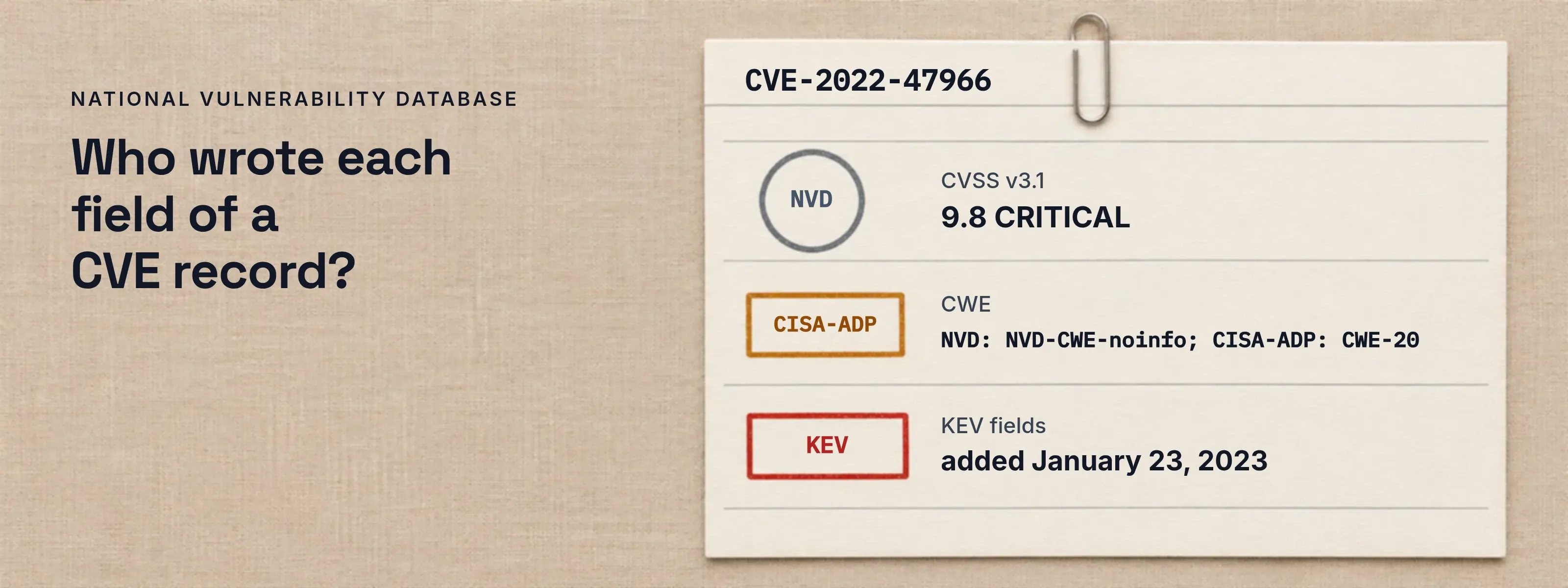
One NVD record, field by field
Each field has an author: the CNA that published the CVE, an NVD analyst, or CISA’s Authorized Data Publisher (CISA-ADP).
- ID and status
CVE-2022-47966, Analyzed- NVD has finished enrichment. The website labels this status Enriched; the API value stays Analyzed.
- Source and dates
cve@mitre.org; published January 18, 2023; last modified July 31, 2026- The source is the CNA that published the CVE. Last modified changes on any edit by any party.
- Description
- “Exploitation is only possible if SAML SSO has ever been configured for a product”
- Written by the CNA. It names Apache Santuario xmlsec 1.4.1 and 24 ManageEngine on-premise products with fixed builds. The precondition is here, not in the score.
- CVSS v3.1
- 9.8 CRITICAL,
AV:N/AC:L/PR:N/UI:N/S:U/C:H/I:H/A:H; NVD Primary, CISA-ADP Secondary - Primary is NVD’s own score; Secondary is another source’s. Here both say 9.8. The CVSS v3.1 vector, decoded metric by metric, reads the same way on any record.
- SSVC
- exploitation: active; automatable: yes; technicalImpact: total
- Added by CISA-ADP, role “CISA Coordinator”, SSVC 2.0.3. These are decision inputs, not a number.
- CWE
- NVD:
NVD-CWE-noinfo; CISA-ADP:CWE-20 - Two sources, two answers. NVD-CWE-noinfo means the analyst had too little information to pick a weakness; CWE-20 is Improper Input Validation.
- CPE configurations
- 14 configurations, 156 match criteria, 22 products; for example
cpe:2.3:a:zohocorp:manageengine_adselfservice_plus:*with versionEndExcluding6.2 - Written by NVD analysts. Scanners match installed software against these strings. ADSelfService Plus builds 6200 to 6210 are listed one by one, because the fix is build 6211.
| Field | Value | What it tells you |
|---|---|---|
References |
21 links, tagged Patch, Vendor Advisory, Exploit, US Government Resource and others |
NVD adds the tags. Filter on Patch or Vendor Advisory to reach the fix. |
KEV fields |
added January 23, 2023; due February 13, 2023; “Apply updates per vendor instructions.” |
Copied from CISA’s catalog, which also marks ransomware use as Known. The KEV fields and federal deadlines have their own page. |
affected (CNA) |
vendor n/a, product n/a, version n/a, status affected |
The CNA’s product data is empty; NVD’s CPE list is full. On an unenriched record, this block and the description are all you get. |
The same record from the API in one GET
The CVE API 2.0 returns every field above as JSON. No key is needed for a single lookup.
curl -s "https://services.nvd.nist.gov/rest/json/cves/2.0?cveId=CVE-2022-47966"{ "totalResults": 1, "timestamp": "2026-11-18T14:14:09.278", "vulnerabilities": [{ "cve": { "id": "CVE-2022-47966", "sourceIdentifier": "cve@mitre.org", "published": "2023-01-18T18:15:10.570", "lastModified": "2026-07-31T04:16:41.843", "vulnStatus": "Analyzed", "metrics": { "cvssMetricV31": [{ "source": "nvd@nist.gov", "type": "Primary", "cvssData": { "vectorString": "CVSS:3.1/AV:N/AC:L/PR:N/UI:N/S:U/C:H/I:H/A:H", "baseScore": 9.8, "baseSeverity": "CRITICAL" } }] }, "cisaExploitAdd": "2023-01-23", "cisaActionDue": "2023-02-13", "cisaRequiredAction": "Apply updates per vendor instructions.", "weaknesses": [ { "source": "nvd@nist.gov", "type": "Primary", "description": [{ "lang": "en", "value": "NVD-CWE-noinfo" }] }, { "source": "134c704f-9b21-4f2e-91b3-4a467353bcc0", "type": "Secondary", "description": [{ "lang": "en", "value": "CWE-20" }] } ], "configurations": [{ "nodes": [{ "operator": "OR", "negate": false, "cpeMatch": [{ "vulnerable": true, "criteria": "cpe:2.3:a:zohocorp:manageengine_adselfservice_plus:*:*:*:*:*:*:*:*", "versionEndExcluding": "6.2" }] }] }] } }]}- Status.
vulnStatus: Analyzed, Modified, Deferred and the other API values. - Who scored.
metrics.cvssMetricV31[].sourceand.type. The NVD Source API resolves the UUID134c704f-...to CISA-ADP. - Products.
configurations[].nodes[].cpeMatch[], ranges inversionStartIncludingandversionEndExcluding. - Exploited.
cisaExploitAddappears only on KEV entries;kevStartDateandkevEndDatefilter by it.
Without a key the limit is 5 requests in a rolling 30-second window; with an API key it is 50. NVD asks clients to pause six seconds between requests and to sync no more than once every two hours, using lastModStartDate and lastModEndDate. OWASP Dependency-Check, a build tool that reads this API, runs exactly that sync.
The CNA and NIST can score the same flaw differently
One record can carry two CVSS scores. Three SAML flaws, read from NVD on November 18, 2026:
| CVE | What broke | Other source’s score | NVD Primary |
|---|---|---|---|
CVE-2024-45409 |
ruby-saml did not properly verify the SAML Response signature; fixed in 1.17.0 and 1.12.3 |
GitHub (CNA): 10.0, CVSS v3.1, S:C/C:H/I:H/A:N |
9.8, CVSS v3.1, S:U/C:H/I:H/A:H |
CVE-2025-25291 |
ruby-saml parser differential between REXML and Nokogiri allows signature wrapping; fixed in 1.12.4 and 1.18.0 |
GitHub (CNA): 9.3, CVSS v4.0 |
9.8, CVSS v3.1 |
CVE-2022-47966 |
ManageEngine products shipped xmlsec 1.4.1 |
CISA-ADP: 9.8, CVSS v3.1 |
9.8, same vector |
On CVE-2024-45409, GitHub scored a changed scope and no availability impact; NVD scored the opposite. A dashboard showing one number hides that. The CVSS v4.0 vector on CVE-2025-25291 adds metrics v3.1 lacks:
- AT:N Attack Requirements: none. No deployment condition has to hold for the attack to work.
- VC:H, VI:H, VA:N Vulnerable System: confidentiality and integrity high, availability none. This is the Ruby application that accepts the response.
- SC:N, SI:N, SA:N Systems beyond the vulnerable one: no impact scored. CVSS v4.0 drops the Scope metric and uses these two groups instead.
Since April 15, 2026, NVD no longer routinely adds its own score when the CNA has provided one. Newer records can carry the CNA’s score only; an NVD score is available on request by email.
Since April 2026, KEV and federal software come first
NVD still lists every CVE, but enriches in priority order. From the NVD news page and NIST’s announcement:
- 2024A backlog of unenriched CVEs begins in the spring. CVE submissions rise 32% over the year, NVD reports on March 19, 2025.
- April 2, 2025CVEs published before 2018 that await further enrichment are marked Deferred.
- 2025NVD enriches nearly 42,000 CVEs, 45% more than in any prior year. Submissions rose 263% from 2020 to 2025.
- April 15, 2026KEV CVEs come first, with a goal of one business day. Then software used in the federal government and EO 14028 critical software. All others are “Lowest Priority - not scheduled for immediate enrichment”. Backlogged CVEs with an NVD publish date before March 1, 2026 move to Not Scheduled. KEV CVEs were never in the backlog.
- April 28, 2026NVD announces a fix for about 4,500 records with an incorrect numerical CVSS v4.0 score.
- June 17, 2026SSVC data from CISA-ADP and the CNA’s “affected” data arrive in the API and the feeds.
- August 26, 2026The CVE detail page shows the affected list and SSVC; the
/cvehistoryfeed links to GitHub instead of carrying the affected JSON.
An unenriched record has no NVD CPE list, so tools that match on CPE cannot tie it to your software. For those records, read the CNA’s affected data and the vendor advisory yourself.
Questions people ask
What does NVD stand for and what is its purpose?
NVD stands for National Vulnerability Database, the US government repository that NIST maintains. It lists every CVE published by the CVE Program and adds analysis to published CVEs, KEV CVEs first: CVSS severity scores, CWE weakness types and CPE product lists. Scanners and build tools use those fields to match vulnerabilities to installed software and rank them.
What is CVE vs CVSS?
A CVE is an identifier for one publicly disclosed vulnerability; CVSS is a scoring system that rates its severity from 0.0 to 10.0. FIRST maintains CVSS. A score comes with a vector that shows how it was reached, and one CVE can carry several scores: one from the CNA, one from NVD and one from CISA-ADP.
Is the NVD API free?
Yes. NIST offers the NVD API as a public service, and calls work without a key. The key request form asks only for an organization name, an email address and an organization type. A key raises the limit from 5 to 50 requests in a rolling 30-second window. It is passed in the apiKey request header.
What is the official CVE database?
The official source is the CVE List, published by the CVE Program at cve.org and sponsored by CISA. CVE Numbering Authorities (CNAs) assign the IDs and publish the records there. NVD is downstream: it copies each published record and adds scores, weakness types and product lists. Reserved CVE IDs do not appear in NVD.
Sources, read 2026-11-18
Next, the vulnerability management process puts these records into a patch queue; the Learn hub lists the other identity and security explainers.
- NVD CVE API 2.0 records: CVE-2022-47966 (last modified July 31, 2026), CVE-2024-45409 (November 4, 2026), CVE-2025-25291 (June 17, 2026); record count from
?noRejected; CISA-ADP from the NVD Source API - NVD: Start Here (rate limits and best practices), Request an API key, Vulnerability status, News
- NIST, NIST Updates NVD Operations to Address Record CVE Growth (April 15, 2026, updated April 17, 2026)
- CISA KEV JSON feed (catalog version 2026.11.17), CVE Program overview, FIRST CVSS v4.0 specification
Updated