Google Threat Intelligence Group counts a flaw as a zero-day when attackers exploited it in the wild before a patch was publicly available. NIST’s glossary describes a zero-day attack as one that exploits a hardware, firmware or software vulnerability nobody had found before. The name counts the days defenders have had a fix: none.
Headlines mix up three terms.
- Vulnerability. The flaw itself, such as a session ID stored without validation.
- Exploit. The code or crafted request that uses the flaw, for example to run a command as root.
- Attack. One use of the exploit against a real target, on a recorded date.
CVE-2024-3400, counted in days
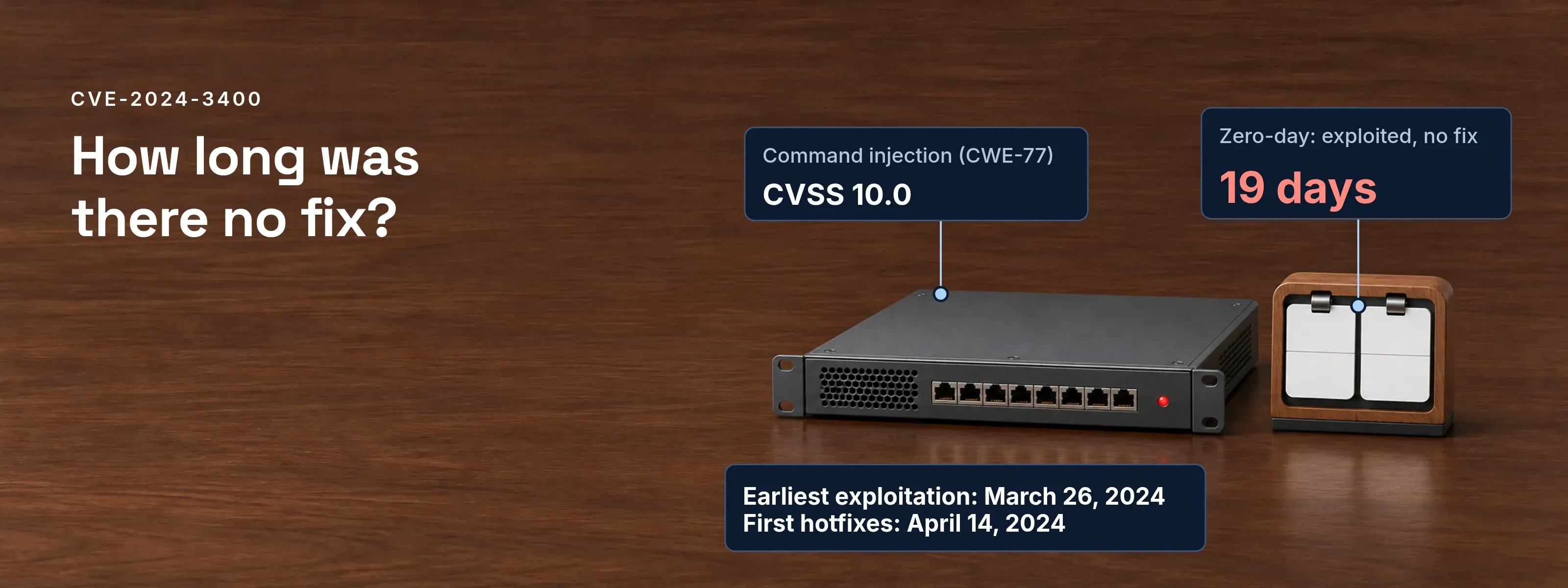
Attackers used this flaw for 17 days before the advisory and 19 days before the first fix.
CVE-2024-3400 is a command injection flaw (CWE-77) in GlobalProtect, the VPN feature of Palo Alto Networks PAN-OS firewalls. It lets an unauthenticated attacker run code as root, CVSS 10.0. Day 0 is the advisory, April 12, 2024, at 06:55 UTC.
CVE-2024-3400, Day −17 to Day +7 (2024)
- Day 0 Advisory, April 12
- Day +2 First hotfix, April 14
| Day | Date | What happened | Source | What a defender could do that day |
|---|---|---|---|---|
| -17 | March 26, 2024 | Earliest exploitation Volexity found: zero-byte files placed on firewalls to test the exploit | Volexity | Keep gateway logs; they later show this test |
| -2 | April 10, 2024 | Volexity detects exploitation at a customer and tells Palo Alto Networks’ PSIRT | Volexity, Palo Alto PSIRT | Watch traffic that starts at the firewall itself |
| -1 | April 11, 2024 | Threat Prevention signature, Threat ID 95187, released | Palo Alto PSIRT | Subscribers get a block before the CVE is public |
| 0 | April 12, 2024 | Advisory with two interim mitigations: the signature, or turning off device telemetry. It reports “a limited number of attacks”. CISA adds the CVE to KEV, due April 19, 2024 | Palo Alto advisory, CISA KEV | Apply a mitigation and start hunting; no fix exists |
| +2 | April 14, 2024 | First hotfixes: PAN-OS 10.2.9-h1, 11.0.4-h1 and 11.1.2-h3; the rest follow by April 18, 2024 | Palo Alto advisory | Upgrade where your release has a hotfix |
| +4 | April 16, 2024 | Advisory revised: turning off telemetry “is no longer an effective mitigation”, and third parties have published proofs of concept | Palo Alto advisory | Re-check gateways that relied on the telemetry setting |
| +7 | April 19, 2024 | KEV due date for federal agencies. The advisory now reports “an increasing number of attacks” | CISA KEV, Palo Alto advisory | Finish the patch and the hunt |
The firewall was only the entry point. Volexity saw the attacker copy firewall configurations and move inside. In one case, a Domain Admins service account used by the firewall carried it to Windows hosts over SMB and WinRM. It took ntds.dit, DPAPI keys and browser Login Data and Cookies files: enough, Volexity found, to compromise the credentials of every domain account.
Zero-day, then n-day: the label follows the patch
The same flaw becomes an n-day once a fix ships for it.
Zero-day: no fix exists. Attackers know the flaw; the vendor may not. Defenders mitigate and hunt. CVE-2024-3400 was a zero-day from March 26, 2024, to the first hotfix on April 14, 2024.
N-day: a fix exists, and some systems still lack it. Google’s 2024 report defines it as “a vulnerability exploited after its patch has been released”. Exploit code is often public by then. Defenders patch before a deadline.
Here the switch came release by release: a site on 10.2.9 could patch on Day +2, one on 10.2.0 on Day +6. The CISA KEV catalog lists exploited CVEs of both kinds.
Before the patch: what defenders do
Reduce exposure, hunt, assume credentials were taken, then patch and check again.
- Apply the vendor’s interim mitigation. Here, the Threat Prevention signature on the GlobalProtect interface. Limit who can reach the gateway until the fix ships.
- Hunt with the vendor’s indicators. On April 17, 2024, the advisory added a CLI command that finds exploit attempts. Unit 42 grades findings from Level 0, a failed probe, to Level 3, interactive access.
- Treat the device’s secrets as exposed. Level 2 means a file, typically
running_config.xml, was copied where the web can reach it. Rotate every password, key and certificate it holds, including service account passwords. - End sessions and tokens that may have been copied. A stolen cookie replays a sign-in without password or MFA. Revoke the affected users’ sessions and reissue tokens.
- Patch, then read the advisory again. One mitigation here failed on Day +4. Palo Alto Networks recommends an enhanced factory reset where fixes or signatures were not applied by April 25, 2024. After that, vulnerability management takes over: fix, then verify.
Limit what a compromised edge device can reach
These SSOGEN controls limit what an attacker on the edge reaches, and how long stolen access lasts.
- SSOGEN makes the sign-in decision. The SSOGEN Gateway asks SSOGEN before it forwards a request, and refuses when it gets no decision: what the SSOGEN Gateway does.
- A DMZ gateway runs the App Proxy only. With
networkZoneset todmz, the directory connection stays on an internal gateway. - Private networks open no inbound port. An Outbound Connector dials out and listens on no port; a gateway can sit behind a relay it dials out to. See gateway ports and firewall.
- Revoking a session signs that browser out immediately. Each user’s Sessions tab lists active sign-ins with a Revoke button.
How many zero-days Google counted in 2025
Google’s newest yearly review counted 90 zero-days exploited in the wild in 2025.
- Zero-days exploited, 2025
- 90
- Aimed at enterprise technology
- 43, or 48%
- In security and networking products
- 21
The report puts 2023 at 100 and 2024 at 78. Fourteen 2025 zero-days hit edge devices, where GTIG notes that missing EDR can leave defenders blind.
Exploit terms, answered
What is an exploit in cyber security?
An exploit is the code, file or sequence of requests that turns a vulnerability into an effect the attacker wants. In CVE-2024-3400 the flaw was a session ID that GlobalProtect stored without validation, and the exploit was a request that made the firewall run the attacker’s command as root.
Is every zero-day a remote code execution?
No. A zero-day is defined by timing, not by effect. CVE-2024-3400 gave remote code execution as root, but zero-days also include privilege escalation and authentication bypass flaws. Google’s 2025 review names authentication and authorization bypass as common on edge devices. The causes and best-known cases of remote code execution have their own explainer.
When does a zero-day stop being a zero-day?
When the vendor publishes a fix for the affected version. Google counts a flaw exploited before its fix as a zero-day of the year it was disclosed, and it stays in that count after the patch ships. Attacks after the fix, on systems nobody updated, are n-day exploitation. The day table above shows where that line fell.
The records behind the day count
Sources, all read 2026-11-18:
- Palo Alto Networks security advisory CVE-2024-3400, its revision history and CVE record; earlier wording from Internet Archive copies of April 13, 2024, 00:50 UTC and April 16, 2024, 08:23 UTC
- Palo Alto Networks PSIRT, “More on the PAN-OS CVE-2024-3400”, April 19, 2024
- Unit 42 threat brief, Operation MidnightEclipse, with its update log
- Volexity, zero-day exploitation of CVE-2024-3400, April 12, 2024
- NVD, CVE-2024-3400 and the CISA KEV JSON feed, catalogVersion 2026.11.17
- NIST CSRC glossary, zero-day attack
- Google Threat Intelligence Group, 2025 Zero-Days in Review, March 5, 2026, and A 2024 Zero-Day Exploitation Analysis, April 29, 2025
Updated