SSOGEN / Learn / Lateral Movement in Cybersecurity: One Intrusion, Hop by Hop
Learn
Lateral Movement in Cybersecurity: One Intrusion, Hop by Hop
After the first foothold, an attacker signs in to the next machine with valid credentials or a remote service and repeats until a domain controller or cloud tenant is in reach: that is lateral movement, MITRE ATT&CK tactic TA0008.
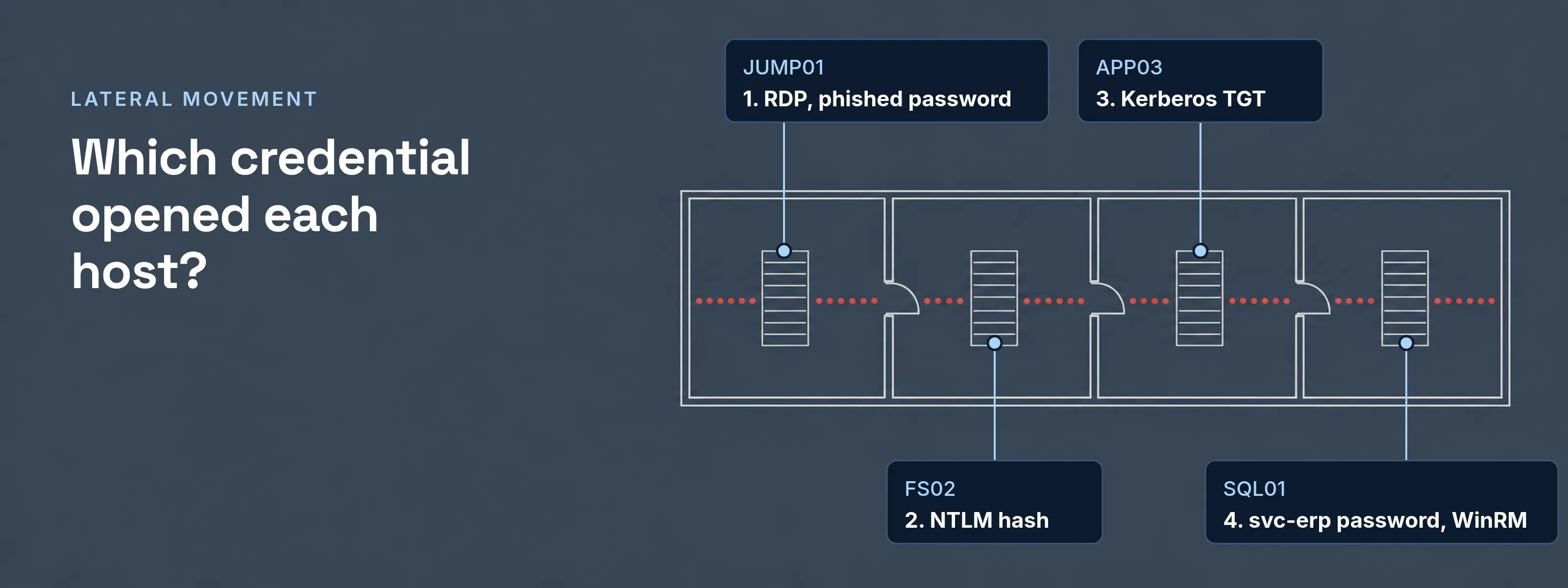
None of the five hops below uses malware. Each one is a successful sign-in with a credential the attacker took on the previous host, so the evidence sits in authentication logs, not in antivirus alerts.
Five reused credentials from the VPN to the cloud tenant
Acme Corp is fictional, and its internal hosts use the documentation range 192.0.2.0/24. On a Monday morning, an HR employee, d.foster, types her password into a fake sign-in page.
Fictional intrusion, five hops
Hops 1 to 3: inside the Active Directory domain
Hops 4 and 5: the database, then the cloud
Each hop leaves a record on the host it reaches, and often a second one on the domain controller.
| Hop | From, to | Credential used | ATT&CK technique | Log line that shows it |
|---|---|---|---|---|
| 0 | Phishing page, Acme VPN | d.foster’s password, typed into the fake page | T1566 Phishing (Initial Access, not TA0008) | Identity provider sign-in for d.foster from 198.51.100.23, an address she never used |
| 1 | VPN address 192.0.2.77, JUMP01 | The same password over Remote Desktop | T1021.001 Remote Desktop Protocol | Event 4624 on JUMP01: Logon Type 10, Source Network Address 192.0.2.77 |
| 2 | JUMP01, FS02 | The NTLM hash of adm-tchen, a file server administrator who signed in to JUMP01 earlier | T1550.002 Pass the Hash | 4624 on FS02: Logon Type 3, Authentication Package NTLM; 4776 on the domain controller |
| 3 | FS02, APP03 | The Kerberos ticket-granting ticket (TGT) of j.reyes, an ERP administrator with a session on FS02 | T1550.003 Pass the Ticket | 4769 on the domain controller: Service Name APP03$, Client Address 192.0.2.20 (FS02); 4624 on APP03: Logon Type 3, Kerberos |
| 4 | APP03, SQL01 | The password of the service account svc-erp, read from a configuration file | T1021.006 Windows Remote Management | 4648 on APP03: Target Server Name SQL01; 4624 Logon Type 3 and 4672 for svc-erp on SQL01 |
| 5 | SQL01, Acme cloud tenant | An OAuth refresh token cached on SQL01 by a directory sync tool that runs as a public client, so the log shows the replaying address | T1550.001 Application Access Token | Entra non-interactive sign-in log entry from 203.0.113.50; ID Protection risk detection anomalousToken |
MITRE describes pass the hash as authenticating without the cleartext password, by moving straight to the part of the protocol that uses the hash. That is why hop 2 needed nothing more than a value copied from memory.
What ties the hops together in the logs
Every event in the table looks routine on its own. The intrusion shows when you join events across hosts, per account.
- An account on a host it never used. Join 4624 Source Network Address and 4769 Client Address by account. d.foster on JUMP01 and j.reyes asking for tickets from FS02 are both first-time pairs.
- NTLM where Kerberos is normal. In a domain that runs on Kerberos, a 4624 with Authentication Package NTLM for an administrator, matched by a 4776 on the domain controller, marks hop 2.
- Explicit credentials toward new servers. Hop 4 wrote one 4648 naming SQL01. A rapid run of 4648 events from one process toward many servers is the wider form of the same step.
The cloud log has one limit to know. For non-interactive sign-ins by confidential clients, Microsoft logs the IP address used when the token was first issued, not the source of the refresh request. A replayed token from such a client can carry an old, familiar address. Field-level signals for this case and four other identity attacks are in identity threat detection and response (ITDR).
Where identity controls cut the path
Hop 1 worked because the VPN placed the attacker on the whole network. Per-server access gives a stolen login one server instead.
Network-wide VPN. Once the VPN session for d.foster was up, every host listening on TCP 3389 was in reach. JUMP01 was simply the first one that accepted her password.
SSOGEN Remote Access. People open SSH, RDP or VNC in the browser through the SSOGEN Gateway, one server per resource. The Gateway connects only to the destination in the signed configuration, never one the browser names. A resource can require approval, and the session ends when the approved window ends.
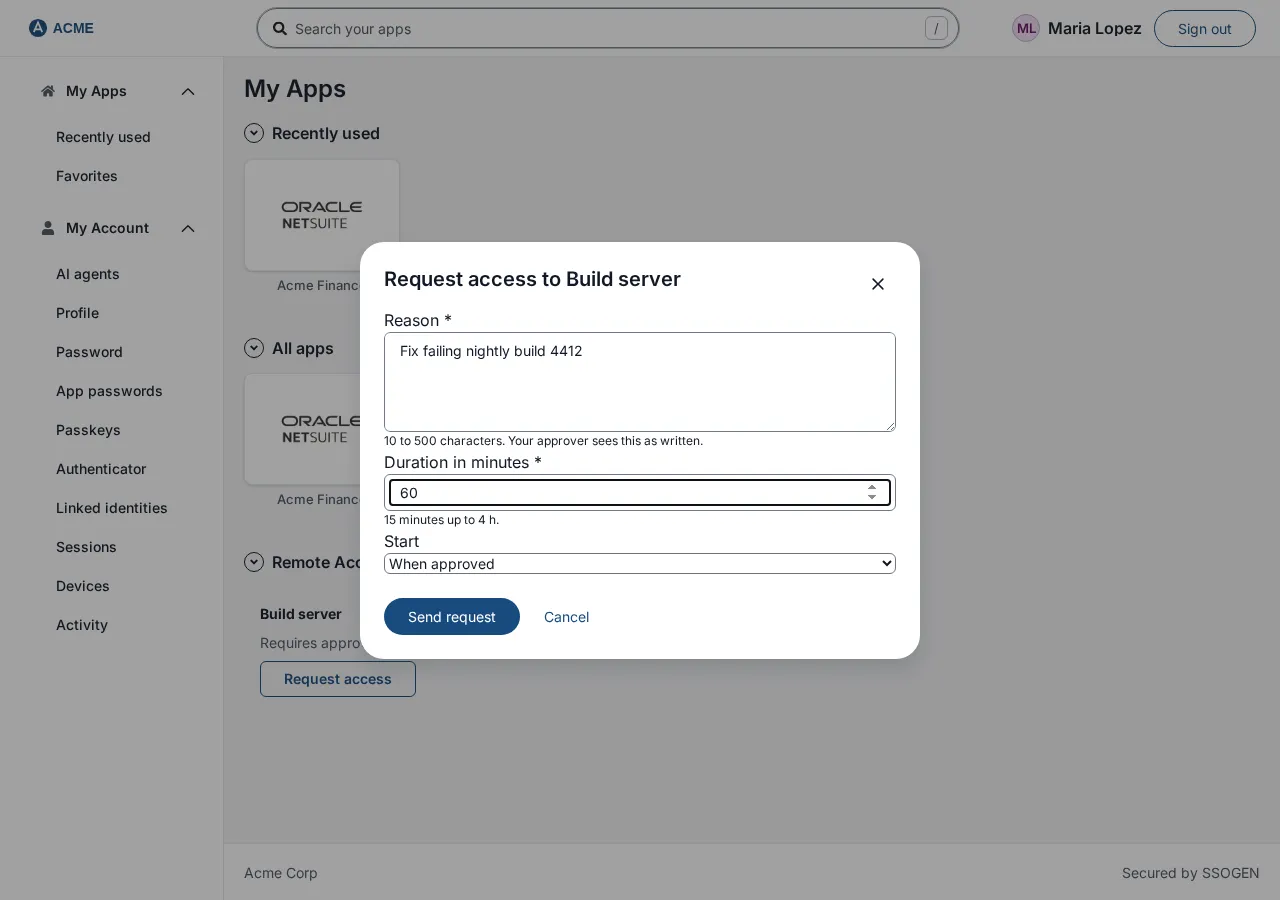
The setup for each resource, its approvers and its live sessions is in Remote Access sessions for SSH, RDP and VNC. The other hops meet different controls.
- Hop 0, the phishing page. A policy that requires the sign-in strength Passkey or security key accepts only those two, and neither can be phished. A password typed into a fake page does not complete the sign-in.
- Hops 2 and 3, hash and ticket reuse. These are Microsoft controls. Credential Guard protects NTLM password hashes and Kerberos TGTs in an isolated LSA process. Members of the Protected Users group cannot authenticate with NTLM, and their TGTs are not renewed beyond the first four hours.
- Hop 4, a password someone could read. A Remote Access stored account is write-only: nobody can read it back, and it goes only to the Gateway of one session. People reach the server and type nothing.
- Hop 5, a replayed token. Sender-constrained tokens fail without their key; every token SSOGEN issues to an AI agent on an MCP route is DPoP-bound by default.
Where it sits in ATT&CK and the kill chain
Both models treat lateral movement as a step after the attacker is already inside.
- MITRE ATT&CK, TA0008. In the Enterprise matrix of the MITRE ATT&CK framework, Lateral Movement sits between Discovery (TA0007) and Collection (TA0009). MITRE lists nine techniques under it. Hops 1 to 5 use sub-techniques of two: Remote Services (T1021) and Use Alternate Authentication Material (T1550).
- Lockheed Martin kill chain. The seven phases of the cyber kill chain have no separate lateral movement step. The Lockheed Martin paper places it in phase 7, Actions on Objectives, where intruders may use the first compromised machine “as a hop point to compromise additional systems and move laterally inside the network.”
Questions people ask
What is lateral movement?
Lateral movement is the set of techniques an attacker uses, after the first foothold, to reach other systems on the same network. Most of it is sign-ins with stolen but valid credentials over remote services such as RDP, SMB or WinRM. The goal is a high-value system, for example a domain controller, a database or a cloud tenant.
How does it differ from privilege escalation?
Lateral movement goes sideways to another system; privilege escalation goes upward to more rights. Real intrusions mix the two. In the example above, hop 2 reached FS02 and also gained a server administrator’s rights, because the reused hash belonged to that administrator. ATT&CK lists them as separate tactics: TA0008 Lateral Movement and TA0004 Privilege Escalation.
Can MFA stop lateral movement?
MFA stops the hops that pass through an MFA prompt, and only those. In the example, a passkey or security key at the identity provider stops hop 0, because neither can be phished. Hops 2 and 3 reuse an NTLM hash and a Kerberos ticket inside Active Directory, where no MFA prompt appears. Those hops need controls on the Windows side.
What is a real example?
A common example is a phished password used over Remote Desktop to reach a jump server, followed by a reused administrator hash to reach a file server. Each step is a valid sign-in, so there is no malware for antivirus to flag. The five-hop table above walks one full example, with the Windows event or Entra log entry for each step.
Sources, all read 2026-11-18: MITRE ATT&CK TA0008, T1021.001, T1021.006, T1550.001, T1550.002, T1550.003 and T1566; Microsoft Learn event pages 4624, 4648, 4672, 4769 and 4776; Entra non-interactive sign-in logs; Credential Guard overview; Protected Users security group; Hutchins, Cloppert and Amin, Intelligence-Driven Computer Network Defense (Lockheed Martin).
Updated