SSOGEN / Learn / What Is ITDR? Identity Threat Detection and Response, Attack by Attack
Learn
What Is ITDR? Identity Threat Detection and Response, Attack by Attack
Attacks that sign in with valid credentials leave their trace in identity provider and directory logs; identity threat detection and response (ITDR) reads those logs and ends the access by revoking sessions, refresh tokens and accounts.
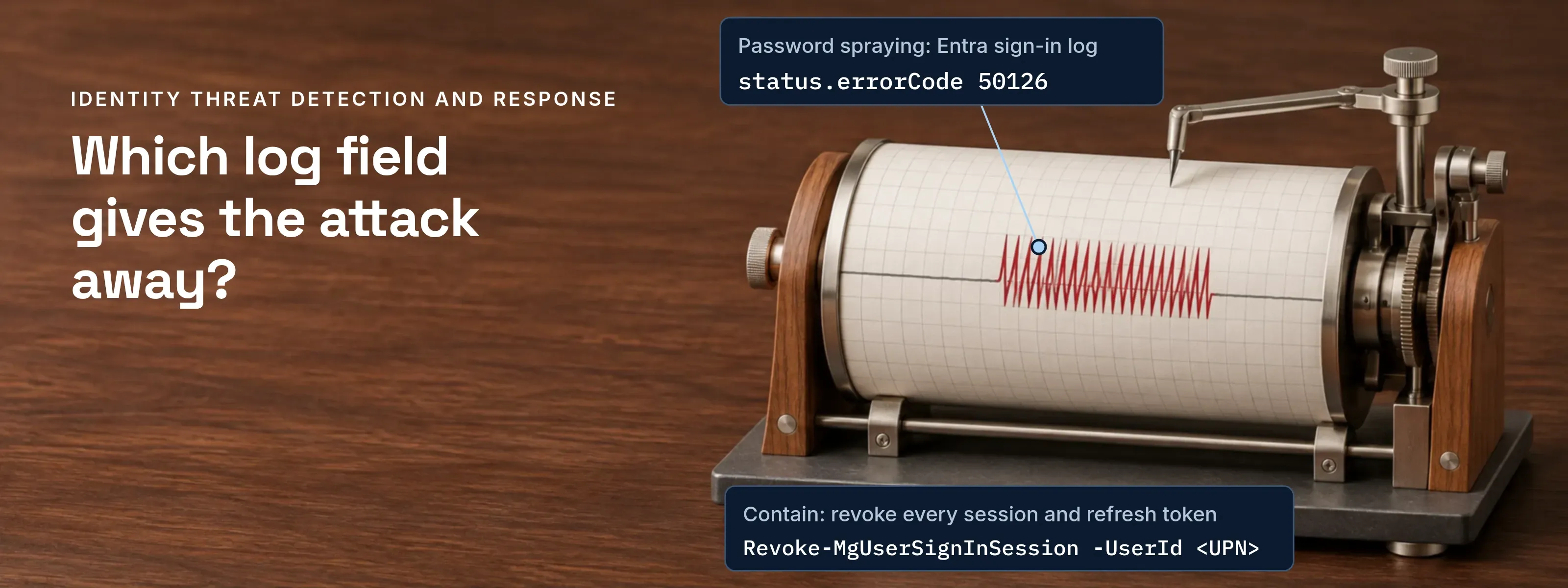
A sprayed password or a stolen refresh token produces a sign-in that succeeds. Endpoint tools see an ordinary browser. The evidence sits in identity logs: the Microsoft Entra sign-in log, the directory audit log and the Security log on each domain controller.
Five attacks and the field that gives each away
Field names and values are Microsoft’s, read at Microsoft Learn on November 18, 2026. Each row is one query you can run.
| Attack | Log source | Field and value to watch | Pattern over time | First response |
|---|---|---|---|---|
| Password spraying | Entra sign-in log; Windows Security log | status.errorCode 50126 (InvalidUserNameOrPassword) on many userPrincipalName values from one ipAddress; event 4625 with Sub Status 0xC000006A |
One or two failures per account, many accounts, one source | Block the source; reset every account that succeeded after the run |
| MFA fatigue | Entra sign-in log; Entra ID Protection | status.errorCode 500121 (“User didn’t complete the MFA prompt”) repeated for one user; risk detection userReportedSuspiciousActivity |
Prompt after prompt for one account within minutes | Revoke sessions and reset the password, which the attacker already holds |
| Token theft | Entra ID Protection; riskEventTypes_v2 on the sign-in |
anomalousToken (unusual token lifetime, or a token played from an unfamiliar location); attackerinTheMiddle (session linked to a malicious reverse proxy) |
Access continues from a new location with no new password or MFA step | Revoke refresh tokens and sessions, then find the device that leaked them |
| Kerberoasting | Windows Security event 4769 on domain controllers | Ticket Encryption Type 0x17 (RC4-HMAC) where Service Name is a user account: no trailing $, not krbtgt |
One account requests tickets for many services in minutes | Disable the requesting account; rotate the service accounts’ passwords |
| Consent phishing | Entra audit log | Activity “Consent to application” with ConsentContext.IsAdminConsent = false; “Add delegated permission grant” where DelegatedPermissionGrant.Scope holds high-privilege permissions |
A new app with a generic or misspelled name, granted wide scopes by one user | Revoke the grant; disable the app’s service principal |
Count the 50126 failures yourself. Entra ID Protection raises passwordSpray only after the attacker validates a password, and Microsoft states that unsuccessful spray attempts generate no detection. The run of failures is your early signal.
Where ITDR sits next to EDR, SIEM and posture
ITDR reads identity logs during an attack. Posture management fixes identity settings before one. An outside team can run these detections for you as a managed detection and response (MDR) service.
- EDR. Watches processes and files on laptops and servers. A sign-in with a sprayed password runs no malware, so EDR has nothing to flag.
- SIEM. Collects logs from every source and runs the rules you write. The table above is the identity part of that rule set, and lateral movement detection joins those events across hosts.
- Posture management. Finds the weak setting before it is used: a stale administrator, a service account that still accepts RC4.
- ITDR. Sees the setting being used: the 4769 request with 0x17 against that service account. Its job ends with a response, not a report.
Response ends the attacker’s sessions
An alert leaves the attacker signed in. Microsoft’s playbook for a compromised account disables the account first and revokes access second.
Detect
A query or a risk detection fires: a 50126 run, a 500121 run, a 0x17 ticket or a new consent grant.
Confirm with the person
Ask the account owner through a channel the attacker cannot reach, such as a call to a known number. A prompt the user reported is already confirmation.
Contain
Disable the account, then revoke every session and refresh token. In Microsoft Graph PowerShell,
Revoke-MgUserSignInSession -UserId <UPN>does both. Reset the password; app passwords survive a reset, so delete them too.Recover
Remove MFA methods the user did not register, revoke app consent grants nobody approved and review the account’s administrative roles. For Kerberoasting, rotate the targeted service-account passwords.
What SSOGEN records at every sign-in
SSOGEN is an identity provider, so each sign-in, refusal and second-factor answer lands first in its audit log. The log is tamper evident (a hash chain) and exports as CSV or JSON.
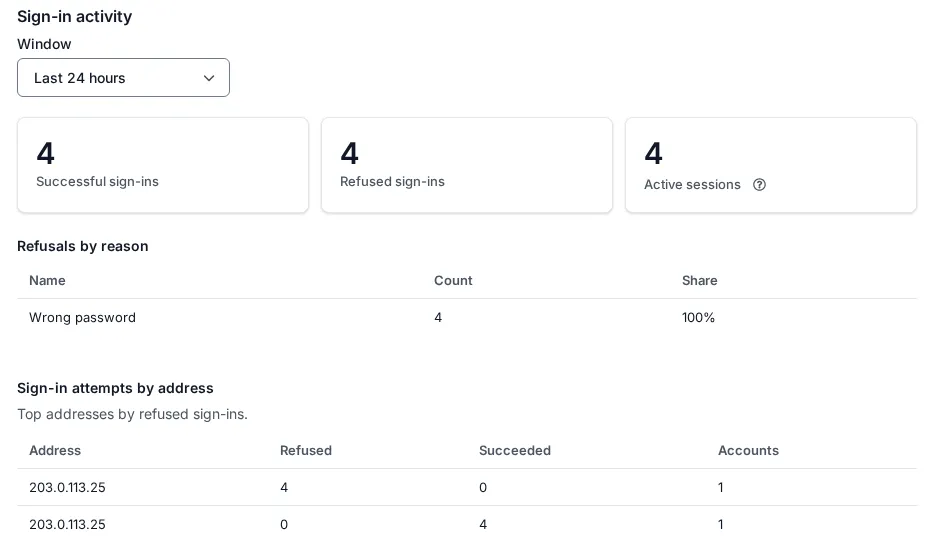
- Failed passwords.
login.failedcarries the username as typed and a reason code, never the password. Filter by result and from address to count accounts per source. - Push answers.
authenticator.push_denied,authenticator.push_number_mismatch,authenticator.push_reportedandauthenticator.push_suspended. Approval is always by number matching, and 3 consecutive denials or wrong numbers pause push for 15 minutes by default. - Risk at sign-in.
authentication.risk_scoredrecords a deterministic score from 0 to 100, built from the person’s browser and network history, your network zones and recent failures. A rule set to Allow and alert lets the sign-in through and marks the decision in the audit log. See sign-in policy rules. - Containment.
platform.session.revokedandoauth.refresh_family.revokedrecord each revoked session and refresh-token family. - Reports. System health flags every “This wasn’t me” answer from the last 24 hours.
- Forwarding. Webhooks send the same events, signed and filtered by event name, to the system that runs your detections. Every name is in the audit event reference.
Questions people ask
Is ITDR the same as identity posture management?
No. Posture management finds weak identity settings before an attack; ITDR watches for an attack in progress and responds to it. Posture flags the administrator account nobody has signed in to for months. ITDR sees that account’s name in a run of 50126 failures from one source, and the one success that follows. Some products bundle both.
What is cybersecurity threat detection?
Threat detection is finding attacker activity in telemetry before it causes damage. Endpoint detection reads processes and files. Network detection reads traffic. Identity detection reads sign-in, audit and Kerberos logs, and ITDR is that identity part: it catches attacks that use valid credentials, which the other two record as normal use.
What is an insider threat in cyber security?
CISA defines an insider threat as the risk that an insider uses authorized access, wittingly or unwittingly, to do harm. The insider can be an employee, contractor or partner. Their sign-ins succeed, so detection looks at what the account does: new consent grants, Kerberos tickets for services the person never uses, access at unusual hours.
Sources, all read 2026-11-18: Entra error codes; Entra sign-in error troubleshooting; Entra ID Protection risk detections; Microsoft Graph signIn resource; Entra security operations for applications; Windows event 4625; Windows event 4769; Respond to a compromised email account; CISA, defining insider threats.
Updated