SSOGEN / Learn / What Is MDR? Managed Detection and Response, and Who Acts on the Alert
Learn
What Is MDR? Managed Detection and Response, and Who Acts on the Alert
You buy people and process, not a tool, when you buy managed detection and response (MDR). A provider's analysts watch your endpoint, identity and cloud telemetry around the clock, investigate each alert and contain the threat within the authority your contract grants. The tools can be theirs or yours.
Two are services, one is a team and two are tools. Read the “When it fires” column first: it shows who acts. Tool-level detail is in EDR vs XDR.
MDR, MSSP, SOC, EDR and XDR side by side
| Model | What it is | Who operates it | Telemetry it watches | When it fires | What you receive |
|---|---|---|---|---|---|
MDR |
A service |
The provider’s analysts, around the clock, on the provider’s stack or yours |
Endpoint first, often plus identity, cloud and network logs |
Investigates, hunts and contains within the authority the contract grants: isolate a host, end sessions, disable an account |
Investigated incidents with the actions taken, and reports |
MSSP |
A service |
The provider, managing and monitoring security devices |
Firewall, IDS, SIEM and device logs |
Raises an alert or a ticket; response usually stays with you |
Alerts, device changes, monthly reports |
SOC (in-house) |
A team and a function |
Your staff, on your tools |
Whatever your tools collect |
Triage, escalation, then your incident response plan |
Tickets, incident records, metrics |
EDR |
A tool |
Whoever runs it: your team, an MSSP or an MDR provider |
Processes, files, registry and connections on each host |
Alerts; can isolate a host or kill a process |
Alerts with a process tree |
XDR |
A tool (a suite) |
As EDR |
Endpoint plus email, identity, cloud and network, correlated |
One correlated incident across sources |
Incidents grouped across sources |
The lines blur in practice. NIST SP 800-61 Rev. 3 (April 2025) describes incident handlers “on contract”, such as a SOC outsourced to an MSSP, and the UK NCSC observes that most SOCs outsource some of their operations, even if only the detection signatures.
From alert to containment in an MDR engagement
The contract decides what the provider may do alone. NIST asks that it define the provider’s “authority to act on behalf of the organization”, including whether it may deactivate services to contain an incident.
- Onboarding: both sides. You connect log sources, create the provider’s accounts and agree a runbook listing the actions it takes without a call.
- Detection: provider. Rules and analytics on the provider’s systems run against your telemetry, day and night.
- Investigation: provider. An analyst confirms or dismisses the alert, scopes the affected hosts and accounts, and hunts for related activity.
- Escalation: provider, then you. For anything outside the runbook, the analyst calls your named contact. The contract sets the response time for each severity.
- Containment or hand back: either. Inside its authority, the provider isolates the host or ends the sessions. Otherwise it hands you the findings and your incident response plan takes over.
What an MDR provider needs from your identity provider
An event feed, read access and containment on request. None of the three gives the provider an account that can change your sign-in configuration.
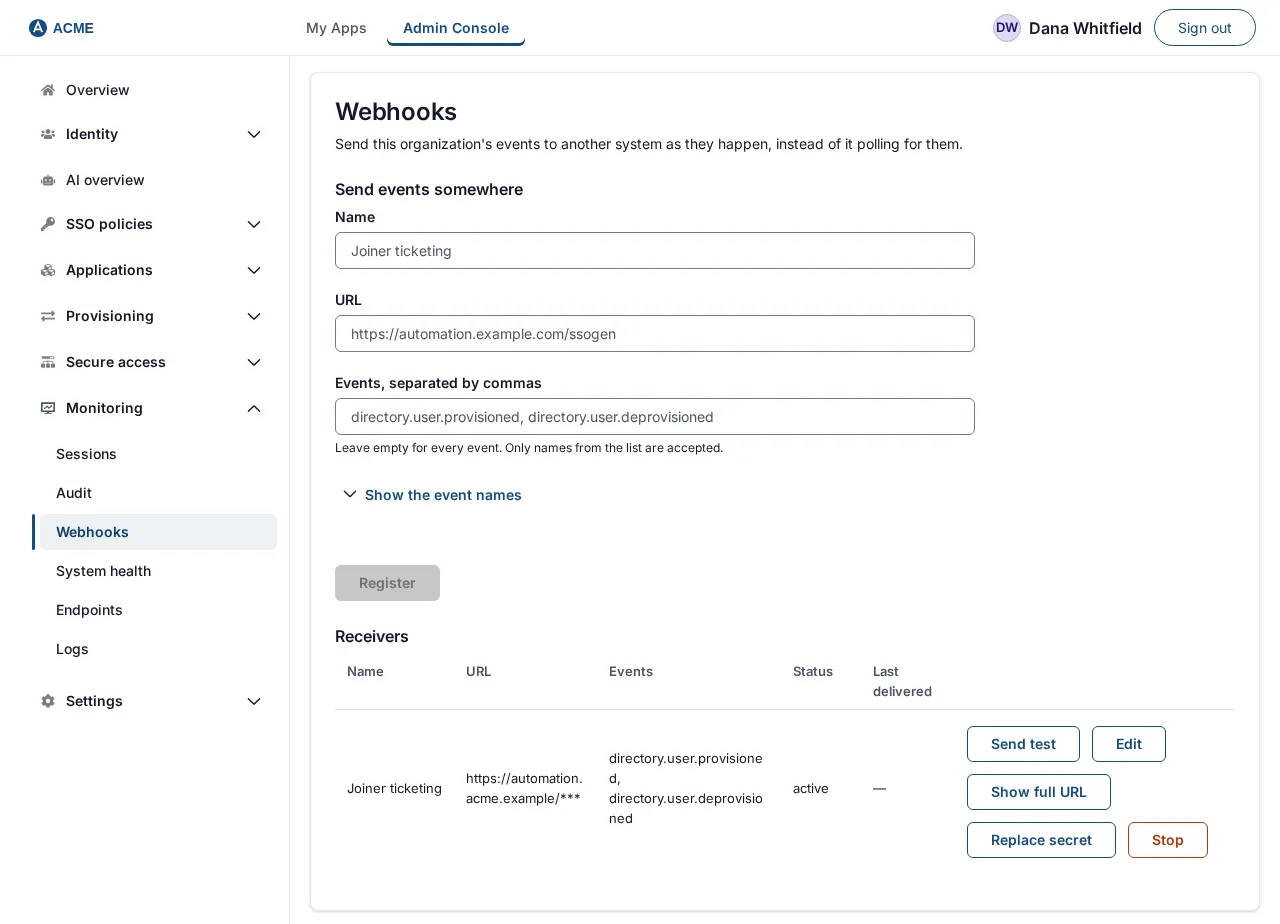
- Feed. SSOGEN webhooks send the same events as the audit log, as HTTPS POSTs signed with HMAC SHA-256 in the
X-SSOGEN-Signatureheader. Pick up to 64 event names, or every event. Batches of up to 50 leave about every 30 seconds, delivered at least once, each event with anevent_id. - Read. The Security audit reader role reads the audit trail and changes nothing. A webhook never carries more than that audit page shows.
- Contain. When the provider asks, your administrator revokes the person’s sessions on the Sessions tab, which ends that browser session on the spot, and revokes application sign-ins per application. Each session revocation is recorded as
platform.session.revoked. - AI agents. Suspend stops new tokens for one agent at once, and a kill switch suspends every agent of one type. Tokens already issued stop working within 5 minutes at most.
The attack signals worth forwarding, field by field, are in what ITDR is.
What buyers ask about MDR
What does MDR mean?
In cybersecurity, MDR means managed detection and response: a service that monitors, investigates and contains threats for you. Other fields share the letters. In healthcare, MDR is the EU Medical Device Regulation, Regulation (EU) 2017/745. In disease, MDR-TB is tuberculosis that resists rifampicin and isoniazid. In payments, MDR is the merchant discount rate charged on each transaction.
Are MDR and EDR the same?
No. EDR is a tool; MDR is a service, often built on an EDR tool. EDR records processes, files and connections on each host and raises alerts. Somebody still has to read an alert at 03:00 and decide whether to isolate the host. With MDR, that person is the provider’s analyst, working within the authority your contract grants.
Does an MDR provider need admin rights to the identity provider?
No. It needs your identity events and a read-only view of them; containment stays with your administrators. In SSOGEN, a signed webhook delivers the events and the Security audit reader role shows the audit trail without changing anything. NIST SP 800-61 Rev. 3 warns that service providers often hold privileged access, so keep that access narrow.
Before you sign an MDR contract
Five terms decide whether the provider acts or only reports.
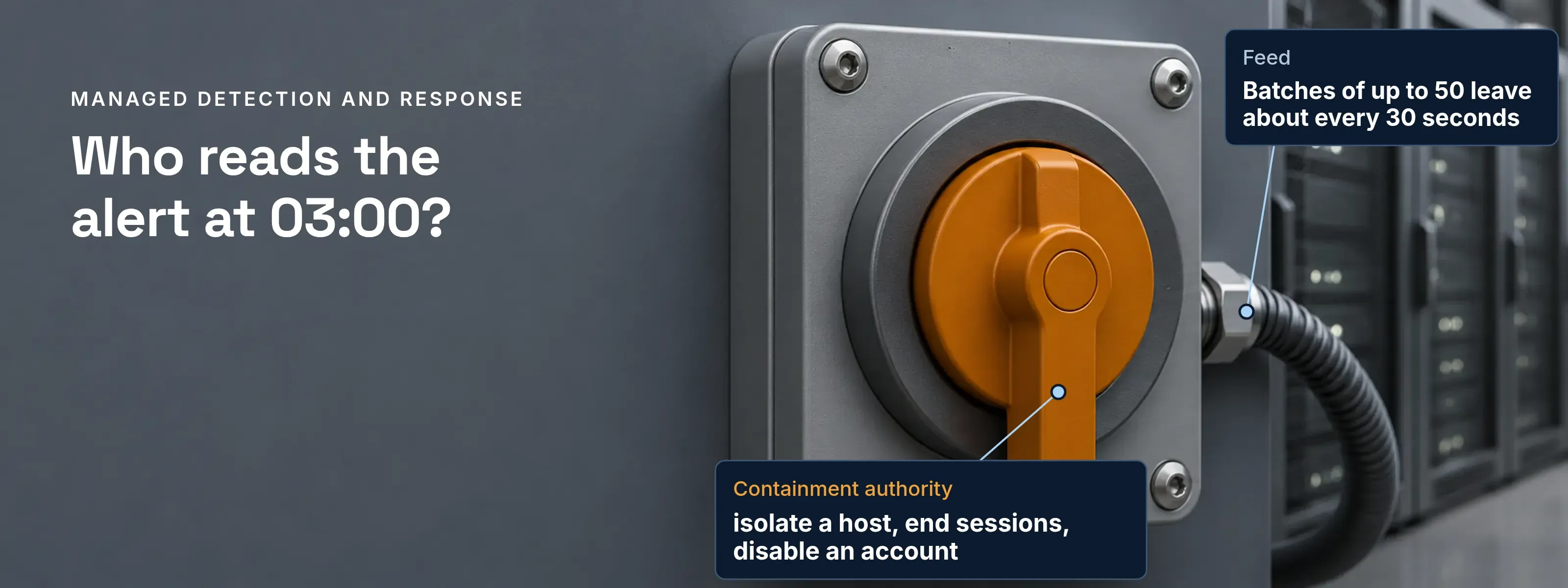
- Containment authority. The actions the provider takes without a call: isolate a host, end sessions, disable an account.
- Log sources in scope. Endpoint only, or identity, cloud and email as well. A sign-in with a stolen password leaves nothing on the endpoint.
- Response time per severity. One figure for each severity level, with the point where the clock starts written down.
- Data retention and location. How long the provider keeps your telemetry, and in which country it is stored.
- Exit. Removal of the provider’s accounts, keys and webhook receivers on the last day. In SSOGEN, a Super admin selects Stop on the receiver’s row.
Sources, all read 2026-11-18: NIST SP 800-61 Rev. 3, Incident Response Recommendations and Considerations for Cybersecurity Risk Management; UK NCSC, Building a Security Operations Centre: designing an operating model; Regulation (EU) 2017/745 on medical devices; WHO tuberculosis fact sheet.
Updated