SSOGEN / Learn / MITRE ATT&CK Framework: How the Matrix Works, With One Real Intrusion
Learn
MITRE ATT&CK Framework: How the Matrix Works, With One Real Intrusion
Since 2013, MITRE has kept the ATT&CK framework, a public knowledge base of attacker behavior seen in real intrusions, sorted into tactics (the goal) and techniques (the how). Version 20.1, current since October 13, 2026, lists 15 Enterprise tactics, 227 techniques and 479 sub-techniques.
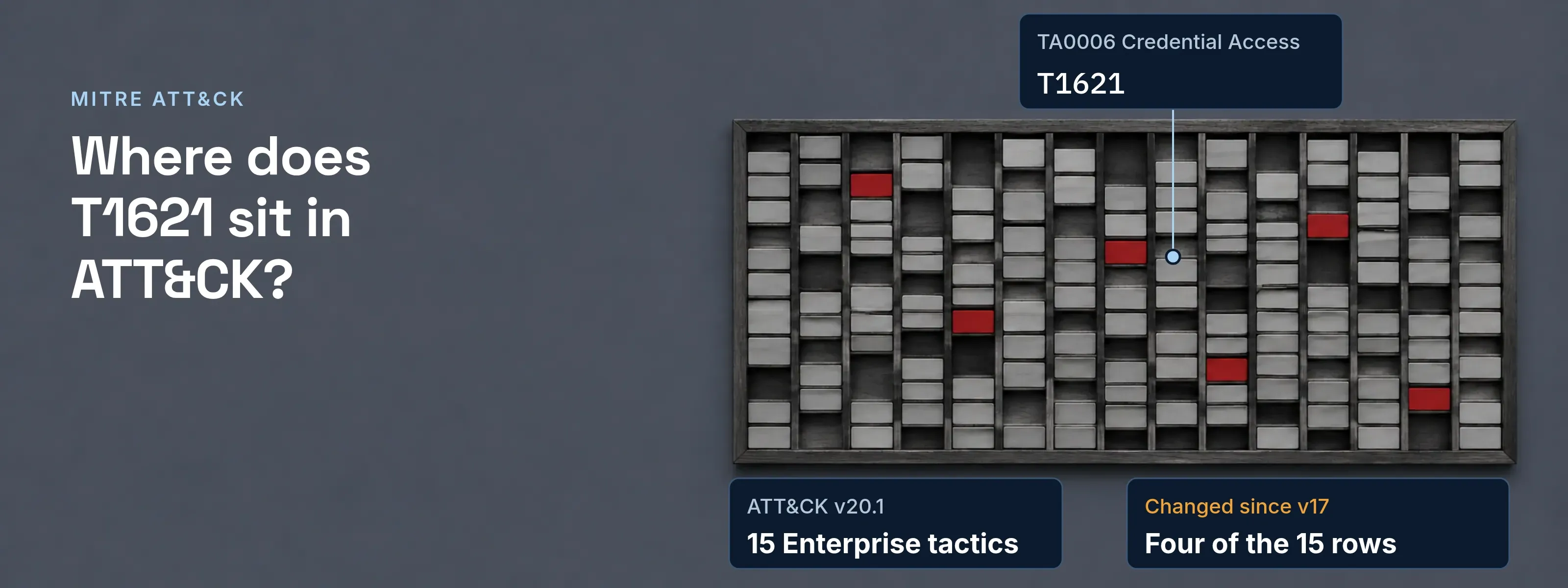
The count changed in April 2026. ATT&CK v19 split Defense Evasion in two: TA0005 is now Stealth, and TA0112 Defense Impairment is new. A mapping made before then has 14 tactics. The Mobile and ICS matrices, 12 tactics each, use the same model.
Scattered Spider, mapped tactic by tactic
CISA and FBI advisory AA23-320A maps the group to ATT&CK v17. We took one technique per tactic and re-opened each technique page on November 18, 2026.
Scattered Spider across the 15 Enterprise tactics, ATT&CK v20.1
TA0043 Reconnaissance
T1598.004Spearphishing VoiceTA0042 Resource Development
T1583.001DomainsTA0001 Initial Access
T1566.004Spearphishing VoiceTA0002 Execution
T1204User ExecutionTA0003 Persistence
T1078Valid AccountsTA0004 Privilege Escalation
T1484.002Trust ModificationChanged since v17
TA0005 Stealth
T1684.001ImpersonationChanged since v17
TA0112 Defense Impairment
T1556.006Multi-Factor AuthenticationChanged since v17
TA0006 Credential Access
T1621Multi-Factor Authentication Request GenerationTA0007 Discovery
T1538Cloud Service DashboardTA0008 Lateral Movement
T1021.007Cloud ServicesTA0009 Collection
T1213.002SharepointTA0011 Command and Control
T1219Remote Access ToolsChanged since v17
TA0010 Exfiltration
T1567.002Exfiltration to Cloud StorageTA0040 Impact
T1486Data Encrypted for Impact
Source: CISA AA23-320A Tables 4 to 17; IDs checked on attack.mitre.org, ATT&CK v20.1, November 18, 2026.
Anatomy of one technique page
One technique page holds every layer of the model. Here is T1621.
- Tactic
- TA0006 Credential Access
- The why: the attacker wants credentials, or a way past them
- Technique
- T1621 Multi-Factor Authentication Request Generation
- The how: send MFA requests until a person approves one
- Sub-techniques
- None for T1621
- A more specific how. T1556 has nine, including T1556.006 from the table
- Platforms
- IaaS, Identity Provider, Linux, Office Suite, SaaS, Windows, macOS
- Where the technique applies
- Procedure examples
- G1015 Scattered Spider, G0016 APT29, G1004 LAPSUS$
- Observed use, each with a cited report
- Mitigations
- M1036 Account Use Policies, M1032 Multi-factor Authentication, M1017 User Training
- What MITRE says reduces the risk
- Detection strategy
- DET0160, with analytics AN0449 to AN0454
- What to look for in identity, cloud and host logs
- Version
- 1.2, last modified October 24, 2025
- The version to cite when you map a control to it
MITRE replaced “data sources” with detection strategies, analytics and data components in v18 (October 2025).
What is MITRE ATT&CK used for?
Teams use ATT&CK to measure detection coverage, to test controls against behavior attackers have actually used, and to describe both in one vocabulary. The IDs are the shared key: a SOC rule and a government advisory can both point at T1621 and mean the same behavior.
Map your detection coverage
Tag each detection rule with its technique ID, then walk the 15 rows. A row with no rule is a named gap.
Test controls against a real adversary
AA23-320A gives the loop: pick a technique, test your tools against it, analyze detection and prevention, and tune.
Report in shared terms
Write findings as technique IDs with the ATT&CK version. CISA’s Best Practices for MITRE ATT&CK Mapping keeps analysts consistent.
Identity techniques and the controls that answer them
Each record pairs a MITRE mitigation for an identity row with the SSOGEN control behind it.
- T1621, mitigation M1032: replace one-tap push with a number from the login screen, and limit prompts.The SSOGEN Authenticator shows six numbers and the person taps the one on the sign-in page. No setting turns number matching off. By default, 3 denials pause push for 15 minutes, and one person can start 5 requests per 10 minutes.
- T1078, mitigations M1032 and M1036: MFA on every account, plus conditional access.With the sign-in strength Passkey or security key, only a credential that cannot be phished counts. The Admin Console always takes a second factor.
- T1484.002 and T1556, mitigation M1047: audit authentication settings.Account matching for an identity provider needs a super administrator and a sign-in restriction with a required claim. SSOGEN joins only on a verified email, never joins an administrator’s account, and records every change in the hash-chained audit log.
The user’s side of push bombing is in MFA fatigue attacks.
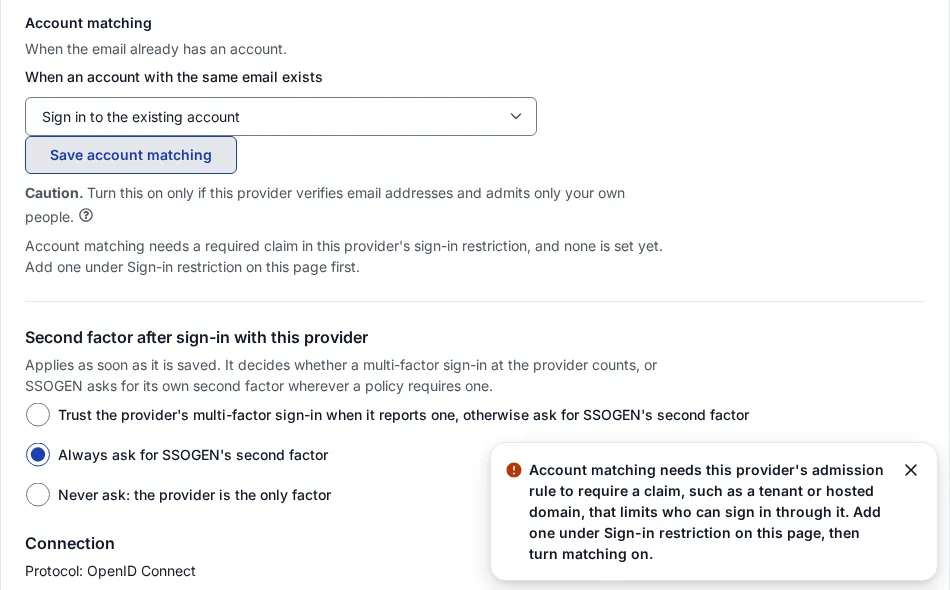
Every joining rule is in account matching for identity providers.
ATT&CK compared with other models
What is the difference between MITRE ATT&CK and the Cyber Kill Chain?
The two are complementary: the kill chain uses ordered phases for high-level objectives, while ATT&CK describes behavior one level lower, with tactics in no fixed order. MITRE’s FAQ adds that a single intrusion may not use every tactic. The phases themselves are explained in the cyber kill chain.
Is ATT&CK a control framework?
No. ATT&CK describes attacker behavior; a control framework lists the controls a security program should have. Three common control frameworks are NIST CSF 2.0, ISO/IEC 27001 and the CIS Critical Security Controls v8.1. Use them together: the control framework sets the controls, and ATT&CK shows which techniques each control has to stop.
How do you learn the MITRE ATT&CK framework?
Start from one report you already have, not from the full matrix. Take an advisory such as AA23-320A and open each technique ID it cites on attack.mitre.org. Read each page’s procedure examples and mitigations, and note the ATT&CK version you read.
Sources, all read 2026-11-18: MITRE ATT&CK versions, v20 release notes, v19 release notes, Enterprise tactics, Enterprise matrix, FAQ, data sources, T1621, T1078, T1556, T1484.002, T1684.001; CISA and FBI advisory AA23-320A, Scattered Spider (November 16, 2023, last revised July 29, 2025); CISA, Best Practices for MITRE ATT&CK Mapping; NIST Cybersecurity Framework; CIS Critical Security Controls.
Updated