SSOGEN / Learn / Cyber Kill Chain: Seven Stages, One Phishing Attack
Learn
Cyber Kill Chain: Seven Stages, One Phishing Attack
Lockheed Martin's Cyber Kill Chain splits an intrusion into seven stages: reconnaissance, weaponization, delivery, exploitation, installation, command and control (C2), and actions on objectives. The intruder has to complete every stage, so a defender who breaks one link stops that intrusion.
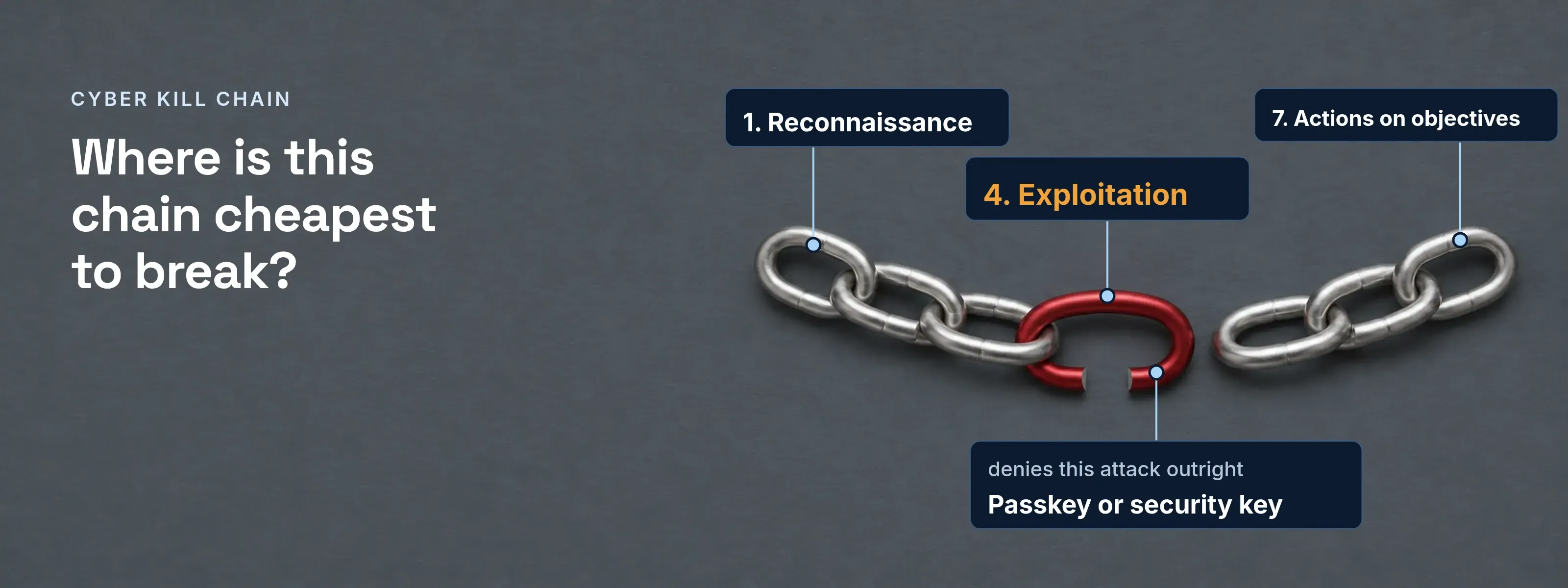
The paper built its stages around malware: a trojan hidden in a PDF, then a backdoor that beacons to a C2 server. The attack below uses none, and the seven stages still fit. Only the defender’s best move changes.
One phishing attack, stage by stage
The company and people are invented. An attacker wants the vendor bank records of a manufacturer that signs in at acme.example, through one finance employee, r.miller.
| Stage | What the paper means | Example controls in the paper | In this attack | Defender’s best move | Course of action (paper’s term) |
|---|---|---|---|---|---|
| 1. Reconnaissance | Research, identify and select targets | Web analytics, firewall ACL | The attacker collects finance staff names and the email address format from public pages | Keep staff lists and address formats off public pages | Deny |
| 2. Weaponization | Build the deliverable payload | NIDS, NIPS | Registers acme-login.example and hosts a sign-in page that relays every request to the real one | Watch Certificate Transparency logs and new domain registrations for lookalike names | Detect |
| 3. Delivery | Send the weapon to the target | Vigilant user, proxy filter, in-line AV, queuing | One email to r.miller, “Invoice approval pending”, with the link | Mail filtering, link rewriting and staff who report the message | Deny, detect |
| 4. Exploitation | Trigger the intruder’s code, or “exploit the users themselves” | HIDS, patch, DEP | r.miller types her password and her one-time code. The relay phishing kit passes both on and keeps the session cookie | Accept only a passkey or security key: it is bound to the real site, so the relay gets nothing | Deny |
| 5. Installation | Keep a foothold on the victim system | HIDS, “chroot” jail, AV | No malware. The attacker tries to add their own authenticator to her account | A method added during a session cannot confirm that session; credential changes need a recent sign-in | Disrupt |
| 6. Command and control | A channel the intruder controls | NIDS, firewall ACL, NIPS, tarpit, DNS redirect | The attacker replays the stolen cookie from their own network | Short idle timeout and lifetime; revoke the session | Degrade, disrupt |
| 7. Actions on objectives | Typically data exfiltration | Audit log, quality of service, honeypot | Exports vendor bank records from a web application | Review the audit log; revoke the application sign-in | Detect, disrupt |
The last column uses the paper’s six courses of action: detect, deny, disrupt, degrade, deceive and destroy. Row 4 is marked because one sign-in policy denies this attack outright.
The paper’s controls barely touch this attack
The third column lists the example controls from the paper’s Table 1. Against a relayed sign-in, most of them see nothing.
- Delivery. An email with a link and no attachment; the user and the proxy filter have a chance.
- Actions on objectives. The audit log records the export.
- The other five stages. Ordinary page views, a kit on the attacker’s servers, no code on the laptop, an account change and a browser talking to the application: nothing for the listed controls to catch.
Paul Pols reaches the same verdict in the unified kill chain paper: the original model is “perimeter- and malware-focused”. His research also found that real attacks skip phases or run them out of order, so one early break is no guarantee.
Stage 4 is the cheapest place to break this chain
A relayed sign-in fails when the credential only works on the site that registered it.
Password and one-time code. r.miller types the code from her phone into acme-login.example. The relay submits it to the real site within seconds and keeps the session cookie that comes back.
Passkey or security key. The browser offers a passkey only to the origin it was registered for. On acme-login.example there is no matching credential, so nothing reaches the relay.
In SSOGEN, a policy with the sign-in strength Passkey or security key accepts only those two. Phone approval in the SSOGEN Authenticator always uses number matching; against relay phishing, passkeys are the phishing-resistant choice.
Short sessions and fast revocation shrink stages 6 and 7
A stolen cookie lasts only as long as the session behind it. In SSOGEN, two settings bound that session and one click ends it.
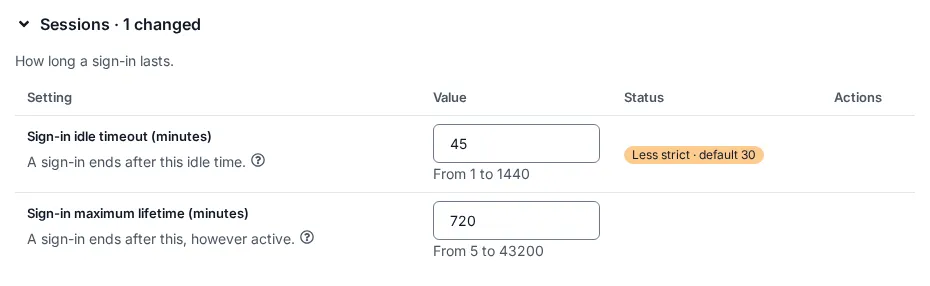
- Lifetime. Idle timeout 30 minutes by default (1 to 1,440); maximum lifetime 720 minutes (5 to 43,200). A replayed session that the attacker keeps busy still ends at the maximum lifetime.
- Revoke. On the user’s Sessions tab, revoking a session signs that browser out immediately. Application sign-ins are revoked one by one, and the application can no longer renew access.
- Stage 5 rules. A sign-in method added during a session cannot confirm that session. Changing your own credentials needs a sign-in within the re-sign-in window, 300 seconds by default.
Timeouts and the re-sign-in window are set in SSOGEN security settings. How a replayed cookie shows up in logs is on the session hijacking page.
The unified kill chain: 18 phases in three loops
Pols first published the unified kill chain in December 2017; the white paper is at version 1.3, February 2023. It extends and combines the Lockheed Martin model and MITRE ATT&CK, grouping its phases under three goals.
- In: phases 1 to 8. Reconnaissance, Resource Development, Delivery, Social Engineering, Exploitation, Persistence, Defense Evasion, Command & Control. The attacker gets an initial foothold.
- Through: phases 9 to 14. Pivoting, Discovery, Privilege Escalation, Execution, Credential Access, Lateral Movement. The attacker works across the network toward the assets.
- Out: phases 15 to 18. Collection, Exfiltration, Impact, Objectives. The attacker acts on the target and the goal behind it.
Two names changed to match ATT&CK: Target Manipulation became Impact after ATT&CK v4 (April 2019), and Weaponization became Resource Development after v8 (October 2020). Social Engineering and Credential Access, which describe the attack above best, have no stage in the seven-stage model.
Kill chain, unified kill chain and ATT&CK answer different questions
Three models, three questions
Cyber Kill Chain
Lockheed Martin
- The question it answers: where can we break this intrusion, and with which control?
- Where lateral movement sits: inside stage 7, actions on objectives.
Unified kill chain
Pols
- The question it answers: in what order do real attacks combine tactics?
- Where lateral movement sits: phase 14, in the Through loop.
MITRE ATT&CK
MITRE
- The question it answers: which technique did the attacker use, and how do we detect it?
- Where lateral movement sits: a tactic of its own, with techniques under it.
Host-to-host hops, with the log line for each, are on the lateral movement page.
Kill chain basics
What is a cyber kill chain?
A cyber kill chain is a model that splits an intrusion into ordered stages, so a defender can place a control at each one. The term comes from military targeting, where the process is called a chain because one failed step interrupts all of it. Lockheed Martin’s version has seven stages, from reconnaissance to actions on objectives.
Who developed the model?
Three Lockheed Martin authors developed it: Eric M. Hutchins, Michael J. Cloppert and Rohan M. Amin. Their paper is titled “Intelligence-Driven Computer Network Defense Informed by Analysis of Adversary Campaigns and Intrusion Kill Chains”. It draws on Lockheed Martin incident data from 2004 to 2010.
How do defenders use it?
Defenders map each stage to controls that detect, deny, disrupt, degrade, deceive or destroy the intruder’s action. The paper takes these six verbs from US Department of Defense information operations doctrine and lays them out as a matrix, one row per stage. Empty cells show where to invest, and one working control on any stage ends that attempt.
What is a supply chain cyber attack?
A supply chain attack reaches its target through a supplier that the target already trusts. The attacker compromises the supplier first and lets the trusted relationship carry the attack in. The unified kill chain lists it as one form of Delivery, next to spear phishing and watering hole attacks.
Sources, all read 2026-11-18: Hutchins, Cloppert and Amin, Intelligence-Driven Computer Network Defense Informed by Analysis of Adversary Campaigns and Intrusion Kill Chains (Lockheed Martin), sections 3.2 and 3.3 and Table 1; Lockheed Martin, Cyber Kill Chain; Paul Pols, The Unified Kill Chain, white paper version 1.3, February 2023.
Updated