SSOGEN / Learn / EDR vs XDR: What Each Sees in One Intrusion
Learn
EDR vs XDR: What Each Sees in One Intrusion
On each managed host, endpoint detection and response (EDR) records processes, files and connections and can stop them there. Extended detection and response (XDR) takes that endpoint data, adds email, identity and cloud logs, and correlates all of it into one incident. The difference is the number of sources and the join between them.
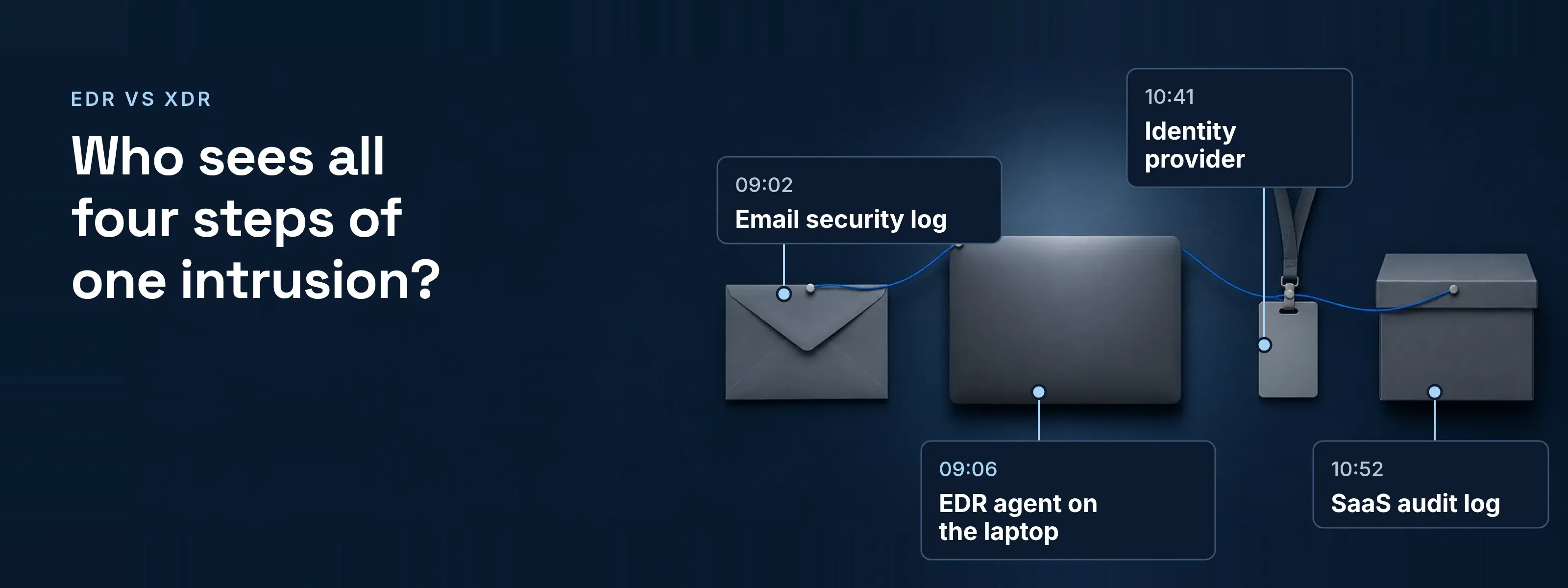
EDR records one of the four steps below. XDR joins all four.
Where the laptop agent goes blind after a token theft
The intrusion is fictional; addresses come from the RFC 5737 documentation ranges.
| Time | What happens | Recorded by | EDR sees | XDR sees |
|---|---|---|---|---|
09:02 |
A phishing email with an attachment reaches j.ortiz@acme.example |
Email security log |
Nothing: no process has run yet |
Sender, attachment hash, recipient |
09:06 |
The attachment starts a script that copies the browser’s tokens and connects to 198.51.100.23 |
EDR agent on the laptop |
Process tree, file reads, the outbound connection; it can kill the script and isolate the laptop |
The same events, linked to the 09:02 email by attachment hash and recipient |
10:41 |
The stolen refresh token is redeemed from 198.51.100.23, a network this account has never used |
Identity provider sign-in and audit log |
Nothing: the attacker’s machine runs no agent |
Token use by the same account, from the address seen at 09:06 |
10:52 |
Bulk download from a SaaS file-sharing app |
SaaS audit log, read through its API |
Nothing |
Download by the same account from the same address; all four steps become one incident |
EDR can end the attack at 09:06. If the tokens left the laptop first, steps 3 and 4 still happen, on machines and services that run no endpoint agent. Who watches either console at 03:00 is a separate decision, covered in managed detection and response.
The stolen-token step lives in the identity log
At 10:41 no managed endpoint is involved. The identity provider’s event is the only record, and its fields are the keys an XDR product joins on.
- Time
- 10:41
- Event
- Refresh token redeemed
- Account
- j.ortiz@acme.example
- Client address
- 198.51.100.23
- Address history
- A network this account has never used
- Endpoint agent
- None: the attacker’s machine runs no agent
- Joins on
- The account, and the address seen at 09:06
- Stream. SSOGEN webhooks send the same events to the system that correlates them. SSOGEN checks for new events about every 30 seconds and posts up to 50 per request, signed in the
X-SSOGEN-Signatureheader. Each event carriesevent_id,event_type,occurred_at,actorandclient_ip, and never a token, cookie or password. - Replay. When a refresh token that was already rotated is presented again, SSOGEN revokes its whole token family and records
token_replay.detectedwith the client and the family, never the token itself. - Agents. AI agent tokens are DPoP-bound by default: every request carries a proof signed with the client’s key. A stolen Bearer token can be replayed; a DPoP-bound token also needs that private key. Delegated agent refresh tokens rotate on each use.
The identity signals for five common attacks, field by field, are on the page that explains identity threat detection and response.
Three questions for any XDR rollout
Correlation is only as good as the sources connected and the key that joins them.
- Identity feed. Which identity provider sends events, and how: pushed as they happen, or polled on a schedule. A slow feed leaves the 10:41 token use unjoined while the attacker downloads files.
- Join key. Which field links the sources: account, address or host name. An account that is
j.ortiz@acme.exampleat the identity provider andACME\jortizon the laptop joins nothing until someone maps the two. - Response reach. Which actions the XDR product takes outside the endpoint. With SSOGEN as the identity provider, your administrator revokes the person’s sessions on the Sessions tab, and that browser is signed out right away.
EDR and XDR side by side
XDR adds sources and correlation. EDR stays in place as its endpoint input.
| Aspect | EDR | XDR |
|---|---|---|
| Scope | Each managed host: laptops, servers, often phones | The environment: endpoints plus email, identity, cloud and network |
| Telemetry | Processes, file reads and writes, registry changes and network connections on the host | Endpoint telemetry, usually from an EDR agent, plus email, identity provider, SaaS and cloud audit logs |
| Unit of detection | An alert on one host, with its process tree | An incident that joins alerts from several sources on account, address and host |
| Response | Kill a process, quarantine a file, isolate the host | The endpoint actions, plus actions in connected systems such as pulling an email from every mailbox or disabling an account |
| Deployment | An agent on every host and a management console | A correlation service with a connector per source, often sold with the vendor’s own EDR agent |
EDR and XDR, briefly answered
Is EDR an antivirus?
No. Antivirus blocks known malicious files when they are written or run; EDR records host activity continuously and supports investigation and response. That record lets an analyst follow behavior that matches no known file, such as a legitimate tool used to copy tokens. Most endpoint products ship both in one agent.
What is EDR?
OMB memo M-22-01 defines it: EDR “combines real-time continuous monitoring and collection of endpoint data … with rules-based automated response and analysis capabilities.” The memo, dated October 8, 2021, gives workstations, mobile phones and servers as example endpoints. Issued under Executive Order 14028, it directed US federal agencies to adopt EDR and to give CISA access to their deployments.
Does XDR replace EDR?
No. XDR usually takes its endpoint data from an EDR agent and adds other sources on top. Remove the agent and the 09:06 row of the table goes dark: no process tree, no file reads, no host isolation. What XDR replaces is the manual work of joining an endpoint alert to the email before it and the sign-in after it.
Sources, all read 2026-11-18: OMB M-22-01, Improving Detection of Cybersecurity Vulnerabilities and Incidents on Federal Government Systems through Endpoint Detection and Response; RFC 5737, IPv4 Address Blocks Reserved for Documentation.
Updated