SSOGEN / Learn / What Is a Trojan Horse? How One Arrives, Runs and Calls Home
Learn
What Is a Trojan Horse? How One Arrives, Runs and Calls Home
Malware that a user runs because it looks legitimate is a trojan horse, or trojan. It does not copy itself the way a virus or worm does. An infostealer trojan such as LummaC2 then sends saved passwords and session cookies to its operator.
A trojan horse needs a person to start it, and its disguise is how it gets one. NIST defines it as a program that appears useful but also has a hidden, potentially malicious function. The name comes from the wooden horse that carried Greek soldiers into Troy.
How a trojan arrives, runs and calls home
Each LummaC2 step leaves a trace defenders can look for.
Source: CISA and FBI advisory AA25-141B (May 21, 2025), covering November 2023 to May 2025. ATT&CK IDs follow CISA’s mapping unless marked.
- 1. ArrivesA spearphishing link or attachment delivers the payload, often inside a fake media player or utility.
- ATT&CK:
- T1566.001 and T1566.002 Spearphishing Attachment and Link, T1036 Masquerading.
- Look for:
- a file whose name, icon or metadata imitates a known application.
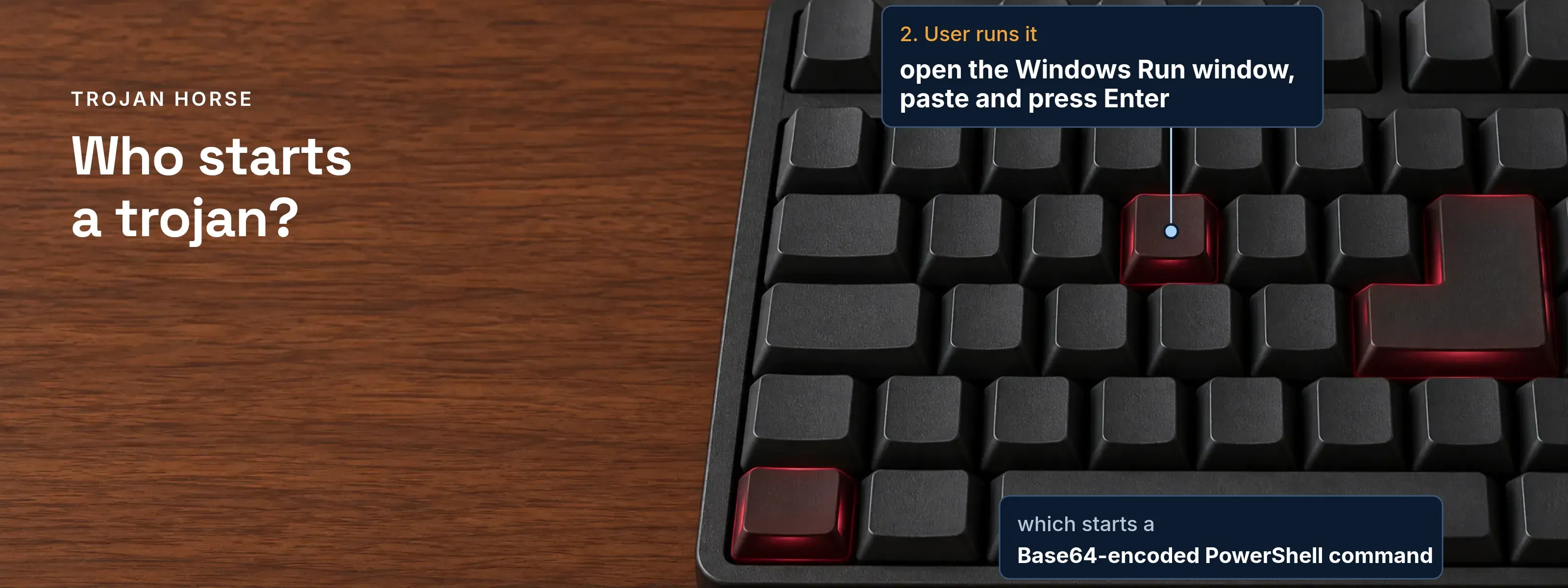
- 2. User runs itA fake CAPTCHA tells the user to open the Windows Run window, paste and press Enter, which starts a Base64-encoded PowerShell command.
- ATT&CK:
- T1204.004 User Execution: Malicious Copy and Paste (our mapping; MITRE lists the parent T1204 for Lumma Stealer).
- Look for:
- a command interpreter started with an encoded one-liner right after browser activity.
- 3. HidesObfuscation gets it past EDR and antivirus. At run time it decrypts its list of command-and-control domains.
- ATT&CK:
- T1027 Obfuscated Files or Information, T1140 Deobfuscate/Decode Files or Information.
- Look for:
- behavior alerts, not signature hits. CISA recommends application allowlisting.
- 4. Calls homeIt sends an HTTP POST to each decoded domain, keeps the first that answers and fetches JSON commands, the same pattern a botnet uses.
- ATT&CK:
- T1071.001 Application Layer Protocol: Web Protocols.
- Look for:
- POST-heavy traffic from PowerShell or a similar process to rare domains.
- 5. CollectsIt takes browser data, credentials, cryptocurrency wallets, browser extensions and MFA details.
- ATT&CK:
- T1217 Browser Information Discovery, T1119 Automated Collection; MITRE adds T1555.003 Credentials from Web Browsers and T1539 Steal Web Session Cookie (S1213).
- Look for:
- a process other than the browser reading the browser’s saved-login or cookie database.
- 6. Sends and fetchesThe haul leaves over the same channel, and the operator can push further files to run.
- ATT&CK:
- T1041 Exfiltration Over C2 Channel (MITRE S1213), T1105 Ingress Tool Transfer.
- Look for:
- sensitive-file reads followed by an outbound connection, then the user’s session in use from a new IP address.
Common kinds of trojan
The payload, not the disguise, decides the damage. Each example is a MITRE ATT&CK software entry.
| Kind | What it is for | What it means for accounts |
|---|---|---|
| Infostealer | Collects browser credentials, cookies and wallets, then sends them out. Example: Lumma Stealer (S1213) | Saved passwords and live sessions leave the machine |
| Remote access trojan (RAT) | Gives the operator remote control of the machine. Example: njRAT (S0385) | The attacker works as the user, inside sessions already open |
| Banking trojan | Steals banking information and other credentials. Example: Zeus Panda (S0330) | Bank sign-ins reach the operator |
| Loader or dropper | Downloads and runs further payloads. Example: Bumblebee (S1039), linked to ransomware operations | The next payload decides what happens to the accounts |
| Backdoor | An undocumented way into the system (NIST). Example: Gazer (S0168) | Access survives a password reset until the backdoor is removed |
What a stolen browser profile is worth
Saved passwords need a second factor; cookies need short sessions.
- Saved password. Useless where the policy also asks for a second factor or accepts only a passkey. Phishing-resistant MFA compares the methods.
- Session cookie. It was issued after MFA, so a replay skips the sign-in. Only expiry or revocation ends it. Session hijacking walks through the replay.
- Typed secrets. A trojan with a keylogging module records passwords and one-time codes as they are typed. What is a keylogger lists the capture points.
Where SSOGEN limits a stolen session
Three controls cut what a trojan’s haul is worth.
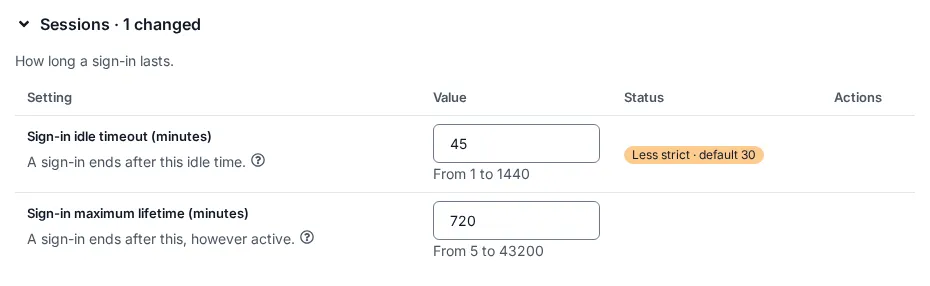
- Short sessions. A sign-in session ends after 30 minutes without use and after 12 hours at most, by default. Both are adjustable on the security settings page.
- Revocation. On a person’s Sessions tab, each session shows its assurance: Single-factor, Multi-factor or Phishing-resistant. Revoke ends that session at once, and the audit log records
platform.session.revoked. - Passkey only. A passkey counts as both factors. A policy set to Passkey or security key only accepts nothing else, so a password from a trojan’s haul opens no application.
What else people ask about trojans
What is a trojan horse in computer?
In computing, a trojan horse is a program that hides a malicious function behind a useful-looking one. It can pose as a game, an invoice viewer or a browser update, and it spreads only when someone runs it. A virus infects other programs; a worm copies itself across a network without help.
What does the slang term “trojan horse” mean?
As an idiom, a trojan horse is anything that looks harmless or welcome but carries a hidden threat. People use it for a gift, a deal or a proposal with a concealed purpose. Security borrowed the term for programs a user lets in that carry something else.
Is the trojan horse a real, true story?
The wooden horse of Troy is a legend, not recorded history. Homer’s Odyssey mentions it briefly in book 8. Virgil’s Aeneid tells it at length in book 2: Greek soldiers hidden inside a wooden horse that the Trojans pulled into their own city.
Are trojan horses illegal?
Using a trojan to get into someone else’s computer without authorization is a crime in the United States and the United Kingdom. The US Computer Fraud and Abuse Act (18 U.S.C. 1030) covers unauthorized access and knowingly sending code that causes damage. The UK Computer Misuse Act 1990 also covers making or supplying tools for those offenses. This is general information, not legal advice.
Who does what after a trojan alert
The identity step ends what the trojan already took.
| Team | Action | Why |
|---|---|---|
Endpoint |
Isolate the machine, then clean or reimage it |
Stops further collection and new payloads |
Identity |
Revoke the user’s sessions, reset passwords from a clean device, move the user to a passkey policy |
Stolen cookies and passwords keep working until this is done |
Security operations |
Hunt the advisory’s indicators; review sign-ins after the infection time |
Finds sessions already replayed elsewhere |
Sources, all read 2026-11-18: CISA AA25-141B, LummaC2; MITRE ATT&CK S1213 Lumma Stealer; T1204.004; T1036; T1071.001; T1555.003; T1539; T1041; njRAT; Zeus Panda; Bumblebee; Gazer; NIST glossary, trojan horse, virus, worm and backdoor; Perseus Digital Library, Tufts University: Homer, Odyssey book 8 and Virgil, Aeneid book 2; 18 U.S.C. 1030; Computer Misuse Act 1990.
Updated