SSOGEN / Learn / ISO 42001: The AI Management System Standard on One Page
Learn
ISO 42001: The AI Management System Standard on One Page
ISO and IEC published ISO/IEC 42001:2023 on December 18, 2023, with requirements for establishing, implementing, maintaining and continually improving an AI management system (AIMS). The standard is certifiable: an accredited body audits your AIMS against clauses 4 to 10 and the Annex A controls that apply to you.
The text is a paid, 51-page document. The structure below comes from public official sources: the IEC catalogue, NIST’s crosswalk and accredited certification bodies.
ISO/IEC 42001:2023, Information technology, Artificial intelligence, Management system: edition 1, December 18, 2023, from committee ISO/IEC JTC 1/SC 42, sold by the ISO and IEC webstores and national standards bodies.
The standard on one sheet
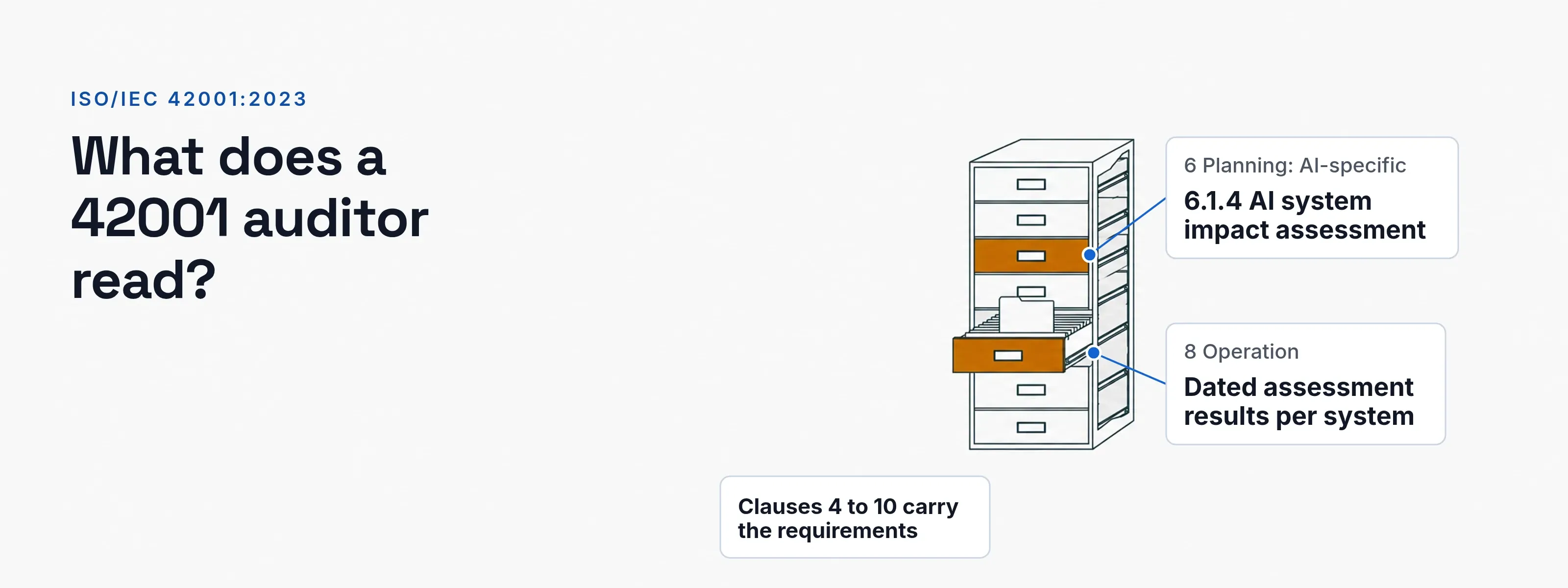
Clauses 4 to 10 carry the requirements. The AI-specific ones sit in clauses 6 and 8.
| Clause | Sub-clauses (titles from NIST’s crosswalk) | What it asks for | Evidence an auditor reads |
|---|---|---|---|
| 4 Context of the organization | 4.1 Understanding the organization and its context; 4.4 AI management system | The AIMS boundary, intended uses and foreseeable misuse | A scope statement naming the AI systems and roles in scope |
| 5 Leadership | 5.1 Leadership and commitment; 5.2 AI policy; 5.3 Roles, responsibilities and authorities | Top management owns the AIMS and the AI policy | The approved AI policy and the named AI roles |
| 6 Planning | 6.1.2 AI risk assessment; 6.1.3 AI risk treatment; 6.1.4 AI system impact assessment; 6.2 AI objectives and planning to achieve them | AI-specific: three assessments, plus objectives | A risk register, treatment decisions and one impact assessment per AI system |
| 7 Support | 7.1 Resources; 7.2 Competence; 7.3 Awareness; 7.4 Communication; 7.5.3 Control of documented information | People, skills and controlled documents | Competence records and a document register |
| 8 Operation | 8.2 AI risk assessment; 8.3 AI risk treatment; 8.4 AI system impact assessment | AI-specific: the clause 6 assessments carried out in operation | Dated assessment results per system |
| 9 Performance evaluation | 9.1 Monitoring, measurement, analysis and evaluation; 9.2.2 Internal audit programme; 9.3.3 Management review results | Measure, audit and review the AIMS | Monitoring results, audit reports, review minutes |
| 10 Improvement | 10.1 Continual improvement; 10.2 Nonconformity and corrective action | Correct findings and improve | Corrective action records |
Annex A: nine control areas
Annex A lists the controls and Annex B the guidance for each. Annex C lists AI objectives and risk sources; Annex D covers domains and sectors. Numbers are Annex B items from NIST’s crosswalk.
- Policies for AI (B.2). B.2.2 AI policy, B.2.3 Alignment with other organizational policies, B.2.4 Review of the AI policy.
- Internal organization (B.3). B.3.2 AI roles and responsibilities.
- Resources for AI systems (B.4). B.4.2 Resource documentation; data, tooling, computing and human resources (B.4.3 to B.4.6).
- Assessing impacts (B.5). B.5.2 Impact assessment process, B.5.4 Impact on individuals and groups, B.5.5 Societal impacts.
- AI system life cycle (B.6). From B.6.2.2 Requirements and specification to B.6.2.8 AI system recording of event logs.
- Data for AI systems (B.7). B.7.3 Acquisition, B.7.4 Quality, B.7.5 Provenance, B.7.6 Preparation.
- Information for interested parties (B.8). B.8.2 Information for users, B.8.3 External reporting, B.8.4 Communication of incidents.
- Use of AI systems (B.9). B.9.2 Processes for responsible use, B.9.4 Intended use of the AI system.
- Third-party and customer relationships (B.10). B.10.2 Allocating responsibilities, B.10.3 Suppliers, B.10.4 Customers.
Getting certified, step by step
An accredited body audits in two stages, then returns every year.
- Scope. Name the AI systems and roles in scope; compare current controls with the standard.
- Build. Approve the AI policy and roles, assess each system and put the applicable Annex A controls in place.
- Operate. NQA asks for at least three months of operation, one management review and a full cycle of internal audits before the audit.
- Stage 1. The auditor reviews documentation, impact assessments, management review results and internal audits.
- Stage 2. The auditor tests whether every AIMS process works, on site or remotely.
- Cycle. The certificate is valid for three years, with annual surveillance audits and recertification before expiry.
DQS puts initial certification at 4 to 9 months for most organizations.
What is the difference between ISO 42001 and ISO 27001?
Both follow the harmonized structure, so clauses 4 to 10 line up and one management system can run both. ISO 27001 manages information security risk with 93 Annex A controls. ISO 42001 manages the risks of developing, providing and using AI, adds an AI system impact assessment and groups its controls in nine AI areas.
| Topic | ISO/IEC 27001:2022 | ISO/IEC 42001:2023 |
|---|---|---|
| System | Information security management system (ISMS) | AI management system (AIMS) |
| Risk is about | Confidentiality, integrity and availability of information in scope | Bias, transparency, societal impact, life cycle accountability and intended use |
| Clause 6 assessments | Information security risk assessment and treatment | AI risk assessment, AI risk treatment and AI system impact assessment |
| Annex A | 93 controls in four themes: Organizational 37, People 8, Physical 14, Technological 34 | Controls in nine AI areas, with guidance in Annex B |
| Scope | Information assets | AI systems, models, datasets and roles; a 27001 scope does not cover AI on its own |
| Running both | Shared audit, review and improvement processes | The same processes, extended; audits can be combined |
The AI governance framework comparison sets the AI RMF, ISO 42001 and the EU AI Act side by side.
Where AI agents meet the controls
Each AI agent in SSOGEN is a registered identity whose records are evidence for B.3.2, B.6.2.8 and B.9.4.
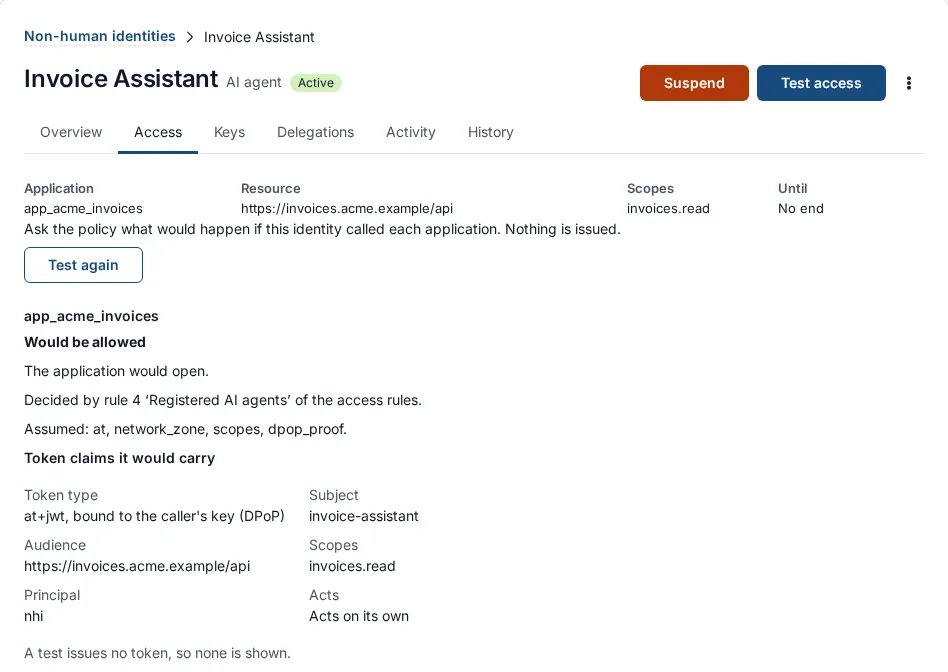
- Owner, for B.3.2. Each agent has up to five owners, all people, and one primary owner. When the last owner leaves, SSOGEN suspends the agent.
- Activity, for B.6.2.8. Every token issued or refused, delegation, approval and Gateway call decision is recorded under When, Event, Result and Done by.
- Grants, for B.9.4. You grant applications and scopes. A request outside them is refused, and a Sensitive scope needs a fresh approval each time.
- Stop, for Manage 2.4. Suspend one agent or engage a kill switch for a type. New tokens stop at once and issued tokens stop working within 5 minutes.
See AI agent identity for the model, AI agent access control in SSOGEN for the screens and the AI agent governance checklist for all six agent controls.
Questions people ask
What is ISO 42001 for AI?
It is the international standard for running AI under a management system, and the one you can be certified against. It applies to any organization that develops, provides or uses AI systems. It asks for an AI policy, named roles, AI risk and impact assessments, controls chosen from Annex A, internal audits and management review.
What are ISO business standards?
The ISO standards businesses certify against are management system standards: requirements an organization meets and an accredited body audits. ISO 9001 covers quality, ISO 14001 the environment, ISO/IEC 27001 information security and ISO/IEC 42001 AI. They share the harmonized structure, so one integrated system with one audit program can cover several.
How much does certification cost?
No body publishes a fixed price; each quotes per organization. DQS names the drivers: organization size, the scope of AI systems, the number of sites and the complexity of AI life cycle activities. Budget for a licensed copy of the standard, internal effort, the two-stage audit and an annual surveillance audit.
Sources, all read 2026-11-18: IEC webstore, ISO/IEC 42001:2023; NIST AI RMF to ISO/IEC FDIS 42001 crosswalk; NIST AI Risk Management Framework; DQS, ISO 42001 explained; DQS, ISO 42001 certification; DQS, ISO 27001 explained; NQA, ISO 42001 certification; BSI, ISO 27001 and ISO 42001 infographic.
Updated