SSOGEN / Learn / What Is Identity Governance?
Learn
What Is Identity Governance?
Identity governance is the record of who decided each access change and the proof that it happened. One employee's access changes four times in 14 months, and each change has an approver.
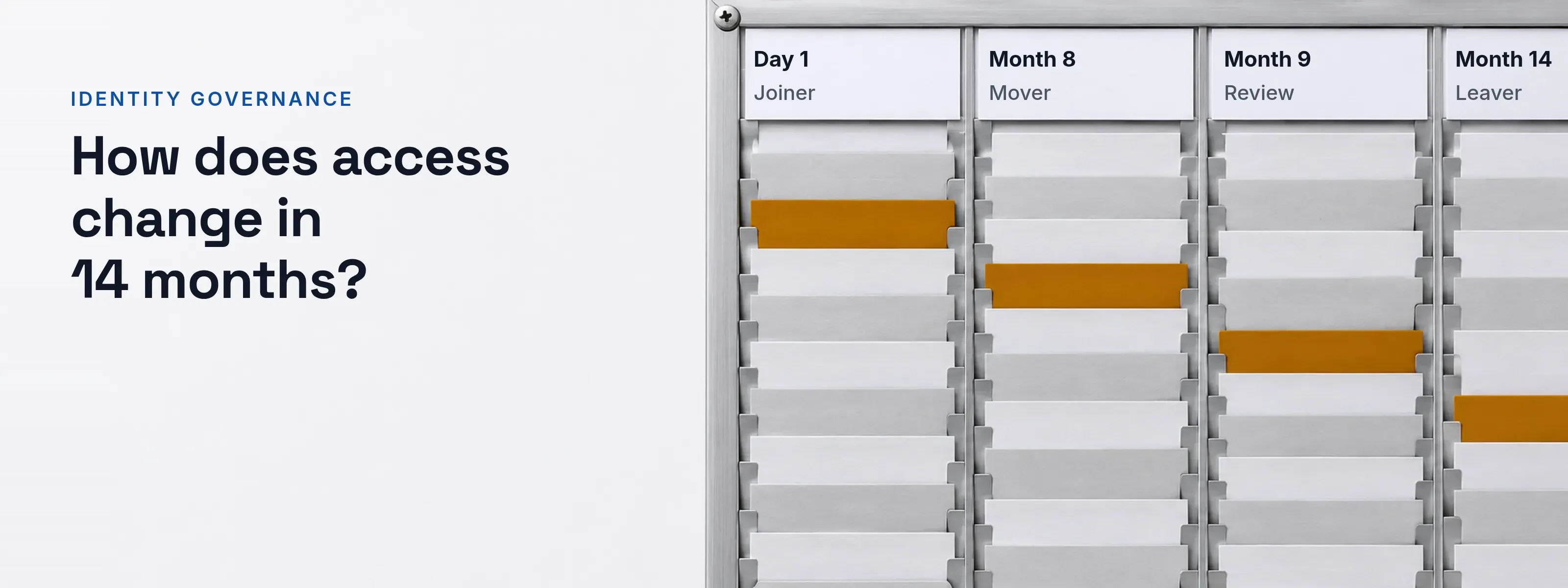
Identity governance decides who should have access to which systems and keeps the proof. It covers who owns each application, who approves access, when access is reviewed, when it is removed and what record remains. Identity governance and administration (IGA) adds the account work that carries those decisions out.
Joiner, mover, review and leaver in a 14-month ledger
Maria Lopez is an invented accounts-payable analyst at Acme Corp. Nothing here describes a customer. At each step, the ledger shows the change, who signs off and the evidence an auditor can ask for.
| Day | Event | Who decides | Evidence |
|---|---|---|---|
| Day 1 | Joiner. HR creates the record. Maria gets the accounts-payable group, which opens the invoice app and the expense app, and nothing else. | Her manager approves the role template. | The account creation event and the group membership. |
| Month 8 | Mover. Maria transfers to treasury. The accounts-payable group is removed and the treasury group is added, so old access leaves the day new access arrives. | The new manager approves and the old manager confirms the removal. | Two dated membership changes. |
| Month 9 | Review. The quarterly check lists who holds each application. The invoice app’s list no longer shows Maria, which confirms the move, and the reviewer removes one stale grant held by another person. | The application owner certifies the list. | The signed list and the removal. |
| Month 14 | Leaver. Maria resigns and HR triggers the leaver event. Her account is disabled, her sessions end and her accounts in connected applications are switched off the same day. | IT confirms the result. | The disable event in the audit log. |
What identity governance covers
Five jobs make up governance. Each one answers a question an auditor asks and leaves an artifact that answers it.
| Job | Question it answers | Artifact an auditor accepts |
|---|---|---|
| Ownership | Who answers for this application and its access? | A list of applications, each with a named owner |
| Request and approval | Who decided this person gets it? | The approved request, or the role template and its approver |
| Review | Is the access still needed? | A dated list signed by the owner |
| Removal | Did access end when the need ended? | A dated membership removal or disable event |
| Evidence | Can you show all of this for one person? | A log export filtered to that person |
The role template in Maria’s first row is a role-based decision; RBAC vs ABAC compares that model with attribute rules.
What is the difference between management and governance?
Management changes access; governance decides and checks it.
- Management
- Makes the change: adds Maria to the treasury group, disables her account. IT, an application owner or an automated sync does the work.
- Governance
- Decides that the change should happen and checks it afterwards: the new manager approves, the old manager confirms the removal and a reviewer checks the list a month later.
Where governance sits next to IAM
Identity and access management (IAM) makes access work. IGA decides who should hold access and proves it.
- IAM runs access. Question: who is this, and may they sign in now? Owner: IT operations. Output: a sign-in decision for each request. Cadence: every sign-in. Example: SSO and MFA.
- IGA justifies access. Question: should this person hold this access at all? Owner: application owners and managers. Output: an approval, a review result and a record. Cadence: at each joiner, mover and leaver event, and on a review schedule. Example: the signed quarterly list.
IGA vs IAM gives the full comparison of the two decisions on one grant and where they hand off.
The same split holds for customers; CIAM vs IAM shows where it changes.
What is the difference between IDM and IAM?
The two terms overlap, and many sources use them interchangeably. Where they are separated, identity management (IDM) means the account lifecycle: creating, changing and disabling accounts and their attributes. IAM adds access control, such as authentication, SSO and MFA. No standard fixes the split, so check how a document uses each term.
Where the evidence comes from
An auditor needs three things: the rule, the change and the proof. NIST SP 800-53 Rev. 5 states the rules; each ledger row produces the change and the proof. When the scope includes AI systems, ISO 42001 adds named AI roles and impact assessments to the rules. A wider GRC program links each rule to a scored risk and a mapped control.
- AC-2 (c, e, f): Day 1. Criteria for group membership (c), approval of new accounts (e); accounts created, enabled, modified, disabled and removed under defined rules.
- AC-5: Day 1. Duties that must be kept apart are identified, and access is defined to support that. For example, the person who enters an invoice does not also release the payment.
- AC-6: Month 8. Least privilege: only the accesses a person needs for the assigned task. Moving to treasury ends the accounts-payable access.
- PS-5 (a, c): Month 8. On a transfer, the need for current access is reviewed and confirmed, and access is changed to match the new role.
- AC-2 (j): Month 9. Accounts are reviewed for compliance, at a frequency the organization defines.
- PS-4 (a, b): Month 14. On termination, access is disabled within a period the organization defines, and authenticators and credentials are revoked.
The same controls apply to software that acts for people; see offboarding AI agents.
A CPA testing SOC 2 compliance asks for the same records: the month 14 disable event is what a leaver sample is checked against.
Where SSOGEN enforces the removals
SSOGEN carries out the removals in the ledger and keeps the dated record of each.
- Groups. On a group’s Members tab, Remove takes a person out of that group. They keep the account and lose the applications that membership gave them. This is Maria’s month 8.
- Directory sync. An import creates accounts, refreshes details, and adds and removes the group memberships the directory owns. Run with Disable people who have left, it disables everyone absent or disabled in the directory, with the status reason “Removed from Acme Active Directory”, and their sessions end.
- A guard on the run. A run that would switch off more than the larger of 5 people and 10 % of active people halts before it changes anyone, so a wrong base DN cannot switch off a company.
- SCIM. A SCIM client that sets
activeto false disables the account. Nothing is deleted and the history stays in the audit trail. - Connected applications. With Deactivate leavers on, outbound provisioning sets the leaver’s accounts in connected applications to inactive, never deleted. The setting starts off.
- The record. The audit log is tamper evident and writes events such as
directory.user.deprovisioned. It exports as CSV or JSON for an auditor.
The steps for switching a leaver off are in directory sync and SCIM.
Short answers
What is IGA identity governance?
IGA stands for identity governance and administration. Governance sets and checks who should have access. Administration creates, changes and disables the accounts that carry those decisions out. Together they cover the account lifecycle and the evidence for it, which is why a request for “who has access to what” usually lands here.
How often should access be reviewed?
As often as your own policy says, and whenever a person moves. NIST SP 800-53 AC-2 (j) asks for account reviews at a frequency the organization defines, and PS-5 asks for a review when someone transfers. Maria’s example reviews every quarter to show the shape; your policy sets the real interval.
Who is responsible for identity governance?
Each application has an owner who answers for its access, and managers approve it. IT makes the changes and keeps the records. HR is the source for joiners, movers and leavers. Security or compliance sets the policy and checks the result. In the ledger, no step depends on one person alone.
Sources
Primary sources, all read 2026-11-17:
- NIST SP 800-53 Rev. 5, controls AC-2, AC-5, AC-6, PS-4 and PS-5 (NIST OSCAL catalog, release 5.2.0, modified 2026-10-22).
- Microsoft Learn, Microsoft Entra ID Governance overview, which frames governance as four questions: who should have access, what they do with it, whether controls exist and whether auditors can verify them.
- Wikipedia, Identity management, for the interchangeable use of IdM and IAM.
Updated