SSOGEN / Learn / IGA vs IAM: Two Decisions About the Same Access
Learn
IGA vs IAM: Two Decisions About the Same Access
Two decisions separate IGA vs IAM, and both act on the same grant: whether a person may open an application right now, and whether that person should hold the access at all.
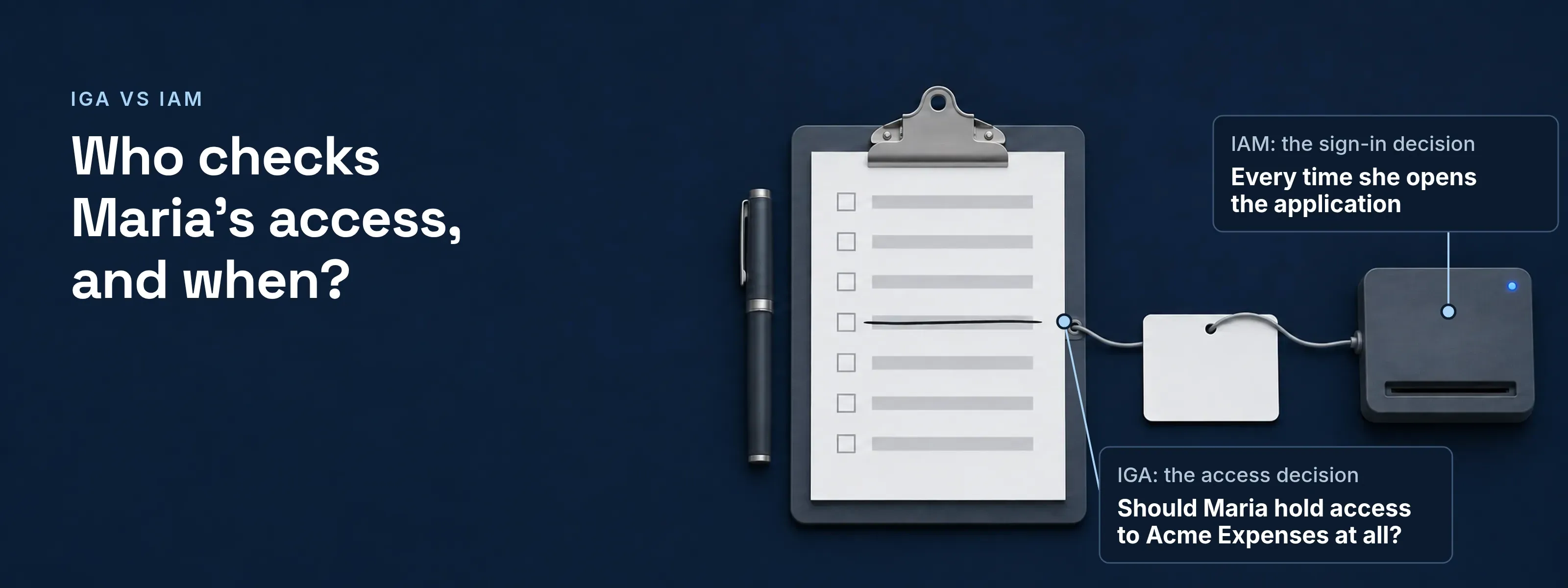
Identity and access management (IAM) checks a person every time they open an application. Identity governance and administration (IGA) decides who should hold that access, when people join, move or leave, and on a review schedule. The two meet at one fact: the group membership or assignment that grants the access.
The sign-in decision and the access decision for an expenses grant
Maria Lopez, an invented finance employee at Acme Corp, is assigned to Acme Expenses. Each row shows how the two decisions treat that one grant. The IAM column follows the check SSOGEN runs at sign-in.
| IAM: the sign-in decision | IGA: the access decision | |
|---|---|---|
| Question | May Maria open Acme Expenses now, and what must she still do first? | Should Maria hold access to Acme Expenses at all? |
| When it runs | Every time she opens the application | When she joins, moves or leaves, and at each scheduled review |
| Who decides | The policy engine, from rules an administrator set in advance | Her manager approves; the application owner certifies the list |
| What it reads | Her assignment, her groups, the strength of her sign-in and the policy rules | HR events, the current list of who holds access, the original approval |
| Output | Allow, ask for a second factor, or refuse | An approval, a removal or a signed review |
| Record it leaves | A sign-in or refusal event in the audit log | The approved request and the signed list |
| When it is wrong | A stranger gets in, or Maria is locked out of work she should do | Maria keeps access her job no longer needs |
| NIST SP 800-53 Rev. 5 | IA-2 identification and authentication; AC-3 access enforcement | AC-2 (j) account review; PS-4 termination; PS-5 transfer |
A strong sign-in answers the left column. An auditor who asks for access reviews is asking about the right one. In a SOC 2 audit, that means sampled leavers checked against their removal events.
Where the two hand off
IGA writes the membership, IAM reads it at every sign-in, and the sign-in record goes back to IGA as review evidence.
One grant passing between IGA and IAM
- IGAmanager and application owner
- IAMsign-in check
- IGA to IAM1Approval becomes a group membership or an assignmentMaria joins Finance, and Finance is assigned to Acme Expenses.
- IAM2The first check of every sign-in reads the assignment
- IAM to IGA3Sign-ins and refusals return as review evidenceThe reviewer sees who used the access, and when.
- IGA to IAM4A review or a transfer removes the membershipAt her next attempt, the first check refuses her.
The approvals and removals themselves are covered in what is identity governance.
When one runs without the other
Each side catches a failure the other cannot see. Both cases are invented examples at Acme Corp.
- IAM without IGA: a mover keeps an old group. A payroll clerk moves to sales. IT adds the sales group, and nobody removes the payroll group. Every sign-in to payroll passes the second factor, correctly. The sign-in check works; the access should not exist.
- IGA without IAM: a signed list with no named user. The quarterly review approves three people on a shared reporting account. They share one password, so the log shows the account signed in, never which person. The review has nothing to test against.
SSOGEN checks six things in a fixed order at sign-in
The first failed check ends the decision with a refusal, and a missing fact counts as a failure.
- Assignment. She is assigned directly or through a group. A stronger sign-in never grants an assignment.
- Application ready. It is switched on, and its App Pack, if any, is active.
- Providers. The application’s policy allows at least one identity provider.
- Access rules. The organization-wide rules; the first matching rule decides.
- Policy rules. The application’s own rules, read the same way.
- Session. Strength, recency and provider. A sign-in weaker than required gets a request for more, such as an authenticator code, instead of a refusal.
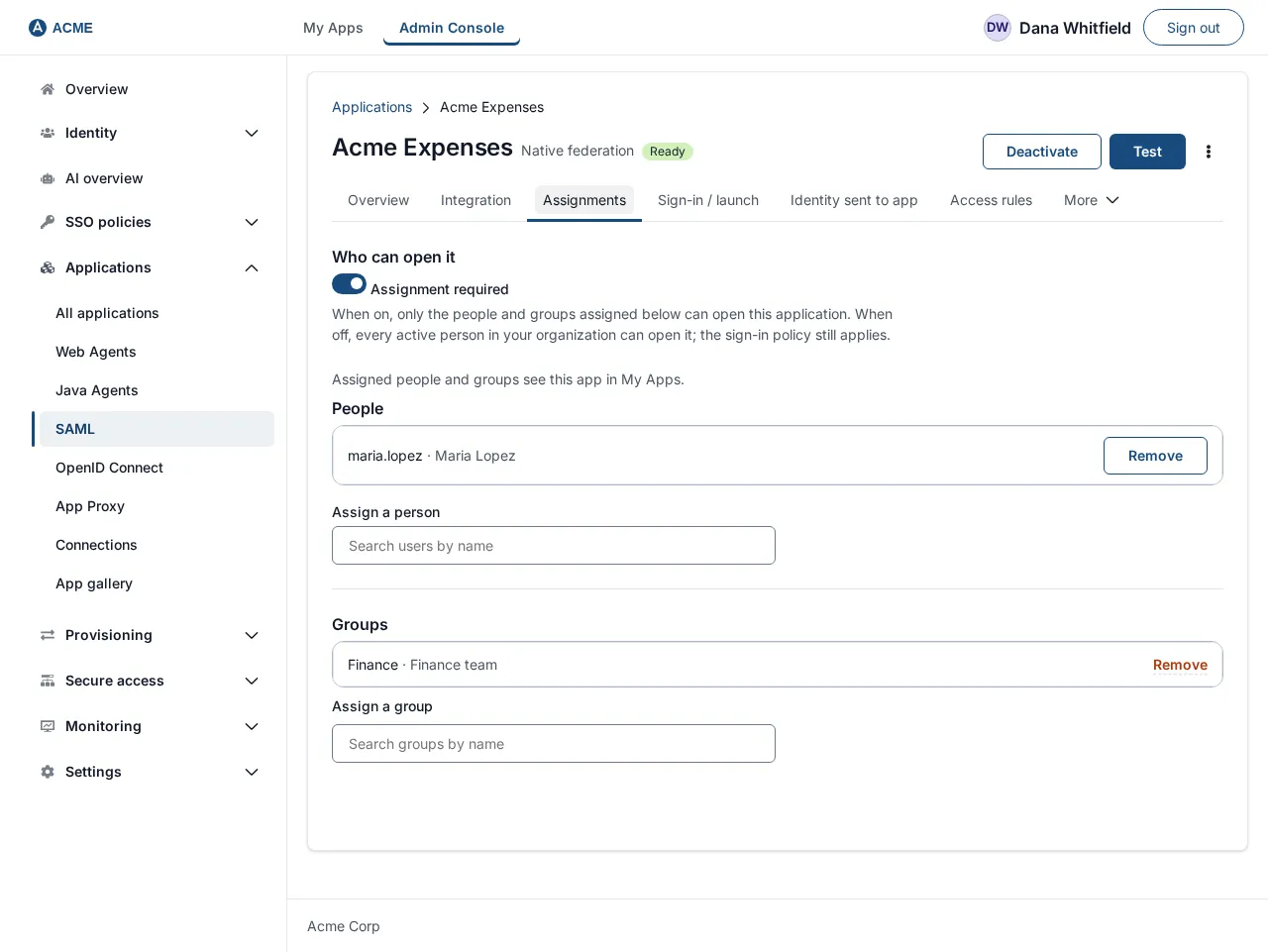
- Assigning a group grants the application to every current and future member. Remove takes access away, and a person still in an assigned group keeps it through the group.
The audit log records every sign-in and refusal in a tamper-evident hash chain and exports as CSV or JSON. What if answers whether a person would get in and which rule decided, without signing anyone in. The SSOGEN sign-in policy engine covers the rules, and how sign-in decisions work walks through each check.
Short answers
What are IAM policies?
IAM policies are the rules that decide who may do what: in AWS, JSON statements that allow or deny actions on resources; in workforce sign-in, the rules for how people sign in. A workforce sign-in policy decides how people sign in to applications.
What does IGA stand for?
IGA stands for identity governance and administration. Governance sets and checks who may hold which access, through approvals and periodic reviews. Administration carries those decisions out: it creates accounts, adds and removes group memberships, and disables accounts when people leave. A request for “who has access to what, and who approved it” belongs to IGA.
Is IGA part of IAM?
IGA is usually treated as one segment of IAM, beside access management and privileged access management. Microsoft is one example. Microsoft Entra ID Governance covers access reviews, entitlement management and lifecycle workflows, and it is licensed as part of the Microsoft Entra family, on its own or in Microsoft Entra Suite. The third segment is compared in PAM vs IAM.
Sources
Primary sources, all read 2026-11-18:
- NIST SP 800-53 Rev. 5, controls IA-2, AC-3, AC-2, PS-4 and PS-5 (NIST OSCAL catalog, release 5.2.0, modified 2026-10-22).
- AWS IAM User Guide, IAM JSON policy element reference.
- Microsoft Learn, What is Microsoft Entra ID Governance?
Updated