SSOGEN / Learn / RBAC vs ABAC: How They Differ and When to Use Each
Learn
RBAC vs ABAC: How They Differ and When to Use Each
RBAC vs ABAC comes down to what the decision reads: RBAC checks the role a person holds, ABAC weighs attributes of the person, the resource and the moment.
Updated
RBAC vs ABAC in one line: role-based access control (RBAC) grants access based on the role a user holds, such as Accounts Payable Clerk. Attribute-based access control (ABAC) grants access when attributes of the user, the resource and the context satisfy a rule, such as “department is Finance, the invoice is under 5,000 and it’s a workday”.
Most production systems use roles for the baseline and attributes for the exceptions.
RBAC vs ABAC at a glance
| RBAC | ABAC | |
|---|---|---|
| Decides by | The role assigned to the person | Attributes of the subject, the object, the action and the environment, tested by rules |
| Strengths | Easy to explain, review and audit: one question, “who holds this role?” | Fine-grained and context-aware; a rule change applies everywhere at once |
| Weaknesses | Static; needs many narrow roles for context-dependent rules (role explosion) | Harder to design, test and explain; the rules are only as good as the attribute data |
| Typical rule | Clerks can view and create invoices | Finance staff may approve an invoice under 5,000 from a managed device on a workday |
| Choose it when | Duties map cleanly to job titles and change slowly | Decisions depend on data, time, place or device |
What is RBAC?
NIST describes RBAC as a model in which each user is assigned one or more roles and each role one or more privileges.
Security administration then means determining which operations users in particular jobs must perform and assigning them to the proper roles (NIST RBAC project page, read 2026-10-09).
- Building blocks. The same page names them, as the ANSI/INCITS 359 standard (2004, updated 2012) defines them: users, roles, permissions, operations and objects.
- Reviewability. The main advantage. An auditor asks “who is in the Approver role?” and gets a list.
- Job changes. When an employee changes jobs, you change one role assignment, not forty individual grants.
What is ABAC?
NIST SP 800-162 defines ABAC as a method in which authorization to perform operations is determined by evaluating attributes of the subject, the object, the operation and sometimes the environment against policy rules (NIST SP 800-162, Guide to Attribute Based Access Control, first published 2014, updated 2019, read 2026-10-09).
The guide notes that ACLs and RBAC are in some ways special cases of ABAC; RBAC works on a single attribute, “role”.
Three kinds of attribute carry most decisions:
- Subject: department, clearance, employment type, training status.
- Object: invoice amount, data classification, owning cost center.
- Environment: time of day, network location, device state.
Rules are expressed in those attributes, never in named users.
A worked example with Acme invoices
Acme Corp runs an invoicing application. Take one requirement, “pay invoices safely”, and implement it both ways.
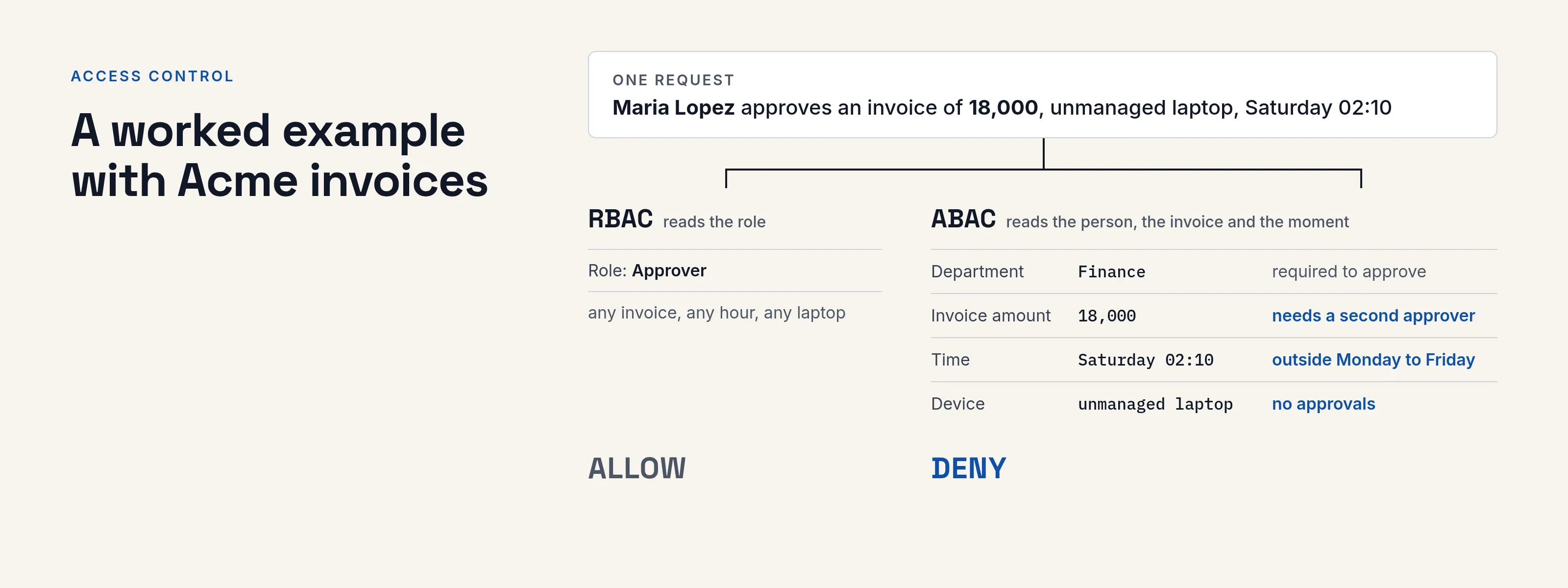
With roles. Acme defines Clerk (view and draft invoices), Approver (approve) and Auditor (read only). Maria Lopez in Finance is an Approver, so she can approve every invoice, at any hour, from any laptop.
Each new condition multiplies roles:
- A limit of 5,000 per approver requires Approver-Small and Approver-Large.
- A managed-device requirement for large approvals adds Approver-Large-Managed.
NIST notes that this leads to what is often termed “role explosion” (SP 800-162, section 2.1, read 2026-10-09).
With attributes. Acme keeps one Approver role and writes rules that read attributes:
| Attribute | Value in the request | Rule outcome |
|---|---|---|
| Department | Finance | Required to approve |
| Invoice amount | 3,200 | Allowed (under 5,000) |
| Invoice amount | 18,000 | Needs a second approver |
| Time | Saturday 02:10 | Denied (outside Monday to Friday) |
| Device | Unmanaged personal laptop | Denied for approvals; viewing allowed |
The rules name no one. A new hire in Finance is covered as soon as the department attribute is set, and changing the 5,000 threshold is one edit.
The cost is data quality: Acme must keep the department and device attributes accurate, because a rule is only as trustworthy as the data it reads.
When is RBAC enough, and when do you need ABAC?
Choose RBAC when:
- Access follows job titles, and titles change slowly.
- You need simple access reviews, with a clear owner for each role.
- The decision never depends on the data being touched.
Choose ABAC when:
- The same person needs different access depending on the record (amount, region, classification).
- Time, place or device must change the answer.
- You find yourself creating roles with three members and a long name.
NIST makes the same point (SP 800-162, section 2.1):
- Multi-factor decisions. RBAC does not easily support decisions that depend on physical location or specialized training.
- NIST’s example. HIPAA records, where recent training on HIPAA data protection may be a prerequisite to view medical records.
- Static positions. Role assignments also tend to follow more static organizational positions.
The hybrid approach most teams end up with
In the usual pattern, roles answer “what kind of user is this?” and attributes narrow the answer for the specific request.
Maria is an Approver (role), but an attempt to approve an 18,000 invoice from an unmanaged laptop on Saturday night is refused (attributes).
Roles keep reviews simple; attributes handle context without new roles. Two cautions apply:
- Keep the number of attributes small and assign an owner to each, because stale attributes silently produce wrong decisions.
- Document the order in which rules are evaluated, so a deny always takes precedence over an allow.
What about AI agents?
An agent acting for a user raises the stakes for both models.
- Roles are too coarse. A role like “Invoice Assistant” does not fit when the agent can both list invoices and cancel them.
- Useful attributes. The user the agent acts for, the named scope granted and how long ago a user approved it.
- A workable pattern. A short list of named scopes on a registered identity, with a user approving the sensitive ones.
- Draft the list. Use the free AI agent permissions builder.
- Owned identity. To see how an agent gets one in the first place, read AI agent identity.
- Authorization itself. See authentication vs authorization.
How SSOGEN handles roles and conditions
SSOGEN applies both models at the sign-in decision.
Roles. Administrators hold one or more of six built-in admin roles. Give each administrator the smallest role that covers the job (admin roles guide).
Rules. Policies with rules decide who may open an application and under what conditions.
First match. A rule says “when these conditions are all true, do this”, and the first matching rule decides.
- Conditions: group membership, person, Network zone, sign-in strength, Days and hours, Risk score, and whether the request comes from a person or an AI agent.
- Outcomes: Allow, Deny, Require a stronger sign-in, and Allow with a shorter session.
A network zone is a named group of IP address ranges, such as the office.
A rule can say “Network is on none of corporate” and then Deny (rules and conditions, network zones).
These rules govern sign-in and access to the application. Decisions that depend on the contents of a record, such as an invoice amount, belong in the application’s own logic.
For how the pieces fit, see how sign-in decisions work.
Questions people ask
Is ABAC better than RBAC?
Neither is better in every case. RBAC is simpler to operate and review; ABAC is more precise when context matters.
Is RBAC a type of ABAC?
In some ways, yes. NIST’s guide calls RBAC a special case of ABAC in terms of the attributes used, since RBAC works on one attribute, role.
Can you use both together?
Yes, and most organizations do: roles for the baseline, attribute rules for context.
What is an example of ABAC?
A rule such as “Finance staff may approve an invoice under 5,000, from a managed device, on a workday”. The decision reads the user’s department, the invoice amount, the device state and the day, not a job title. A change to the 5,000 limit applies to every request at once.
What does an RBAC permission mean?
A permission is approval to perform an operation on an object, such as “approve” on an invoice. In RBAC, permissions attach to roles, and users receive them only through the roles they hold. Removing a role removes every permission that came with it.
What is role explosion?
A growing set of narrow roles, created to encode conditions that roles cannot express.
Where to go next
- Hub. Back to the Learn hub.
- Related. Read authentication vs authorization.
- Agents. See how AI agent permissions apply least privilege to agents.
Sources, all read 2026-10-09: NIST role-based access control project, NIST SP 800-162 (also cited by its DOI).