SSOGEN / Learn / SOC 2 Compliance: Five Categories and Their Evidence
Learn
SOC 2 Compliance: Five Categories and Their Evidence
Customers who ask for SOC 2 compliance want a report: a licensed CPA's examination of your controls against the AICPA Trust Services Criteria. There is no certificate. The report, with the CPA's opinion, is what the customer reads.
The CPA performs the examination under AICPA attestation standards. When a customer’s security questionnaire asks for “a SOC 2 Type 2 report”, it is asking for this document. The criteria in force are the 2017 Trust Services Criteria (with revised points of focus, 2022), set by the AICPA’s Assurance Services Executive Committee (ASEC).
SOC 2 compliance is one output of a wider governance, risk and compliance program. Other frameworks are compared in cyber security frameworks.
The five categories and the evidence auditors ask for
SOC 2 requirements depend on the categories in scope. The common criteria (CC1 to CC9) are the full set for security and apply in every examination; the other four categories add their own series (A, PI, C, P).
| Category | What it protects | Put it in scope when | Evidence a team gathers |
|---|---|---|---|
| Security | The system and its data against unauthorized access and change | Always: the common criteria apply to every examination | The user list with hire and leave dates, the MFA policy, signed access reviews, change tickets |
| Availability | The system’s uptime and capacity | Customers rely on your service commitments | Backup restore test records, capacity monitoring, incident tickets |
| Processing integrity | Complete, accurate and timely processing | You process transactions or calculations for customers | Input and output reconciliations, error queues and their resolution |
| Confidentiality | Information marked confidential | Contracts name confidential data | The data classification, disposal records, encryption settings |
| Privacy | Personal information | You collect personal data from individuals | Privacy notices, consent records, data subject request logs |
SOC 2 type 1 or type 2
The AICPA SOC 2 guide (2018), paragraph 1.05, defines two report types. Customers that ask for SOC 2 Type 2 want controls tested over time.
- Type 1: as of a point in time. The CPA examines whether the description presents the system as designed and implemented on that date, and whether the controls were suitably designed.
- Type 2: throughout a specified period. The same two questions, plus whether the controls operated effectively throughout the period. The report describes the CPA’s tests of controls and their results.
How a SOC 2 audit runs, from scope to report
A first SOC 2 audit runs in this order. The CPA tests what your controls left behind.
Scope the system
Management picks the services, systems and categories, and writes the system description that the CPA evaluates against the description criteria.
Write each control in your own words
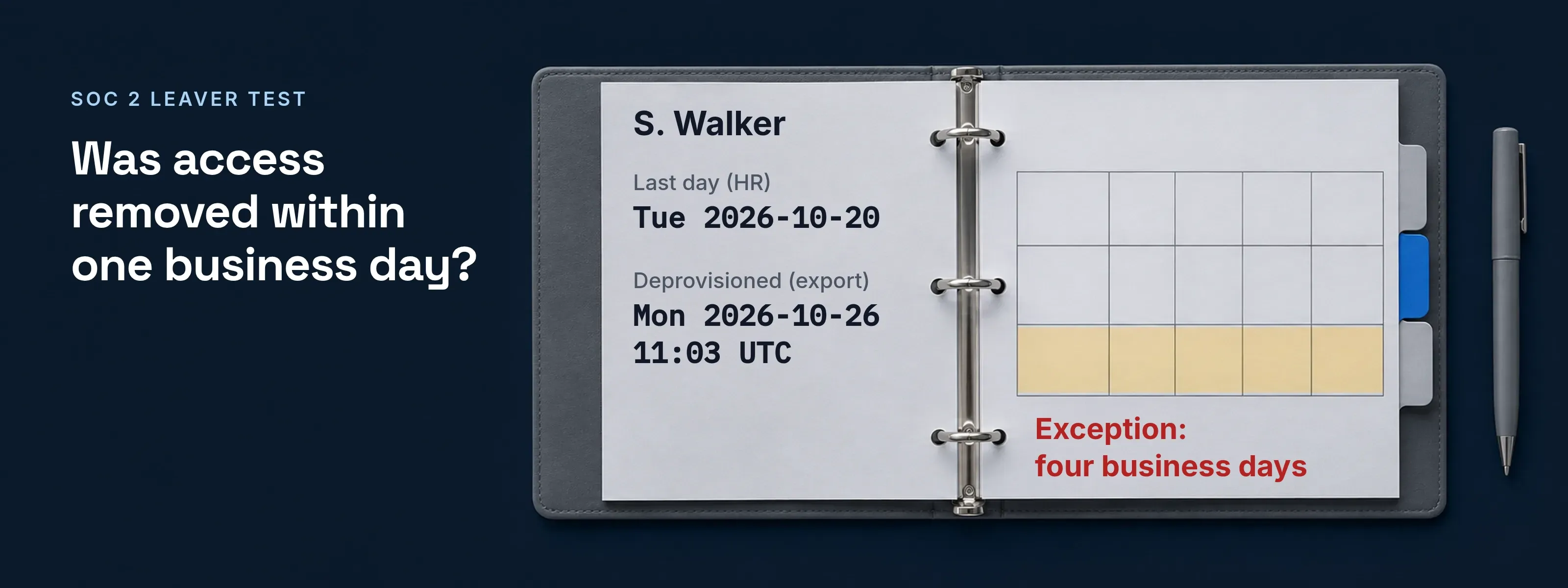
A testable control names an action and a limit: “access is removed within one business day of the last working day”.
Run the controls and keep the records
Each control leaves a dated record: a ticket, a sign-off or a log event.
Fieldwork
The CPA samples each population, such as every leaver, and checks each sample against its record. AICPA peer review guidance (May 2026) treats SOC 2 engagements with identical risk assessments, sample sizes and testing procedures across clients as nonconforming.
The SOC 2 report
Management’s description of the system, management’s assertion and the CPA’s opinion, with any exceptions the testing found.
Renew every year
AICPA’s October 2026 announcement says SOC 2 reports require annual renewal.
Access control: the records your identity system produces
The CC6 series covers logical and physical access controls. For logical access, the proof comes from the identity system.
- Who can sign in, and how? The sign-in policy, with the second factor set to Required or to Passkey or security key only. Changes log as
authentication_policy.updated. - Who was given access?
directory.user.provisionedandapplication.assignment.added, matched to an approved request. - Who holds access now? In SSOGEN, Assignment required is on by default, so only assigned people and groups open an application. Reviews add the sign-off; see identity governance.
- Who lost access, and when?
directory.user.deprovisioned,application.assignment.removedandplatform.session.revoked, matched to the HR leave date.
A leaver test, worked
Acme Corp’s control says access is removed within one business day of the last working day. The CPA samples three leavers and asks for each matching export event. All values are invented.
- event_id
- 7f3c9a2e-41b8-4d0e-9c55-1a2b3c4d5e6f
- event_type
- directory.user.deprovisioned
- result
- success
- created_at
- 2026-09-14T16:42:08Z
- user_id
- 4b1d8e20-6c3a-4f7b-8a91-0d2e3f4a5b6c
- correlation_id
- c2e8a7f1-93d4-4b6e-a0c2-7e8f9a0b1c2d
- actor_username
- hr-scim-client
- client_ip
- 192.0.2.81
| Leaver | Last day (HR) | Deprovisioned (export) | Against the control |
|---|---|---|---|
| J. Rivera | Mon 2026-09-14 | 2026-09-14 16:42 UTC | Within one business day |
| P. Chen | Fri 2026-10-02 | Mon 2026-10-05 09:10 UTC | Within one business day |
| S. Walker | Tue 2026-10-20 | Mon 2026-10-26 11:03 UTC | Exception: four business days |
S. Walker’s account stayed active for four business days. The CPA reports it as an exception and decides how much it weighs.
Access records SSOGEN keeps for an auditor
SSOGEN writes every sign-in, refusal, provisioning event and console change to a tamper-evident audit log.
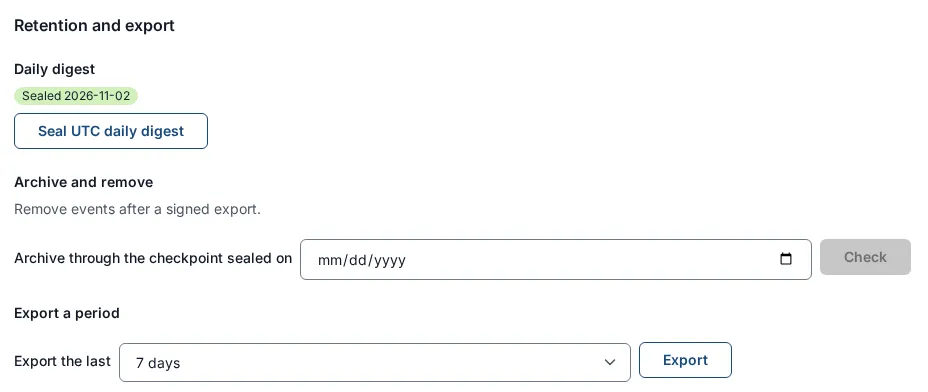
- Hash chain. Each event carries a fingerprint that depends on the one before it, so a change to an old event is detectable. A full verification runs every night at 02:35 UTC and is itself logged as
audit.integrity_verified. - Daily digest. A signed checkpoint of the log is sealed every night at 00:05 UTC.
- Export a period. 24 hours, 7 days, 30 days, 90 days or a year, as one JSON file with the fields in the leaver test, up to 50,000 events per file.
- Leavers stay on record. A SCIM client that sets
activeto false disables the account. The account remains, with every event the auditor may sample. - A role for evidence. The Security audit reader role sees the audit trail and nothing else.
Steps: the audit log guide.
What changes in 2027
What compliance teams ask about SOC 2
Is SOC 2 compliance mandatory?
No law requires it; a service organization commissions SOC 2 because its customers ask for it. The AICPA notes that customers and business partners often request a SOC 2 report to assess the risks of outsourcing to you. The requirement arrives in a security questionnaire or a contract clause.
Is there a SOC 2 certification?
No. There is no SOC 2 certification, only a CPA’s attestation report. The Journal of Accountancy notes that “compliance” is a term never used in SOC 2 examinations. A SOC 2 report is restricted to specified parties who understand the system. SOC 3 is the general-use version, with less detail.
How much does SOC 2 compliance cost?
The price depends on scope, so no single figure applies. The main drivers are the number of categories in scope, the number of systems and locations in the description, how much readiness work your controls need first, and the CPA firm you engage.
What is the difference between SOC 1 Type 2 and SOC 2 Type 2?
The difference is the subject. SOC 1 covers controls at a service organization that are likely to be relevant to its customers’ internal control over financial reporting, and it serves their financial statement auditors. SOC 2 covers controls relevant to security, availability, processing integrity, confidentiality and privacy, and it serves customers assessing those risks.
Sources
Sources, all read 2026-11-18:
- AICPA, 2017 Trust Services Criteria.
- AICPA, SOC 2 guide (2018), excerpt, paragraphs 1.05 (report types), 1.38 to 1.41 (common criteria, CC6 series).
- AICPA, SOC 2 guide, 2022 edition.
- AICPA, SOC 2 Report Walkthrough.
- AICPA, SOC 1 and SOC 3 topic pages.
- AICPA, 2027 exposure drafts, dated November 16, 2026.
- Journal of Accountancy, SOC credibility, February 1, 2026.
- Journal of Accountancy, peer review of SOC 2, May 14, 2026.
- Journal of Accountancy, proposed description criteria, November 17, 2026.
- Journal of Accountancy, AICPA and AIUC offering, October 19, 2026.
Updated