SSOGEN / Learn / Cyber Security Frameworks Compared
Learn
Cyber Security Frameworks Compared
What you hold at the end separates cyber security frameworks: a certificate, an auditor's report, an assessor's validation or your own self-assessment. One control, administrator MFA, is traced through three of them.
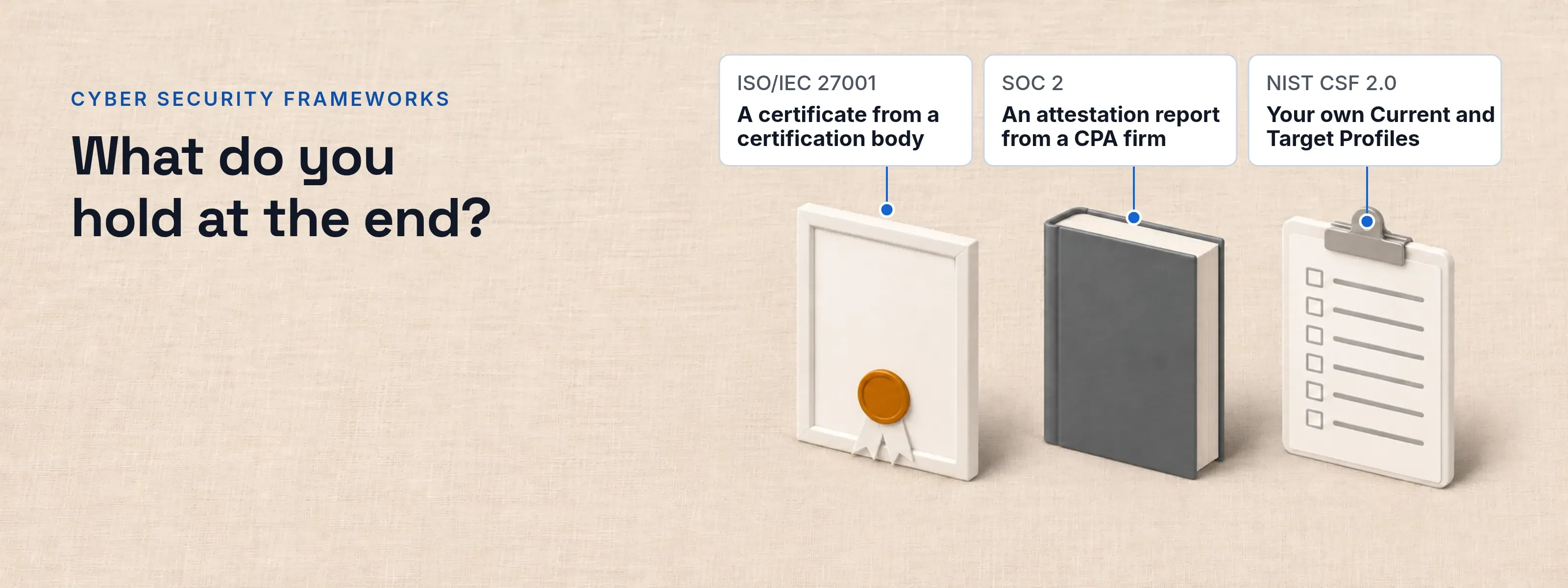
An ISO/IEC 27001 certificate, a SOC 2 attestation report and a PCI DSS validation are different artifacts, each issued by a different outside party. NIST CSF and CIS Controls end in documents you write yourself.
All five cybersecurity frameworks cover accounts, access and logging. What decides between them is who can demand each one.
Five frameworks side by side
Only ISO/IEC 27001 ends in a certificate. The security and compliance frameworks, compared on the facts that decide which one you need:
| Framework | Publisher and version | Legal force | Structure | What you hold at the end | Main cost |
|---|---|---|---|---|---|
NIST CSF 2.0 |
NIST, CSWP 29, published Feb 26, 2024 |
None. NIST says it may be adopted voluntarily |
6 Functions, 22 Categories, 106 Subcategories; Tiers 1 to 4 |
Your own Current and Target Profiles |
Your team’s time to profile and close the gaps |
ISO/IEC 27001:2022 |
ISO and IEC, Edition 3, October 2022; Amendment 1 (climate action), 2024 |
None. Certification is optional |
Requirements for an information security management system (ISMS), plus Annex A controls |
A certificate from a certification body, whose competence an accreditation body confirms |
Certification audits and the upkeep of the ISMS |
CIS Controls v8.1 |
Center for Internet Security, v8.1 |
None. Mapped to and referenced by legal and regulatory frameworks |
18 Controls, 153 Safeguards; Implementation Groups IG1 to IG3 |
Your own self-assessment against the Safeguards |
Engineering time per Safeguard |
SOC 2 |
AICPA, 2017 Trust Services Criteria with revised points of focus (2022) |
None. Customers of service organizations ask for it |
Criteria for Security, Availability, Processing Integrity, Confidentiality and Privacy |
An attestation report from a CPA firm |
The CPA firm’s examination |
PCI DSS v4.0.1 |
PCI Security Standards Council, v4.0.1 |
Contractual. Each payment brand runs its own compliance program |
Technical and operational requirements for payment account data |
Validation by a Qualified Security Assessor (QSA), or a Self-Assessment Questionnaire (SAQ) for eligible merchants |
Scope: every system that touches cardholder data or can affect its security |
Administrator MFA as PR.AA-03, Annex A 8.5 and CIS 6.5
Administrator MFA is one control with a different number and level of detail in each text:
- NIST CSF 2.0
PR.AA-03- “Users, services, and hardware are authenticated.” An outcome only: the CSF “does not prescribe how outcomes should be achieved.” MFA appears as NIST’s first Implementation Example for this Subcategory: “Require multifactor authentication.”
- ISO/IEC 27001:2022
- Annex A
8.5 - NIST’s own informative references map
PR.AA-03to Annex A 8.5 (and 5.17). Annex A names the control; the implementation guidance sits in ISO/IEC 27002:2022. - CIS Controls v8.1
- Safeguard
6.5, IG1 - “Require MFA for Administrative Access”: every administrative account, where supported, on-site or at a service provider. Named outright, and part of IG1.
CIS names the method; CSF names the outcome. Under any number, the proof is the same pair: the policy that requires a second factor and the log that shows it applied.
Which question each framework answers
Start from who is asking for proof, and stop at the first line that fits:
- A customer asks for a SOC 2 report: SOC 2. Only a CPA firm’s report answers that request.
- You store, process or transmit card data: PCI DSS. Your acquirer or the payment brand decides how you validate.
- An international customer asks for a certificate: ISO/IEC 27001. A certification body audits your ISMS and issues the certificate.
- A small team needs a first ordered list: CIS Controls. CIS calls IG1 “essential cyber hygiene”, the set every enterprise should start with.
- The board wants one language for risk: NIST CSF. Profiles state where you are and where you plan to be.
NIST CSF 2.0 in brief
Six Functions sort every outcome:
| Function | Outcome |
|---|---|
| Govern | Risk strategy, expectations and policy are set and monitored. |
| Identify | Current cybersecurity risks are understood. |
| Protect | Safeguards are used, including identity management, authentication and access control. |
| Detect | Possible attacks and compromises are found and analyzed. |
| Respond | Actions on a detected incident are taken. |
| Recover | Affected assets and operations are restored. |
Tiers rate the rigor of your risk practices: Partial (1), Risk Informed (2), Repeatable (3) and Adaptive (4). Profiles state outcomes: Current (today), Target (planned) and Community (a shared baseline for a sector or use case).
Administrator MFA as SSOGEN records it
The Admin Console has its own sign-in policy, and SSOGEN refuses to save that policy without a second factor. One administrator entering the console, as the audit log writes it. The excerpt is illustrative: Acme (acme.example), with an address from the 203.0.113.0/24 documentation range.
All from 203.0.113.24
| Time (UTC) | Client | Account | Result | Reading |
|---|---|---|---|---|
| 08:14:02 | 203.0.113.24 | dana.reyes@acme.example |
Success | mfa.challenge_started: the console asks for the second factor |
| 08:14:19 | 203.0.113.24 | dana.reyes@acme.example |
Failure mfa.rejected |
Second factor failed; the console stays closed |
| 08:14:25 | 203.0.113.24 | dana.reyes@acme.example |
Success | mfa.challenge_started: a second attempt |
| 08:14:37 | 203.0.113.24 | dana.reyes@acme.example |
Success | mfa.verified: the approval with number matching passed |
| 08:14:38 | 203.0.113.24 | dana.reyes@acme.example |
Success | admin.elevation_issued: the administrator entered the Admin Console |
Each line is evidence an assessor can sample. The policy behind the log:
- SSOGEN’s own second factor. The console never takes an email or text-message code, or another identity provider’s MFA. An administrator who signs in through a provider is asked for SSOGEN’s second factor first.
- Strongest choice offered. The policy editor suggests Passkey or security key only, which takes approvals and codes off the console.
- Short admin sessions. Administrator sign-in asks for a new sign-in after an hour. Admin mode ends after 15 minutes idle or 60 minutes in total, by default.
Setup and checks: Admin Console sign-in guide.
Common framework questions
What are some essential risk management frameworks?
For security work, start with NIST SP 800-37 Rev. 2, ISO 31000:2018 and ISO/IEC 27005:2022. SP 800-37 is NIST’s Risk Management Framework for information systems, published December 2018. ISO 31000 gives guidelines for risk of any kind. ISO/IEC 27005 is guidance on managing information security risks. CSF 2.0’s Govern function ties cybersecurity into enterprise risk management.
ISO 27001 vs SOC 2: what is the difference?
ISO/IEC 27001 ends in a certificate; SOC 2 ends in a report. A certification body audits your information security management system against the standard and certifies it. For SOC 2, a CPA firm examines your controls against AICPA’s Trust Services Criteria and writes an attestation report. Much of the control work overlaps, so one evidence set serves both.
Is NIST CSF the same as ISO 27001?
No. NIST CSF 2.0 is a voluntary set of outcomes; ISO/IEC 27001 is a certifiable management-system standard. The CSF does not prescribe how to reach an outcome. NIST publishes informative references that map CSF outcomes to ISO/IEC 27001:2022 controls, for example PR.AA-03 to Annex A 8.5, so one program can report in both.
Is any cyber security framework required by law?
None of the five is a statute. PCI DSS comes closest: each payment brand runs its own compliance program, and the brand or your acquirer decides whether you must validate. The other four become mandatory only when a contract, an insurer or a regulator names them, so read the exact wording of the clause that applies to you.
Each framework in depth
- SOC 2. Criteria, Type 1 and Type 2, audit stages: SOC 2 compliance.
- CIS Controls. All 18 Controls with their IG1 Safeguards: CIS Controls.
- Running the program. Governance, risk registers and compliance: what is GRC.
Sources, all read 2026-11-18: NIST CSWP 29, CSF 2.0 and its publication page; NIST CSF 2.0 Core export with Implementation Examples and informative references; ISO/IEC 27001:2022; ISO/IEC 27002:2022; CIS Controls v8.1; CIS Implementation Groups; CIS Controls Navigator; AICPA 2017 Trust Services Criteria; PCI DSS and PCI SSC merchant resources; NIST SP 800-37 Rev. 2; ISO 31000:2018; ISO/IEC 27005:2022.
Updated