SSOGEN / Learn / AI Governance Framework: NIST AI RMF, ISO 42001 and the EU AI Act Compared
Learn
AI Governance Framework: NIST AI RMF, ISO 42001 and the EU AI Act Compared
Three AI governance frameworks lead the field: the EU AI Act is law, ISO/IEC 42001 is a standard you can be certified against, and the NIST AI RMF is a voluntary guide. Each sets who decides about AI systems, which risks get assessed and what evidence proves it.
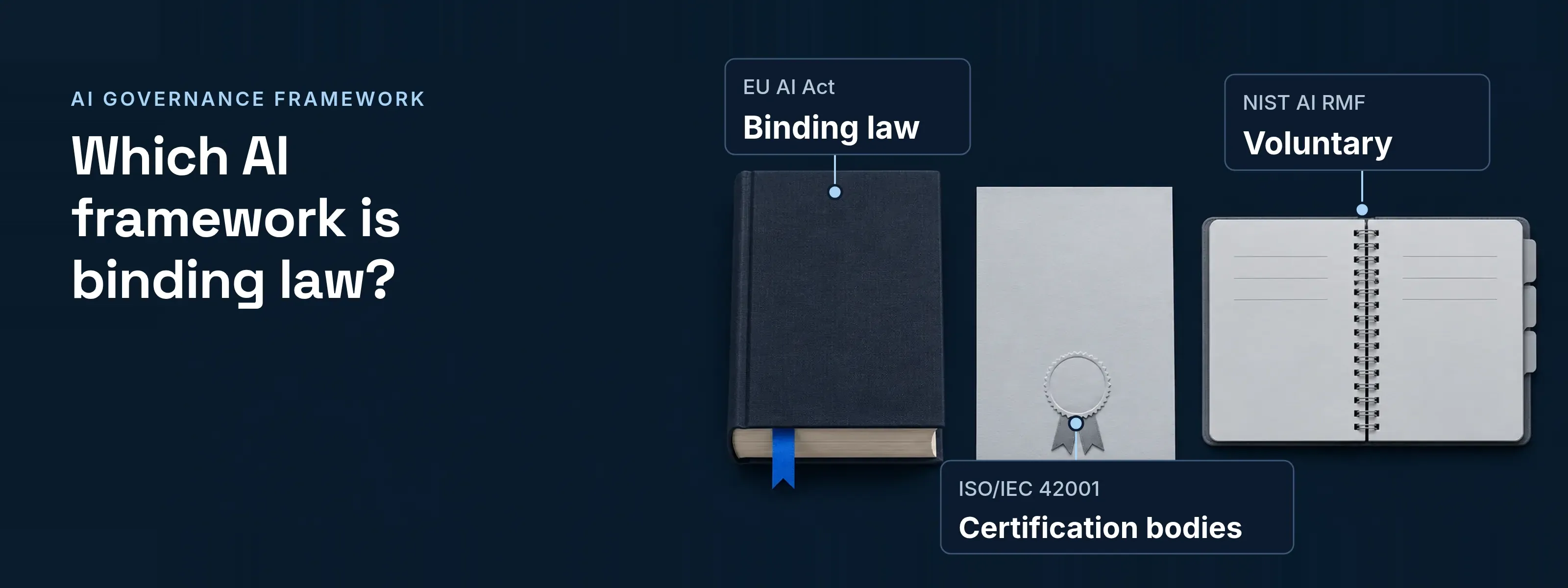
Most teams pick one AI governance framework as the backbone and map the other two onto it. The EU changed the AI Act timetable in 2026, so a guide that still names August 2, 2026 as the high-risk deadline is out of date.
The three frameworks side by side
Facts from NIST, ISO and the European Commission, read November 18, 2026.
| Question | NIST AI RMF | ISO/IEC 42001 | EU AI Act |
|---|---|---|---|
| What it is | A framework for managing AI risk, published by the US National Institute of Standards and Technology | An international standard for an AI management system (AIMS), published by ISO and IEC | Regulation (EU) 2024/1689, which the Commission calls the first comprehensive legal framework on AI |
| Legal force | Voluntary: NIST says it is “intended for voluntary use” | Voluntary, unless a customer or contract requires it | Binding law in every EU Member State |
| Who it applies to | Anyone who designs, develops, uses or evaluates AI, in organizations of any size or sector | Organizations of any size that develop, provide or use AI-based products or services | Providers placing AI on the EU market wherever they are established, deployers in the EU, and non-EU providers and deployers whose AI output is used in the EU |
| Structure | Four functions, Govern, Map, Measure and Manage, broken into categories and subcategories | Management system requirements in clauses 4 to 10, run as a Plan-Do-Check-Act cycle | Four risk levels: unacceptable (prohibited), high, transparency and minimal |
| Who checks it | Your own team, or a customer who asks | Certification bodies, which follow ISO/IEC 42006 (published July 2025) | The AI Office and Member State authorities, from August 2, 2026 |
| Key dates | Released January 26, 2023; Generative AI Profile, NIST-AI-600-1, July 26, 2024 | Edition 1 published December 2023 | In force August 1, 2024; applicable August 2, 2026; high-risk rules from December 2, 2027 (Annex III) and August 2, 2028 (Annex I) |
| Current status | AI RMF 1.0 is being revised as part of the White House AI Action Plan | ISO/IEC 42001:2023, edition 1, is the published edition | Amended by the AI Omnibus, in force since July 27, 2026 |
Clauses, Annex A controls and certification steps are on the page about ISO 42001 clauses and certification.
Dates that apply now
NIST is revising the AI RMF and has not set a date for the new version.
| Date | Framework | What applies |
|---|---|---|
January 26, 2023 |
NIST AI RMF |
NIST releases AI RMF 1.0 |
August 1, 2024 |
EU AI Act |
The Act enters into force |
February 2, 2025 |
EU AI Act |
Prohibitions 1 to 8 and the AI literacy obligations |
August 2, 2025 |
EU AI Act |
Governance rules and general-purpose AI (GPAI) model obligations |
July 27, 2026 |
EU AI Act |
The AI Omnibus enters into force and extends the high-risk timeline |
August 2, 2026 |
EU AI Act |
The Act applies, enforced by the AI Office and national authorities; transparency rules start |
December 2026 |
EU AI Act |
Prohibition 9: AI systems that generate non-consensual intimate content or child sexual abuse material |
December 2, 2027 |
EU AI Act |
High-risk rules in Annex III areas such as employment, education, biometrics and critical infrastructure |
August 2, 2028 |
EU AI Act |
High-risk rules for AI built into regulated products such as lifts and toys (Annex I) |
Which AI governance framework fits your organization?
Where you sell and what you must prove decide it. Selling AI systems in the EU brings the AI Act, which is law. Proving controls to customers points to ISO/IEC 42001 certification. An internal risk program can start from the voluntary NIST AI RMF. The three combine well: NIST publishes a crosswalk from the AI RMF to ISO/IEC 42001.
- You sell AI in the EU, or its output is used there: EU AI Act. Article 2 applies the Act to providers whether they are established in the EU or in a third country.
- Customers ask for a certificate: ISO/IEC 42001. A certification body audits your AI management system. ISO/IEC 42006 sets the requirements that body must meet.
- You need a working structure now: NIST AI RMF. Free to download, with a companion Playbook.
Behind many national AI policies sit the OECD AI Principles, adopted in May 2019 and updated in May 2024.
Turning a framework into evidence
A framework names the control; the auditor asks for the record. In SSOGEN, the records look like this.
- Traceability of access. Every sign-in, refusal and Admin Console change is an audit event with when, from where, who, what and the result.
- Human approval of sensitive actions. A scope marked Sensitive needs a fresh human approval every time, and each request and decision is recorded.
- Inventory of AI systems (AI RMF, GOVERN 1.6). Each AI agent is registered under AI agents, then Identities, and can do nothing until an administrator activates it.
- A record that holds up. Each event’s fingerprint depends on the one before it (a hash chain). A full verification of the chain runs every night at 02:35 UTC.
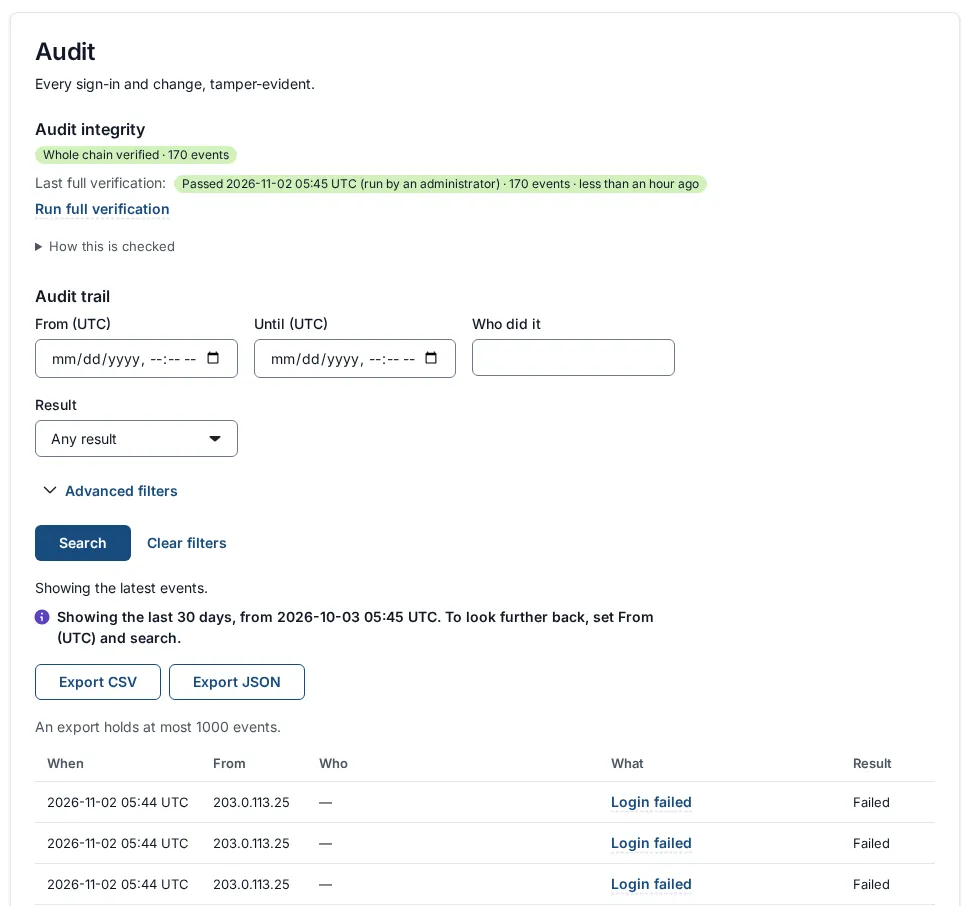
- Audit integrity. Whole chain verified, 170 events.
- Audit trail. One row per event: When, From, Who, What and Result, searchable by period and by person.
- Export. For an auditor, export a period from 24 hours to a year as one JSON file, as described in exporting the audit log.
Access rules leave evidence too. In a conditional access policy with What if, SSOGEN names the rule that would decide a sign-in without signing anyone in, and records each question in the audit log.
When the AI system is an agent
An agent calls applications on its own, so the framework’s accountability has to land on a person.
The six controls an auditor checks for agents are in the AI agent governance checklist.
Questions people ask
What does AI governance mean?
AI governance is the set of roles, policies and records an organization uses to decide which AI systems it builds or uses, which risks it accepts and who answers for each system. A framework gives that work a structure: the NIST AI RMF calls the cross-cutting part Govern, and ISO/IEC 42001 calls the whole an AI management system.
Is the NIST AI RMF mandatory?
No. NIST produced the AI RMF as a voluntary framework, and its FAQ says neither private nor public organizations are required to use it. It becomes binding for you only when a contract, a customer or your own policy adopts it. Version 1.0 is being revised, so check the NIST page before you cite it.
Can you get certified against the NIST AI RMF or ISO 42001?
Against ISO/IEC 42001, yes: a certification body audits your AI management system, under the rules of ISO/IEC 42006, published July 2025. The NIST AI RMF works differently. NIST states that its actions “do not constitute a checklist”, so teams document how they apply the four functions and often reuse that work for 42001.
Does the EU AI Act apply to companies outside the EU?
Yes. Article 2 covers providers that place AI systems or general-purpose AI models on the EU market, wherever they are established. It also covers non-EU providers and deployers when their system’s output is used in the EU. Using a prohibited practice can cost up to EUR 35 million or 7% of worldwide annual turnover.
Where these facts come from
Sources, all read 2026-11-18: NIST, AI Risk Management Framework; NIST, AI RMF FAQs; NIST AI 100-1, AI RMF 1.0; NIST, AI RMF to ISO/IEC 42001 crosswalk; European Commission, AI Act (last updated October 19, 2026); European Commission, AI Omnibus enters into force; AI Act Service Desk, Article 2 and Article 99, consolidated text as at July 27, 2026; ISO, ISO/IEC 42001:2023; ISO, ISO/IEC 42006:2025; OECD, AI Principles.
Updated