SSOGEN / Learn / AI Security Posture Management (AI-SPM)
Learn
AI Security Posture Management (AI-SPM)
Every model, agent, endpoint and data connection an organization runs goes into one inventory under AI security posture management (AI-SPM), which checks each one against a security baseline and ranks the gaps by what they can reach.
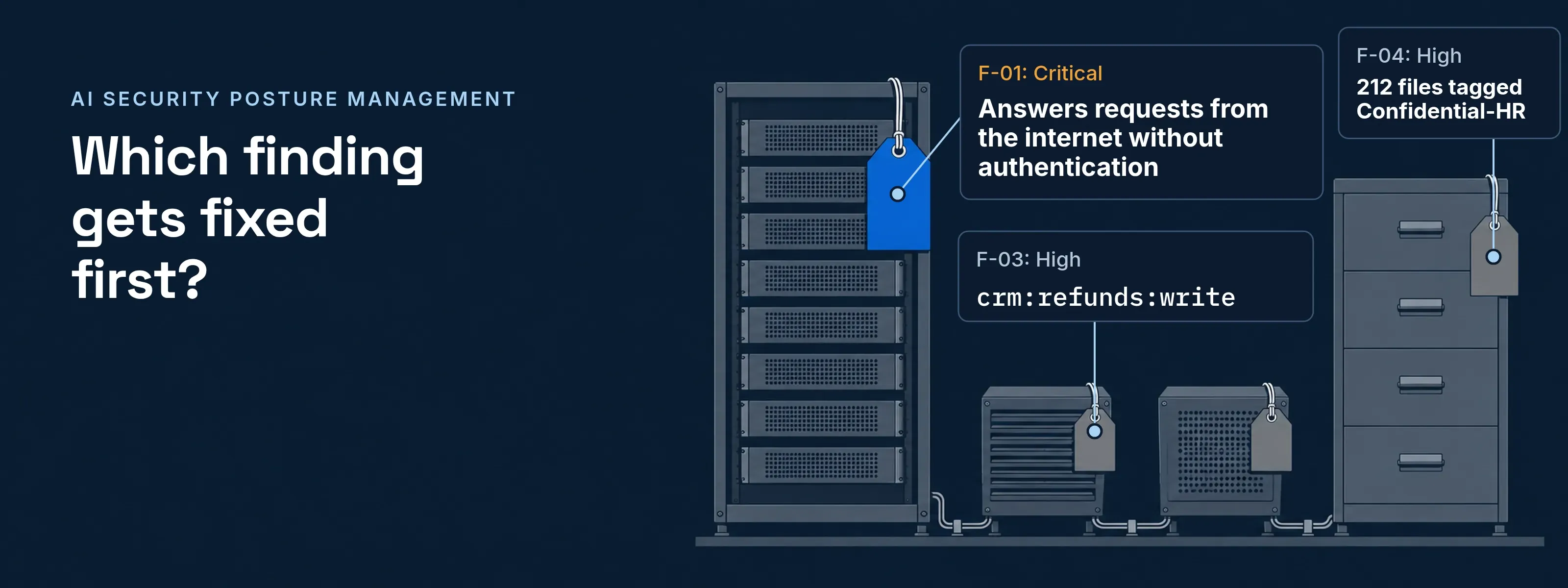
The deliverable of AI security posture management is a findings list, not a score. Each finding names an asset, its evidence, a severity and the person who fixes it.
Crestline’s AI estate: eight findings from one scan
- Company
- Crestline Supply Co. (fictional; values are illustrative)
- Scope
- One cloud account, two agent hosts, 30 days of outbound proxy log
- Scan date
- 2026-11-02
- Findings
- 8: 1 critical, 3 high, 4 medium
| ID | Asset | Finding | Evidence | Severity | Fix owner | Class |
|---|---|---|---|---|---|---|
F-01 |
Model endpoint inference.crestline.example/v1/chat |
Answers requests from the internet without authentication |
An unauthenticated POST from outside the network returns HTTP 200 |
Critical |
Dana Whitfield, infrastructure lead |
Exposure |
F-02 |
Agent support-copilot |
Calls the CRM with a static API key that nobody owns |
Key created 2025-03-02, never rotated; owner field empty |
High |
Jenna Alvarez, support operations |
Identity |
F-03 |
Agent support-copilot |
Can issue refunds, while its job needs read access only |
Grant crm:refunds:write; zero write calls in 90 days |
High |
Jenna Alvarez, support operations |
Identity |
F-04 |
Retrieval index hr-policies |
Holds salary files, and retrieval ignores document permissions |
212 files tagged Confidential-HR in the index |
High |
Marcus Reed, data engineering |
Data |
F-05 |
Model file forecast-v3.pkl |
Loaded as a pickle from a public model hub with no pinned hash |
Download URL with no checksum in the deploy manifest |
Medium |
Marcus Reed, data engineering |
Supply chain |
F-06 |
Agent nightly-forecast |
Past its review date and still receiving tokens |
Review date 2026-08-31; last token 2026-11-02 03:00 |
Medium |
Marcus Reed, data engineering |
Identity |
F-07 |
Outbound proxy |
Staff upload files to an unapproved chat service |
37 distinct users in 30 days to chat.unvetted-ai.example |
Medium |
Dana Whitfield, infrastructure lead |
Visibility |
F-08 |
Agent tool calls |
No record of which agent called which tool, or for whom |
Tool server keeps requests 7 days, with no caller identity |
Medium |
Dana Whitfield, infrastructure lead |
Visibility |
F-01 ranks first: anyone on the internet can use it today. Two of the next three rows concern what one agent holds, not what the model does.
What an AI-SPM inventory covers
A scan covers five asset types, each with its own discovery source and baseline check.
- Models. Hosted model deployments and model files, listed from the cloud inventory API and deployment manifests. Baseline: an approved source, a pinned hash, a format that cannot run code on load (F-05).
- Endpoints. Inference URLs and their API gateways, found in network configuration and confirmed by an outside probe. Baseline: authentication on every route, no public route unless intended (F-01).
- Agents. Every non-human identity that calls tools, with its credential, grants, owner and review date, read from the agent registry. Baseline: a named owner, an expiring credential, grants that match observed use (F-02, F-03, F-06).
- Data connections. Retrieval indexes, vector stores, fine-tuning sets and the tool servers agents call, checked against data classification tags. Baseline: no restricted class unless retrieval enforces permissions, and call logs that name the caller (F-04, F-08).
- Outside AI use. Public AI services that staff reach directly, found in proxy or DNS logs. Baseline: a published list of approved services (F-07).
How it differs from CSPM, DSPM and ISPM
The method is the same in all four disciplines: inventory, compare, rank, fix. The inventory is what changes.
| Discipline | What it inventories | A typical finding | In the Crestline report |
|---|---|---|---|
| CSPM (cloud) | Cloud resources and their configuration | A storage bucket or endpoint open to the internet | F-01, the exposed inference endpoint |
| DSPM (data) | Data stores and the classification of what they hold | Restricted data in a store with broad access | F-04, salary files in a retrieval index |
| ISPM (identity) | The identity system: accounts, administrators, MFA, application consents, machine credentials | A standing credential with no owner | F-02, the unowned static key |
| AI-SPM (AI) | Models, endpoints, agents, AI data paths, outside AI use | Agent grants wider than the job; a model from an unpinned source | All eight; F-03, F-05 and F-07 appear in no other column |
The overlap is deliberate: AI-SPM reads cloud, data and identity facts through the AI asset each one affects. Tenant settings and MFA coverage belong to identity security posture management.
Running an assessment, from discovery to re-scan
Discover
Pull the asset list from the cloud inventory API, the agent registry and 30 days of proxy logs. Output: one row per asset, owner field included even when empty.
Compare with a baseline
Write checks from your policy and a public reference such as the OWASP Top 10 for LLM Applications or the NIST AI RMF 1.0. Output: one finding per failed check, with its evidence.
Rank by reach
Severity follows what the asset can touch and who can touch it. Internet-reachable outranks internal, write access outranks read, restricted data outranks public. Output: the severity column.
Assign and fix
Every finding gets a named owner and a due date. An asset with no owner becomes its own finding, as F-02 shows.
Re-scan the same scope
A finding is closed only when its check passes on the next scan. Expect new agents and endpoints between scans.
Which control closes each finding
Four findings close with network, data, supply-chain and proxy controls.
- F-01, exposed endpoint: Network. Require authentication on the endpoint, remove the public route, then repeat the outside probe.
- F-04, salary files in the index: Data. Remove the Confidential-HR files, or enforce document permissions at retrieval for the asking person.
- F-05, unpinned pickle: Supply chain. Pin the file’s hash in the manifest and store weights as safetensors. Python’s pickle can execute arbitrary code while it loads.
- F-07, unapproved chat service: Proxy. Publish the approved-service list, then block or warn at the proxy.
These four close with identity controls: SSOGEN registers each AI agent as an identity and issues or refuses every token it uses.
- F-02, the unowned static key.When
support-copilotis registered in SSOGEN, then it has up to five named owners and proves itself with a key pair instead of an API key. Each token is bound to that key and lives about four minutes. - F-03, the refund grant.When the agent requests a scope it was not granted, then SSOGEN refuses it. Grant read scopes only and mark refunds Sensitive, so each use waits for a person’s fresh approval. An access rule can also test who is asking and which named agent is acting.
- F-06, the lapsed review.When the Review by date passes without a review, then SSOGEN suspends the agent and issues it no new tokens.
- F-08, no caller on record.When SSOGEN issues or refuses a token, makes an access decision or changes a grant or delegation, then it writes an event to a tamper-evident, hash-chained audit log.
Keeping them closed, with reviews and revocation drills, is the work of AI agent governance.
Posture management questions
What is posture management in cyber security?
Posture management is a continuous inventory of assets, each compared with a baseline, with the gaps ranked and assigned. It runs on a schedule, not once a year, and every finding carries evidence. CSPM applies the method to cloud resources, DSPM to data stores, ISPM to the identity system and AI-SPM to models, agents and AI data paths.
What are the top 3 AI security risks?
In the OWASP GenAI LLM Top 10 2026, the first three are prompt injection, sensitive information disclosure and excessive agency. The ranking is OWASP’s, weighted three quarters on a practitioner vote and one quarter on incident data. In the Crestline report, F-04 is a disclosure risk and F-03 is excessive agency.
How is AI-SPM different from CSPM?
CSPM checks cloud resources; AI-SPM checks the AI assets running on them. CSPM flags a public endpoint or an open storage bucket. AI-SPM adds the model behind that endpoint, the grants each agent holds, what a retrieval index contains and which outside AI services staff use.
Sources, all read 2026-11-18:
- OWASP GenAI LLM Top 10 2026, PDF dated August 4, 2026 (ranking, method, pickle in LLM04)
- Python documentation, pickle, the warning that unpickling can execute arbitrary code
- Hugging Face, Safetensors documentation
- NIST, AI Risk Management Framework, AI RMF 1.0 released January 26, 2023
Updated