SSOGEN / Learn / What Is GRC? Governance, Risk and Compliance in One Worked Example
Learn
What Is GRC? Governance, Risk and Compliance in One Worked Example
Three functions make up GRC: governance writes the rule, risk management scores what the rule protects against, and compliance maps a control to it and keeps the proof.
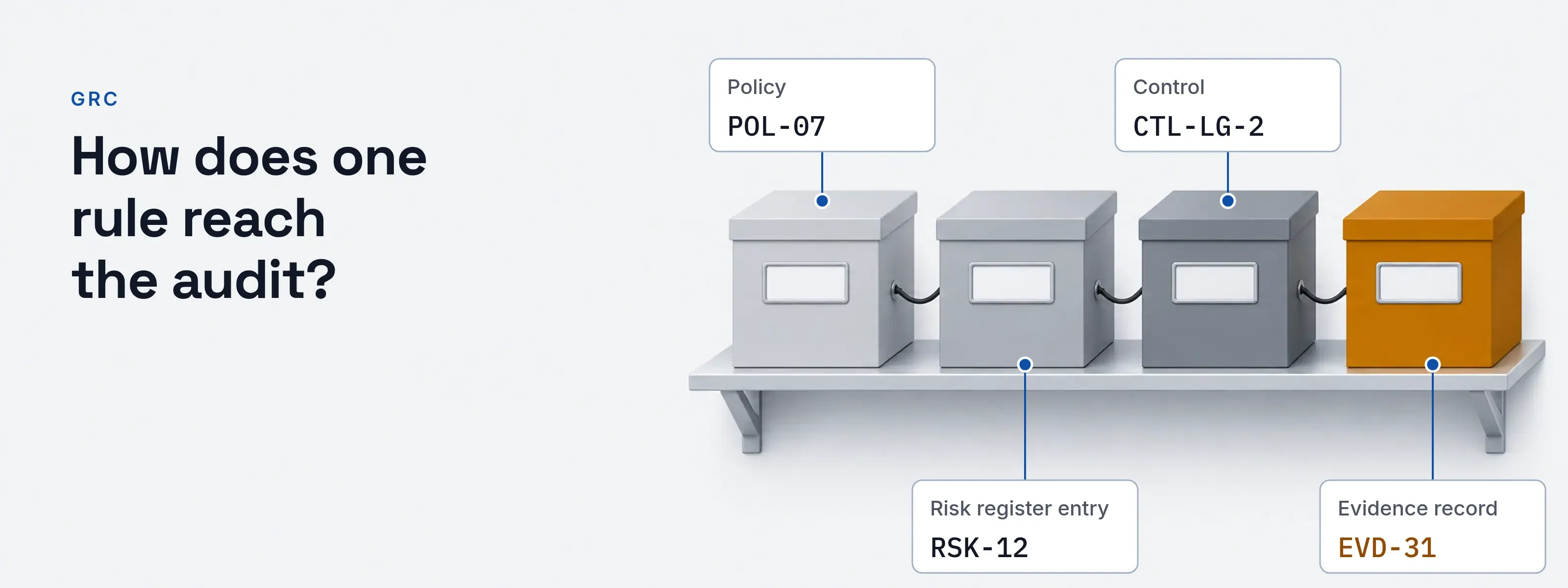
In practice, a GRC program is a chain of four records: a policy, a risk register entry, a control and the evidence that the control works. Each record carries the ID of the next one. An auditor can start at the policy and end at a log file, or start at the log file and find the policy.
This page follows one rule through that chain: audit records are kept, and any change to them shows.
One control, from policy to audit evidence
The IDs, scores, dates and job titles below are a worked example, not data from any organization. The framework IDs and the SSOGEN labels are real.
- Statement
- Security audit records are kept for at least 13 months, and any change to them is detectable.
- Applies to
- The identity provider's audit trail
- Owner
- CISO
- Approved
- 2026-03-02
- Next review
- 2027-03-02
- NIST CSF 2.0
- GV.PO-01
The policy states the outcome and who answers for it. It names no product and no setting.
- Threat
- An intruder with administrator rights edits or deletes audit events to hide a change
- Likelihood
- 3 of 5
- Impact
- 5 of 5
- Score
- 15 of 25 (likelihood × impact)
- Treatment
- Reduce
- Owner
- Head of IT operations
- Policy
- POL-07
- NIST CSF 2.0
- ID.RA-04, ID.RA-06
An incident response plan starts from the audit trail. If events can be changed without a trace, nothing after the incident can be proven.
- Requirement
- Automatic audit retention on at 400 days; archive files kept for seven years; nightly full chain verification passes
- Treats
- RSK-12
- NIST CSF 2.0
- PR.PS-04
- ISO/IEC 27001:2022
- Annex A 8.15 and 8.17 as mapped from PR.PS-04 in NIST's CSF 2.0 informative references
- Test
- Quarterly, by the IAM lead
- Evidence
- EVD-31
One control maps to two frameworks, so one quarterly test serves both. CSF 2.0 words PR.PS-04 as “Log records are generated and made available for continuous monitoring.”
- Control
- CTL-LG-2
- Setting
- Automatic retention: enabled, 400 days
- Test result
- Whole chain verified · 12,408 events
- Log export
- 90 days, JSON, Chain verified
- Collected
- 2026-11-18
Each event’s fingerprint depends on the one before it. An edited or deleted event breaks the chain, so the intruder in RSK-12 cannot hide the change.
What are the three pillars of GRC?
The three pillars are governance, risk management and compliance. Governance sets policy and decides who owns each decision. Risk management finds, scores and treats what could go wrong. Compliance identifies the laws, contracts and frameworks that apply, maps controls to them and proves the controls work. NIST CSF 2.0 places all three in its Govern and Identify functions.
| Pillar | Question it answers | Artifact | Typical owner | NIST CSF 2.0 home |
|---|---|---|---|---|
| Governance | What must be true, and who decides? | Policy with an owner and a review date | Executive leadership, CISO | GV.PO-01 |
| Risk | What could go wrong, how likely is it, how bad would it be? | Risk register entry with likelihood, impact and treatment | One named owner per risk | GV.RM-06, ID.RA-04 to ID.RA-06 |
| Compliance | Which obligations apply, and does each control work? | Control mapped to framework clauses, with evidence | Compliance team, internal audit | GV.OC-03 |
Oversight closes the loop. Under GV.OV-01, risk outcomes are reviewed to adjust the strategy, and the strategy changes the policies at the top of the chain.
The evidence an auditor accepts for this control
EVD-31 holds the setting, a test anyone can repeat and a log export whose integrity can be shown.
PUT /admin/api/audit/retention{"enabled": true, "days": 400}
Allowed range 90 to 2,555 daysDaily run 03:30 UTCArchive folder /var/lib/ssogen/audit-archiveAudit event audit.retention_changed{ "from": "2026-08-20T00:00:00Z", "to": "2026-11-18T00:00:00Z", "count": 12408, "truncated": false, "items": [ { "event_id": "4f1c9a7e-0b52-4e8d-9a31-7c2d5e6f8a10", "event_type": "audit.retention_changed", "result": "success", "created_at": "2026-09-03T08:14:22Z", "user_id": "u-1042", "correlation_id": "c-77d1e3", "actor_username": "k.bishop", "client_ip": "198.51.100.47" } ]}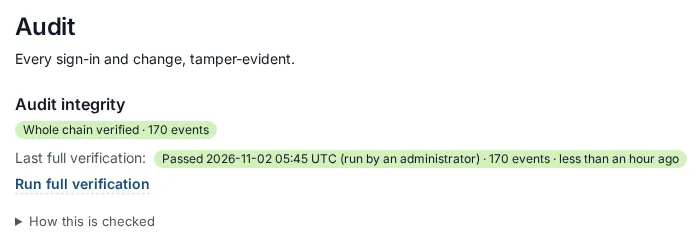
- Repeat the test. Send
POST /admin/api/audit/retention/runwith{"dry_run": true}. It shows what a run would remove, writes no file and is itself recorded in the audit log. - Show the chain is intact. Each audit event carries a fingerprint that depends on the one before it. A full verification runs every night at 02:35 UTC, and a signed daily checkpoint is sealed at 00:05 UTC. The badge reads Chain verified with the event count.
- Check the file is complete. Export a period offers 24 hours, 7 days, 30 days, 90 days or a year. An export holds at most 50,000 events. If
truncatedistrue, export a shorter period or several consecutive ones.
Archive files are the only copy of removed events, so back up the archive folder. The audit log guide covers search, export, archiving and the integrity check in full.
GRC, identity governance, frameworks and SOC 2 answer different questions
- GRC. Which risks matter, which controls treat them, and whether those controls work. It spans every system, not only identity.
- Identity governance. Who should have access to each system, who approved it and when it was removed. See identity governance over one employee’s 14 months.
- Framework. A published catalog of outcomes or controls that a GRC program maps to, such as NIST CSF 2.0 or ISO/IEC 27001:2022. See how cyber security frameworks differ.
- SOC 2. An auditor’s report on a service organization’s controls, tested against the AICPA Trust Services Criteria. See what a SOC 2 audit involves.
Two more questions about GRC
What does GRC stand for?
The letters stand for governance, risk and compliance. Together they cover the policies an organization sets, the risks it accepts or treats, and the obligations it must show it meets. In security teams, GRC usually means the cybersecurity part of that program: policies, a risk register, control mappings and the audit evidence behind them.
Is SAP security and GRC the same?
No. SAP security is the work of building roles and authorizations inside SAP systems, while SAP GRC is SAP’s software for governing that access and the related risks. SAP Access Control, one part of it, automates user provisioning, runs periodic access reviews, checks segregation of duties and controls emergency “firefighter” IDs.
Sources
Sources, all read 2026-11-18: NIST CSWP 29, The NIST Cybersecurity Framework (CSF) 2.0 (February 26, 2024), AICPA, 2017 Trust Services Criteria (With Revised Points of Focus, 2022), SAP GRC and cybersecurity software and SAP Access Control. ISO/IEC 27001:2022 Annex A controls are cited by number.
Updated