SSOGEN / Learn / RADIUS vs TACACS+: Network Access vs Device Administration
Learn
RADIUS vs TACACS+: Network Access vs Device Administration
In RADIUS vs TACACS+, the job decides: RADIUS admits users and devices to a network over UDP 1812; TACACS+ runs over TCP 49 and authorizes each command an administrator types.
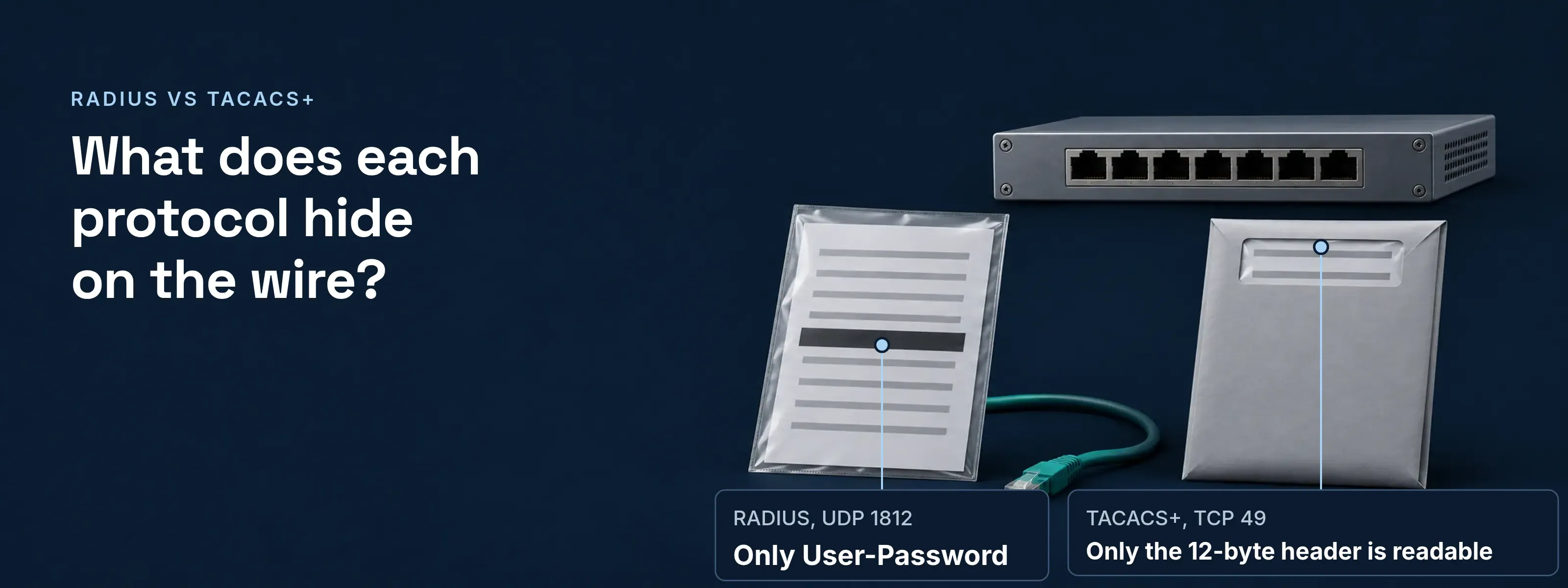
In short: RADIUS controls who joins the network; TACACS+ controls what an administrator may do on a network device, one command at a time. Both are AAA protocols built on a shared secret and MD5.
What is the difference between RADIUS and TACACS+?
RADIUS and TACACS+ differ in transport, in what the packet hides, in how they split authentication from authorization, and in command control. RADIUS uses UDP and returns authorization inside the authentication answer. TACACS+ uses TCP, keeps authentication, authorization and accounting as separate exchanges, and can authorize every shell command on its own.
| RADIUS | TACACS+ | |
|---|---|---|
| Purpose | Network access for users and devices (RFC 2865, section 1) | Device administration (RFC 8907, section 1) |
| Standard | RFC 2865, Standards Track, June 2000; accounting in RFC 2866 | RFC 8907, Informational, September 2020; TLS 1.3 transport in RFC 9887, Standards Track, December 2025 |
| Transport and ports | UDP 1812 for authentication, UDP 1813 for accounting (RFC 2865 section 3; RFC 2866 section 3) | TCP 49 (RFC 8907, section 3.4); TCP 300 over TLS (RFC 9887, section 3.1) |
| What is hidden | Only User-Password, XORed with an MD5 hash of the shared secret (RFC 2865, section 5.2) | The whole body after the 12-byte header, XORed with an MD5 pad the RFC calls obfuscation (RFC 8907, sections 4.1 and 4.5) |
| AAA split | Authentication and authorization combined: the Access-Accept carries the authorization attributes (RFC 2865, section 4.2) | Three separate exchanges; a deployment may use any of them (RFC 8907, section 1) |
| Per-command authorization | Not defined in RFC 2865 | One REQUEST and one REPLY per command, using cmd and cmd-arg (RFC 8907, sections 6 and 8.2) |
| Typical clients | Wi-Fi access points and switches for 802.1X, VPN gateways, ISP access servers | Routers, switches, firewalls and network access servers managed through a CLI |
For the terms behind the AAA row, see authentication vs authorization.
What does each protocol leave readable on the wire?
In a RADIUS Access-Request, every attribute except User-Password is readable in a packet capture. In a TACACS+ packet, only the 12-byte header is readable; the body is XORed with an MD5-based pad. RFC 8907 calls that “obfuscation” and not “encryption”, because it provides “no meaningful integrity, privacy, or replay protection” (section 10.1).
| Field | Example value | In a capture |
|---|---|---|
| Code | 1 (Access-Request) | Readable |
| Request Authenticator | 16 random octets | Readable |
| User-Name (1) | maria@acme.example |
Readable |
| User-Password (2) | 16 octets | Hidden: XORed with MD5(secret + authenticator) |
| NAS-IP-Address (4) | 192.0.2.10 |
Readable |
| Calling-Station-Id (31) | 00-00-5E-00-53-01 |
Readable |
| Field | Example value | In a capture |
|---|---|---|
| version | 0xc major, 0x0 minor |
Readable (header) |
| type | 0x01 (authentication) |
Readable (header) |
| seq_no, flags | 1, 0x00 (obfuscation on) |
Readable (header) |
| session_id, length | 0x3f9c2e71, body length |
Readable (header) |
| action, priv_lvl, authen_type | LOGIN, 1, ASCII | Obfuscated |
| user | maria |
Obfuscated |
| port, rem_addr | tty1, 192.0.2.25 |
Obfuscated |
Field names follow RFC 2865 and RFC 8907; values are fictional. Anyone who learns or breaks the shared secret reads every TACACS+ field, so RFC 8907 section 10.5 says administrators “MUST NOT rely on the obfuscation”.
How does TACACS+ authorize each command?
In command-based authorization, the device sends the TACACS+ server one authorization REQUEST per command: service=shell, the command name in cmd and each argument in cmd-arg (RFC 8907, section 8.2). The server replies PASS_ADD or PASS_REPL to permit, or FAIL to refuse. Accounting records then log what ran.
TACACS+ per-command authorization: show permitted, reload refused
- AdministratorSSH session to the switch
- SwitchTACACS+ client, 192.0.2.10
- TACACS+ serverTCP 49
- Administrator to Switch1Types show running-config
- Switch to TACACS+ server2Authorization REQUEST: cmd=show, cmd-arg=running-configOne request for this one command, user maria.
- TACACS+ server to Switch3REPLY: PASS_ADDThe command is authorized; the switch prints the configuration.
- Administrator to Switch4Types reload
- Switch to TACACS+ server5Authorization REQUEST: cmd=reload
- TACACS+ server to Switch6REPLY: FAILThe policy does not allow maria to restart the device. The switch refuses the command.
- Switch to TACACS+ server7Accounting REQUEST, STOP flag: cmd=showThe record carries the authorization fields plus timing.
RADIUS has no such exchange in RFC 2865: one Access-Accept configures the service from the start. For administrator access to SSH and RDP servers, see how a jump server works.
Where does each protocol fit?
RADIUS fits where a user or device joins a network. TACACS+ fits where an administrator manages a network device.
- 802.1X on wired ports and Wi-Fi: RADIUS. The switch or access point carries EAP to the server inside RADIUS (RFC 3579).
- VPN sign-in: RADIUS. The VPN gateway is the network access server and receives the session attributes in the Access-Accept.
- Dial-in and ISP access: RADIUS. The protocol’s original job; the name stands for Remote Authentication Dial In User Service.
- Router and switch CLI sign-in: TACACS+. Authentication carries a privilege level for the session (RFC 8907, section 9).
- Firewall administration: TACACS+. Configuration commands can be authorized one by one against the administrator’s policy.
- Command audit: TACACS+. Accounting START and STOP records include the
cmdandcmd-argvalues (RFC 8907, sections 7 and 8.3).
How secure are RADIUS and TACACS+ today?
Neither protocol is safe on an untrusted network without a secure transport around it. Both depend on MD5 and a shared secret. RFC 8907 requires TACACS+ to run on networks that “ensure privacy and integrity”, and BlastRADIUS showed in 2024 that RADIUS responses over UDP can be forged. Both protocols now have TLS transports.
- 1993RFC 1492 documents the original TACACS and Cisco’s extended version, over UDP port 49.
- 2000RFC 2865 defines RADIUS. Its section 8 notes that the User-Password hiding method “has not been subjected to significant amounts of cryptanalysis”.
- 2012 and 2014RFC 6614 defines RADIUS over TLS (RadSec) on TCP 2083; RFC 7360 adds RADIUS over DTLS on UDP 2083. Both are Experimental.
- 2020RFC 8907 documents TACACS+ and states its protocol “does not include a security mechanism that would meet modern-day requirements”.
- July 2024BlastRADIUS (CVE-2024-3596): an on-path attacker turns an Access-Reject into an Access-Accept with an MD5 chosen-prefix collision, for non-EAP authentication over UDP. Short-term fix: require Message-Authenticator in every packet, first in Access-Accept and Access-Reject. Long-term fix: RADIUS inside TLS.
- December 2025RFC 9887 defines TACACS+ over TLS 1.3 on TCP 300 with mutual authentication. It makes obfuscation obsolete: clients set TAC_PLUS_UNENCRYPTED_FLAG on every packet inside TLS.
- November 2026A Standards Track revision of RADIUS over TLS and DTLS (draft-ietf-radext-radiusdtls-bis) is in the RFC Editor queue.
Both TLS profiles authenticate client and server, as in mutual TLS.
RADIUS, TACACS+ and Diameter in brief
What is a RADIUS server used for?
A RADIUS server decides whether a user or device may join a network. A network access server, such as a Wi-Fi access point, switch or VPN gateway, sends it an Access-Request on UDP 1812. The server answers Access-Accept, Access-Reject or Access-Challenge, and receives accounting records on UDP 1813 (RFC 2865, RFC 2866). A full sign-in, packet by packet, is decoded in what is RADIUS authentication.
What is the TACACS+ protocol?
TACACS+ is an AAA protocol for device administration. A router, switch or firewall sends its server separate authentication, authorization and accounting requests over TCP port 49, so each administrator command can be checked and logged. RFC 8907 (2020) documents the protocol, and RFC 9887 (2025) adds a TLS 1.3 transport on TCP port 300.
What is the difference between RADIUS and Diameter protocol?
Diameter is a separate AAA protocol, not a newer RADIUS version. RFC 6733 (2012) defines its base protocol for network access and IP mobility, in local and roaming situations. It runs over TCP or SCTP on port 3868; IANA assigns port 5868 for Diameter over TLS and DTLS. RADIUS runs over UDP 1812 and 1813.
What version of TACACS is still in use?
TACACS+ is the version in use; RFC 8907 describes it as widely deployed for device administration. The original TACACS and Cisco’s extended TACACS, documented in RFC 1492 (1993), are older UDP protocols on port 49. RFC 8907 specifies TACACS+ only, and RFC 9887 updates it to run over TLS 1.3.
Related pages and sources
- The Learn hub, with the other protocol explainers.
- SSOGEN Remote Access, browser SSH, RDP and VNC with approval and session audit.
Primary sources (read 2026-11-17): RFC 2865, RFC 2866, RFC 8907, RFC 9887, RFC 1492, RFC 3579, RFC 6614, RFC 7360, RFC 6733, IANA port registry, IETF datatracker, draft-ietf-radext-radiusdtls-bis, NVD, CVE-2024-3596, Blast-RADIUS disclosure.
Updated