SSOGEN / Learn / What Is ReBAC (Relationship-Based Access Control)?
Learn
What Is ReBAC (Relationship-Based Access Control)?
Stored relationships decide access under relationship-based access control (ReBAC): Ann is a member of eng, eng can view the handbook folder, and the folder holds the readme.
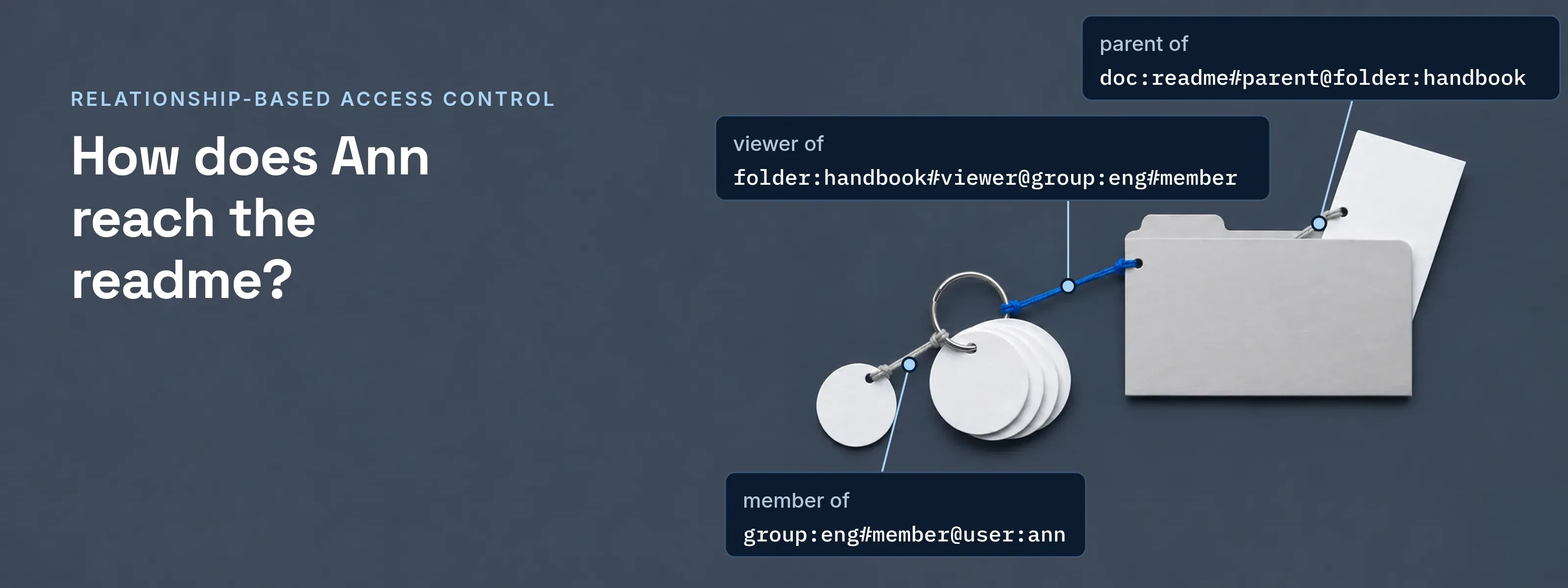
Each grant is stored as a relationship between an object and a user or group. A check asks “does user U have relation R to object O?” and follows those relationships to the answer. Google described the model at scale in its Zanzibar paper (USENIX ATC 2019).
Sharing a readme under RBAC, ABAC and ReBAC
doc:readme sits in folder:handbook. Ann is in group:eng, and eng can view the folder. Bob owns the readme. The same four events, decided three ways (definitions of the first two models are on RBAC vs ABAC):
| Event | RBAC | ABAC | ReBAC |
|---|---|---|---|
| Ann opens the readme | Allowed if one of her roles grants view on handbook documents | Allowed if a policy matches her department attribute to the document’s | Allowed: Ann is a member of eng, eng views the handbook, the handbook is the readme’s parent |
| Bob shares the readme with contractor Carl | A new role, or a one-off exception for one person and one file | A shared_with attribute on the document and a rule that reads it |
One new tuple: doc:readme#viewer@user:carl |
The readme moves to folder:archive |
Every role scoped to the handbook needs a review | The folder attribute changes; the policy reads the new value | One parent tuple is replaced; access now follows the archive’s viewers |
| Carl’s share is revoked | Remove the exception | Edit the attribute list | Delete one tuple |
Sharing is where the models part: a role describes a job and an attribute describes context, but neither records “Bob gave Carl this file”.
Writing relationships as tuples
Each grant is one row: object, relation, user. These five rows hold the whole example:
doc:readme#owner@user:bobdoc:readme#viewer@user:carldoc:readme#parent@folder:handbookfolder:handbook#viewer@group:eng#membergroup:eng#member@user:annThe format object#relation@user comes from the Zanzibar paper, which writes users as integers (doc:readme#owner@10). Typed subjects such as user:ann are the OpenFGA and SpiceDB form.
- Direct grant.
doc:readme#viewer@user:carlnames one user, one relation and one object. - Userset. A subject such as
group:eng#membermeans every member of eng. This is how groups, and groups inside groups, are stored. - Abstract relation.
parentgrants nothing on its own. A rewrite rule turns it into inherited access.
The paper calls each object’s set of tuples its ACL, and groups are ACLs with membership semantics. A classic access control list keeps those entries on the object itself instead.
How a check walks the graph
The paper’s Figure 1 defines three rules for documents: owners are editors, editors are viewers, and viewers of the parent folder are viewers of the document. Each rule is a union of _this (stored tuples), computed_userset (another relation on the same object) and tuple_to_userset (a relation on a linked object).
Check: does user:ann have viewer on doc:readme?
Direct viewers (_this)
Read
doc:readme#viewer. The only stored viewer isuser:carl. No match yet.Editors (computed_userset)
No direct editors are stored. Owners are editors, so read
doc:readme#owner:user:bob. No match.Parent folder (tuple_to_userset)
Read
doc:readme#parentand getfolder:handbook. Evaluatefolder:handbook#viewer.Expand the userset
The folder’s viewer is
group:eng#member. Ask whetheruser:annis in it.Answer
group:eng#member@user:annexists. Allowed, viafolder:handbookandgroup:eng.
The path the check found
OpenFGA and SpiceDB, one model in two syntaxes
OpenFGA describes itself as a CNCF open source system for relationship-based access control that implements the Zanzibar model. SpiceDB describes itself as an open-source, Google Zanzibar-inspired database. Here is the readme model in each:
model  schema 1.1
type user
type group  relations    define member: [user]
type folder  relations    define viewer: [user, group#member]
type doc relations define parent: [folder] define owner: [user] define editor: [user] or owner define viewer: [user, group#member] or editor or viewer from parentdefinition user {}
definition group { relation member: user}
definition folder { relation viewer: user | group#member permission view = viewer}
definition doc { relation parent: folder relation owner: user relation editor: user relation viewer: user | group#member permission edit = editor + owner permission view = viewer + edit + parent->view}Both engines store the same five relationships. Only the names differ:
| Concept | Zanzibar paper | OpenFGA | SpiceDB |
|---|---|---|---|
| Stored row | Relation tuple | Relationship tuple | Relationship |
| The model | Namespace configuration | Authorization model | Schema |
| Inherit from a linked object | tuple_to_userset |
viewer from parent |
parent->view |
At Google scale, consistency was the hard part
The data model is small. The paper spends most of its pages on keeping decisions correct while ACLs change. Figures at publication (2019):
- ACLs stored
- More than two trillion
- Checks
- Millions per second
- Latency
- 95th percentile under 10 ms
- Availability
- Above 99.999% over 3 years
Clients included Calendar, Cloud, Drive, Maps, Photos and YouTube.
- The new enemy problem. Alice removes Bob from a folder, then asks Charlie to move new documents into it. A check that ignores the order of those two changes can show Bob the new documents.
- Zookies. When content is saved, Zanzibar returns an opaque token holding a global timestamp. Later checks on that content run at a snapshot at least that fresh, so Bob’s removal is always seen.
When ReBAC is worth it, and when roles are enough
Choose ReBAC when users share objects with each other. For fixed job duties, roles stay simpler.
| Your application | Fits |
|---|---|
Users share single objects: documents, projects, boards |
ReBAC: one tuple per share |
Objects nest in folders, workspaces or tenants, and access inherits |
ReBAC: a parent relation and one rewrite rule |
Access follows job duties that rarely change |
Roles: fewer moving parts, simpler reviews |
The decision depends on the request: time, network, amount |
Attributes, or conditions and caveats on top of relationships |
A central authority classifies data, and owners must not override it |
Mandatory access control: labels and clearances |
Group membership and delegation in SSOGEN sign-in
SSOGEN decides who opens an application. Two of the facts it weighs are relationships: group membership and an AI agent’s delegation from a person. Details are on SSO policies.
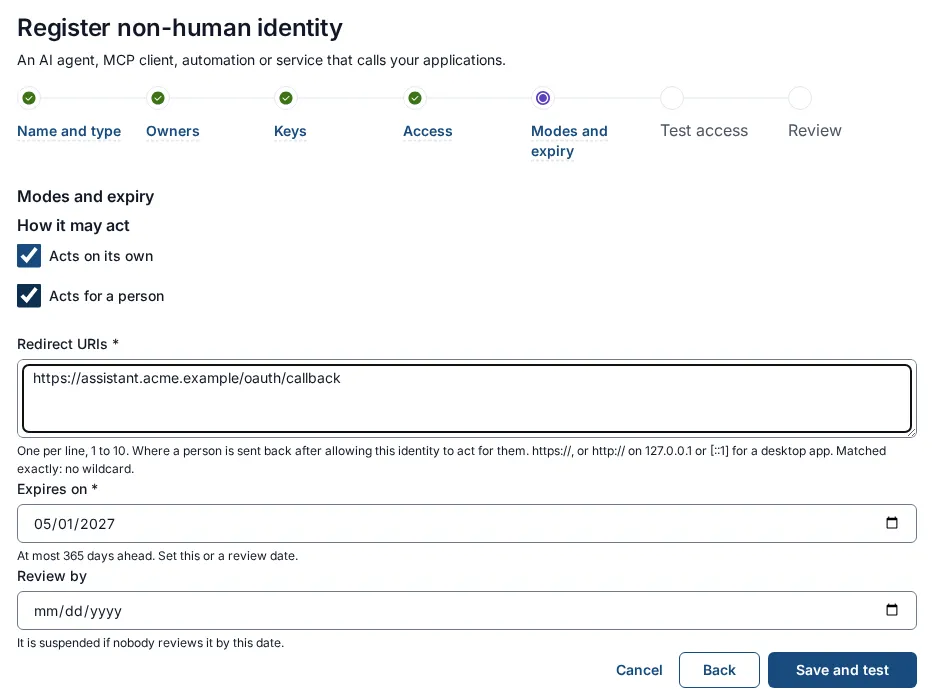
- Agent delegation. An AI agent acting for a person gets its own grant, limited to what the person approved and to what the person can reach now. SSOGEN re-checks this at every token issue and refresh.
- Nested groups. Put Backend inside Engineering and everyone in Backend counts as a member of Engineering. Nothing is copied, so someone removed from Backend stops counting as a member of Engineering.
- Group condition. A rule matches when the person “is in any of” or “is in none of” up to 64 groups. The first matching rule decides.
- What if. Ask whether a person would open an application right now. The answer names the deciding rule, signs nobody in and is recorded in the audit log.
ReBAC next to Zanzibar and RBAC
What is ReBAC authorization?
ReBAC authorization allows a request when a chain of stored relationships links the user to the object. The engine holds tuples such as “eng is viewer of folder:handbook” and rules such as “viewers of the parent folder are viewers of the document”. A check walks those links and returns allowed or denied.
Is ReBAC the same as Zanzibar?
No. ReBAC is the access model; Zanzibar is Google’s system that implements it. The 2019 paper describes how Google stores relation tuples and answers checks for its services. OpenFGA and SpiceDB are separate open-source engines that follow the same data model, each with its own modeling language and API.
Is ReBAC a superset of RBAC?
OpenFGA treats it as one: any role can be written as a relation to an organization. The tuple org:acme#admin@user:ann makes Ann an admin of Acme, and one rewrite rule grants that relation’s rights on every object Acme owns, as a role would.
Can a ReBAC grant depend on context such as an IP address?
Yes, in both open-source engines. OpenFGA attaches a condition to a tuple, written in Google’s Common Expression Language. SpiceDB attaches a caveat; its schema documentation shows a reader relation that counts only when an ip_allowlist caveat is true. The relationship decides who, the condition decides when.
Sources, all read 2026-11-18: Pang et al., Zanzibar: Google’s Consistent, Global Authorization System, 2019 USENIX Annual Technical Conference (abstract, sections 1 and 2, Table 1, Figure 1); OpenFGA concepts, authorization concepts and configuration language, with the DSL checked against the OpenFGA Google Drive sample model; SpiceDB schema language and Discovering SpiceDB.
Updated