SSOGEN / Learn / Access Control List (ACL)
Learn
Access Control List (ACL)
On a router interface, a cloud subnet or a file, an access control list (ACL) holds ordered permit and deny entries. The first entry that matches decides, and anything that matches no entry is denied.
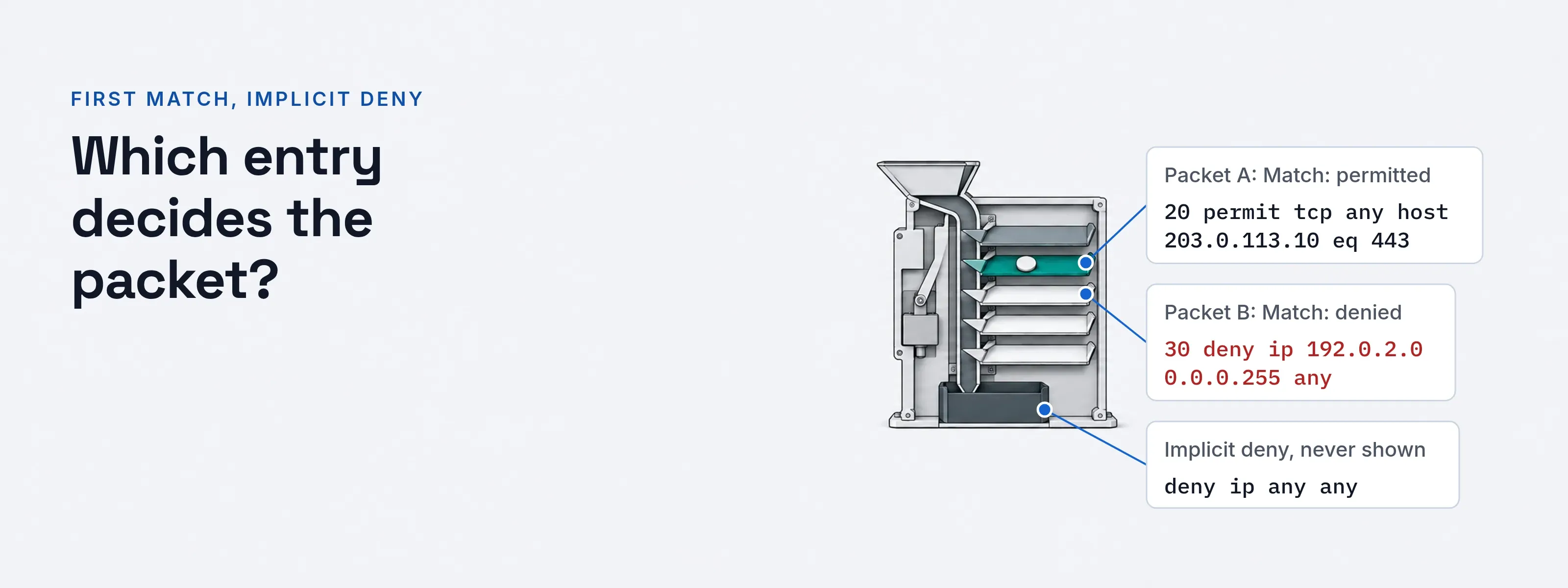
Each line of an access control list is an access control entry (ACE): a match condition and an action, permit or deny. A Cisco router compares a packet with the entries from the top and stops at the first match. Windows calls the list a DACL and writes allow and deny ACEs. Linux writes user:, group: and mask: lines. Below, one Cisco ACL meets three packets.
Read one ACL the way a router does
Extended ACL 110 filters traffic arriving from the internet. Addresses come from the RFC 5737 documentation ranges.
Router# show access-lists 110Extended IP access list 110 10 permit tcp any host 203.0.113.10 eq www (1204 matches) 20 permit tcp any host 203.0.113.10 eq 443 (8311 matches) 30 deny ip 192.0.2.0 0.0.0.255 any (57 matches) 40 permit tcp 192.0.2.0 0.0.0.255 host 203.0.113.25 eq smtp 50 permit udp any host 203.0.113.53 eq domain (2290 matches)Three packets arrive:
- Packet A. TCP from 198.51.100.24 to 203.0.113.10, port 443.
- Packet B. TCP from 192.0.2.15 to 203.0.113.25, port 25 (SMTP).
- Packet C. TCP from 198.51.100.40 to 203.0.113.10, port 22 (SSH).
| Entry | Packet A | Packet B | Packet C |
|---|---|---|---|
10 permit www to .10 |
No match: port 443 |
No match |
No match: port 22 |
20 permit 443 to .10 |
Match: permitted |
No match |
No match |
30 deny from 192.0.2.0/24 |
Not reached |
Match: denied |
No match: source |
40 permit SMTP from 192.0.2.0/24 |
Not reached |
Not reached |
No match |
50 permit DNS to .53 |
Not reached |
Not reached |
No match |
deny ip any any, added by the device and never shown |
Not reached |
Not reached |
Match: denied |
Packet B shows why order decides. Entry 40 would permit it, but entry 30 matches first, so entry 40 has no match count at all. Packet C falls through to the implicit deny. No counter records that drop, because Cisco counts only packets denied by explicit deny statements. Cisco therefore recommends ending a list with an explicit deny ip any any.
What are the types of ACL?
Cisco IOS has two types of network ACL, standard and extended, and either can be numbered or named. Operating systems add filesystem ACLs: POSIX ACLs on Linux, read with getfacl, and NTFS DACLs on Windows. Cloud providers add network ACLs on subnets, such as AWS network ACLs, which check rules in number order.
- Standard: 1 to 99, 1300 to 1999. Matches the source address only, as in
access-list 10 permit 192.0.2.0 0.0.0.255. - Extended: 100 to 199, 2000 to 2699. Adds destination, protocol and port, as in ACL 110 above.
- Named:
ip access-list extended EDGE-IN. A standard or extended list identified by a name. You remove one entry withno permit ...orno deny .... On a numbered list,no access-list 110 ...deletes the entire list.
When nothing matches, four systems reach deny differently
All four deny by default. They reach that answer by different paths, and Windows has one case that grants everyone full access.
| System | An entry matches on | Order of evaluation | When nothing matches |
|---|---|---|---|
| Cisco IOS ACL | Source address (standard); source, destination, protocol and port (extended) | Top to bottom by sequence number; the first match decides | Implicit deny, absent from the configuration and from the counters |
| AWS VPC network ACL | Protocol, port range and CIDR range, inbound and outbound | Lowest rule number first (1 to 32766); the first match decides | The * rule denies. It is visible and cannot be deleted |
| POSIX ACL (Linux) | Effective user ID, group IDs and supplementary groups | Fixed classes: owner, named users, owning and named groups, other | other catches everyone left; without the permission there, access is denied |
| NTFS DACL (Windows) | Security identifiers (SIDs) in the access token | ACEs in sequence until the requested rights are all granted or one is denied | Implicit deny. An empty DACL grants no access; a null DACL grants full access to anyone |
Network ACLs judge packets by address and port. File ACLs judge a user the kernel already knows, which makes them the authorization half of authentication vs authorization.
File ACLs you can read in a terminal
POSIX and Windows ACLs are discretionary: the owner sets them, unlike mandatory access control. Two commands print what the kernel checks.
$ getfacl reports/q3.csv# file: reports/q3.csv# owner: dana# group: financeuser::rw-user:lee:rw- #effective:r--group::r--mask::r--other::---C:\> icacls D:\PayrollD:\Payroll ACME\Contractors:(OI)(CI)(DENY)(W) ACME\Finance:(OI)(CI)(M) BUILTIN\Administrators:(OI)(CI)(F) NT AUTHORITY\SYSTEM:(I)(OI)(CI)(F)
Successfully processed 1 files; Failed processing 0 files#effective:r--. The mask caps named users and groups. Lee holdsrw-but can only read.ls -lprints-rw-r-----+. With a mask present, the group bits show the mask, and+marks an extended ACL. That is whyls -lalone does not explain Lee’s access.(OI)(CI). Files and subfolders inherit the entry.(I)marks an entry inherited from the parent folder.(DENY)on top. icacls keeps the canonical order: explicit denials, explicit grants, inherited denials, inherited grants. A contractor who is also in Finance cannot write to the folder, because the deny is read before the grant.
Three ways an ACL goes wrong
None of these raises an error. Each list does exactly what its order and defaults say.
Before: entry 40 never fires. 30 deny ip 192.0.2.0 0.0.0.255 any sits above the SMTP permit, so all traffic from that range stops at 30. Entry 40 shows no match count in show access-lists.
After: the permit sits above the deny. In ip access-list extended 110, enter 25 permit tcp 192.0.2.0 0.0.0.255 host 203.0.113.25 eq smtp, then no 40. Mail from 192.0.2.0/24 now matches at 25, and other traffic from the range still stops at 30.
- Missing return traffic (AWS). Network ACLs are stateless, so each response needs its own rule for the client’s ephemeral ports. AWS suggests opening 1024 to 65535, with deny rules for unwanted ports placed earlier. Security groups are stateful and need no such rule.
- A null DACL (Windows). Code that sets a DACL to NULL grants full access to any user, with no security check. An empty DACL, with zero ACEs, grants no access. The two look alike in code and do opposite things.
Questions people ask
What is the function of an access control list?
An access control list decides which traffic or which users may reach a resource. On a router it permits or denies packets by address, protocol and port. On a file it grants read, write or execute rights to named users and groups. Entries are checked in a defined order, and anything not permitted is denied.
What is the difference between an ACL and RBAC?
An ACL stores permissions on each object; RBAC grants permissions to roles and assigns roles to people. With ACLs, a new employee means editing every file share or list they need. With RBAC, you add that employee to one role. How RBAC compares with attribute-based control is in RBAC vs ABAC.
Does the order of entries in an ACL matter?
Yes, on routers and cloud network ACLs. Cisco IOS checks entries by sequence number and AWS by rule number, and the first match decides, so a broad deny above a narrow permit blocks it. Windows sorts ACEs into canonical order with explicit denials first. POSIX ignores entry order and checks fixed classes.
The same first-match rule for application access
SSOGEN applies the model to applications after sign-in: one list of access rules for the whole organization decides which applications each person may reach.
- First match decides. Rules are checked from the top. Anything no rule allows is denied when the default is Deny.
- Always first. These rules are checked before every other rule, for example an emergency deny.
- Shadowed rules are flagged. The editor marks a rule “Never reached: rule 3 is covered by rule 2”, the same fault as entry 40 above.
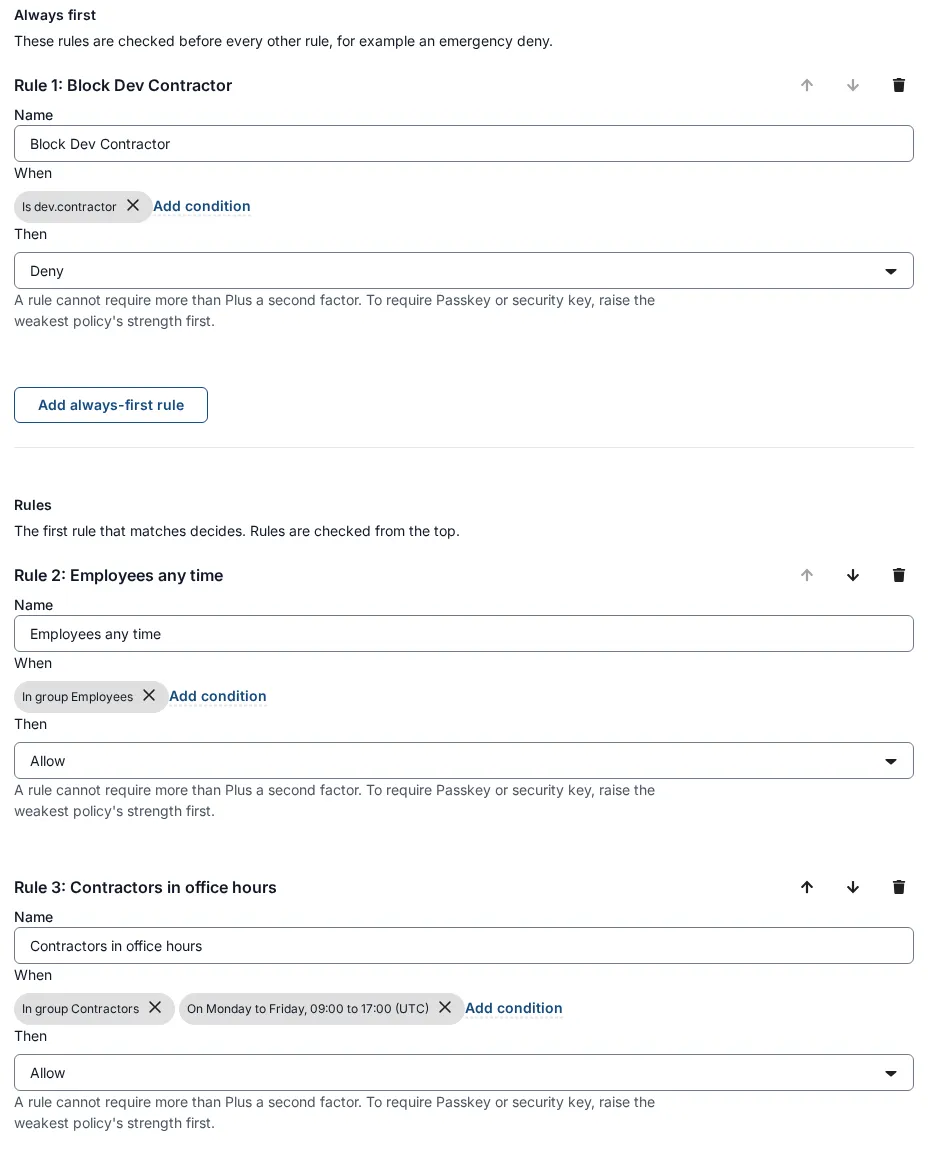
Build the list in access rules, part of the SSOGEN conditional access policy engine.
Sources, all read 2026-11-18: Cisco, IP Access List Entry Sequence Numbering (IOS XE 16.11); Cisco, Creating an IP Access List to Filter IP Options; Cisco, Configure Commonly Used IP ACLs; AWS, network ACL basics; AWS, custom network ACLs and ephemeral ports; acl(5); getfacl(1); Microsoft, How AccessCheck Works; Microsoft, Order of ACEs in a DACL; Microsoft, Null DACLs and Empty DACLs; Microsoft, icacls.
Updated