SSOGEN / Learn / What Is Smishing? Five Text Scams, Annotated
Learn
What Is Smishing? Five Text Scams, Annotated
Phishing by text message is called smishing: an SMS or messaging-app text that pushes you to tap a link, reply or call, so the sender gets a password, a sign-in code, a card number or a malware install.
People told the FTC they lost $470 million to text scams in 2024, more than five times the 2020 figure. The FBI defines smishing as fake text messages that trick people into installing malware, sharing sensitive information or sending money.
Most scam texts follow a handful of scripts. The FTC estimates that its top five account for about half of the text frauds reported in 2024. Learn the scripts and you can match a message in seconds.
Five smishing examples and the tell in each
A typical smishing example is a toll notice: a small amount owed, a late fee, and a link to a site that is not the agency’s own. Each text below carries one to three tells you can check before you tap anything. The five below follow FTC and FBI warnings.
- Unpaid toll, from
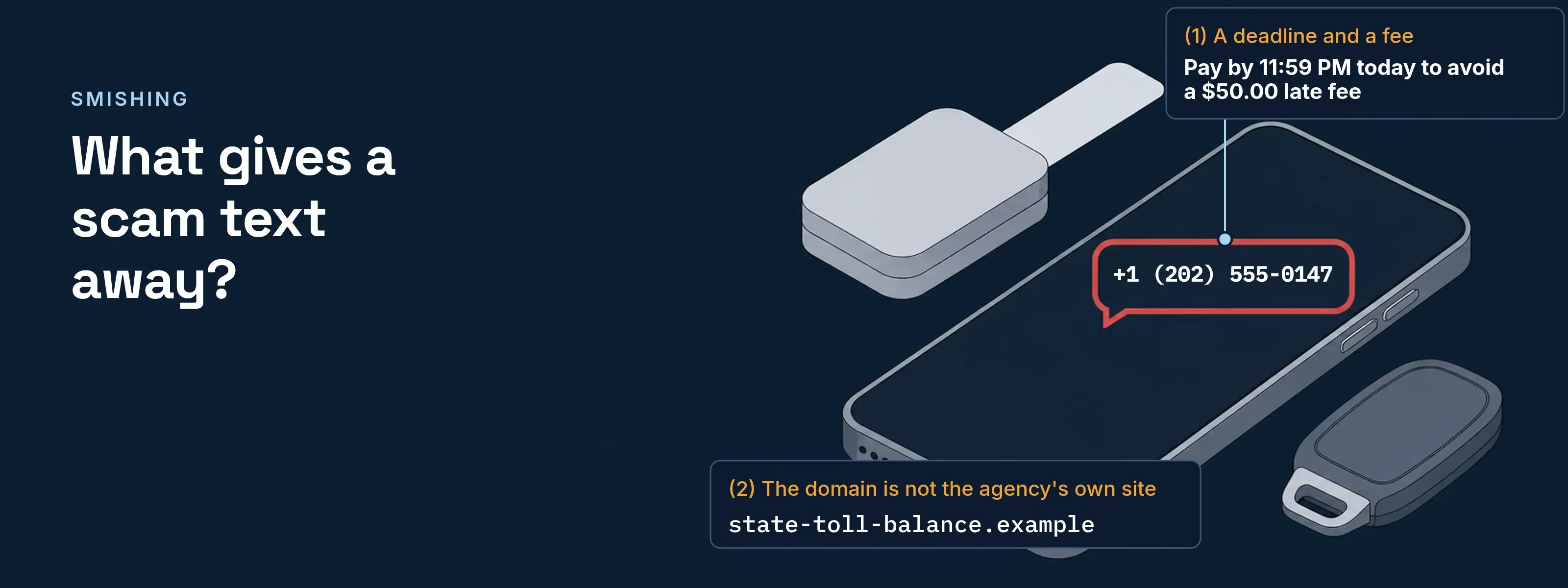
+1 (202) 555-0147 - State Toll Service: an unpaid toll of $11.40 is on your account. Pay by 11:59 PM today to avoid a $50.00 late fee (1):
https://state-toll-balance.example/pay(2) - (1) A deadline and a fee, so you act before you check. (2) The domain is not the agency’s own site. FBI IC3 logged over 2,000 complaints from early March to April 12, 2024 (PSA I-041224-PSA); FTC alert, January 17, 2025.
- Parcel delivery, from
+1 (305) 555-0182 - Parcel Service: we couldn’t deliver your package because the address is incomplete. Confirm it and pay a $1.99 redelivery fee (1):
https://parcel-redelivery.example/track(2) - (1) The small fee is the hook: the form takes your card number, sometimes your Social Security number. (2) A tracking link you never asked for. The most reported text scam of 2024 (FTC Data Spotlight, April 14, 2025).
- Bank fraud alert, from
+1 (212) 555-0119 - Your Bank Fraud Alert: did you attempt a $1,248.00 purchase? Reply YES or NO (1). A fraud specialist will call you (2) if you didn’t.
- (1) A reply connects you to a fake fraud department. (2) The “specialist” says your money is at risk and asks you to move it to a safe account. That account is the scammer’s (FTC Data Spotlight, April 14, 2025).
- Sign-in code request, from
+1 (415) 555-0163 - Account Security: a new device signed in to your account. We sent you a 6-digit code. Reply with the code (1) to keep your account open.
- (1) The code you received is real: the sender started a sign-in on the real site and needs that code to finish it. The FTC’s rule: anyone who asks for your verification code is a scammer (consumer alert, March 7, 2024).
- Remote job offer, from
+1 (646) 555-0128 - Hi, I’m a recruiter. Remote role, about an hour a day rating apps, $300 to $800 a day (1). Reply 1 for details.
- (1) Work with no specifics, from someone you never contacted. Later the “task” job asks for a deposit before you can withdraw earnings, and the money does not come back (FTC Data Spotlight, April 14, 2025).
Numbers in the 555-0100 to 555-0199 range are reserved by NANPA for fiction, and .example is reserved by RFC 2606, so none of these reaches anyone.
What happens if you tap a smishing link?
The link opens a page built to take something, and the harm comes from what you type or install there. It may be a copy of a sign-in page, a payment form or an app download. If you entered nothing, close the page and report the text. If you entered details, secure the account and call your bank.
- A sign-in page. A copy of a real one asks for your password, then for the code the real site just texted you. With both, the sender is in your account.
- An app install. The page asks you to install an app. It can be malware that steals your personal or financial information without you noticing.
- A payment form. A “fee” of a dollar or two collects your card number, and sometimes your Social Security number for identity theft.
Your phone number itself can be taken too: a SIM swap moves it to the attacker’s SIM, and every texted code goes with it.
Smishing vs phishing and vishing
Smishing is phishing by text. The lure is the same; the channel changes what you can check. A text shows only a number, a short code or a name, and there is no sender address to inspect. The types of phishing overview covers the rest of the family.
| Phishing (email) | Smishing (text) | Vishing (call) | |
|---|---|---|---|
| What the sender line shows | A display name and a full email address | A phone number, a short code such as 5XXXX, or a name |
Caller ID: a number or a name |
| How the lure arrives | A link or an attachment | A link, or a request to reply | A voice script and live pressure |
| Typical ask | Sign in, open a file, pay an invoice | Pay a fee, confirm a purchase, send a code | Read out a code, move money |
| Where to report | Your mail app’s report option; ReportFraud.ftc.gov | 7726 (SPAM); your messaging app; ReportFraud.ftc.gov | ReportFraud.ftc.gov |
A call often follows a text, as in the bank script above; see what vishing is for the call side.
Why a texted code is the prize
A phished one-time code works on the real site, as long as the attacker uses it within its lifetime. A fake page relays it in real time, so a code cannot protect you from the page you are typing it into. CISA’s mobile guidance for highly targeted people (December 18, 2024) says not to use SMS as a second factor and to move to FIDO authentication.
Texted code: the fake page relays it. You type the code into state-toll-balance.example, the page passes it to the real site within seconds, and the attacker signs in as you.
Passkey: nothing to relay. The passkey is bound to the real site’s domain, so your device never signs in to the lookalike. There is no code to read out or type.
In SSOGEN, a policy decides which methods count.
- Text-message codes stay off until a policy lists them, and the policy screen labels them “weaker”.
- The Admin Console policy never accepts a text or email code.
- A passkey counts as both factors and cannot be phished, and an application can set its required strength to Passkey or security key for the sign-ins that matter most.
See MFA setup in SSOGEN, and phishing-resistant MFA for the full method comparison.
How do you stop smishing text messages?
Report each one, block the sender, filter senders you do not know, and never reply or tap. Forwarding to 7726 helps your carrier block similar texts. To check a real problem, go to the company yourself, by a website or phone number you already trust, never one from the message.
Leave the link and the reply alone
Do not tap and do not reply. Scammers want a quick reaction; the FTC’s advice is to stop and check first.
Forward the text to 7726 (SPAM)
Copy the message and forward it to 7726 so your wireless provider can spot and block similar texts.
Report it in your messaging app and to the FTC
Use the app’s report junk option, then file at ReportFraud.ftc.gov. For a toll text, the FBI also asks for a complaint at ic3.gov with the sending number and the link.
Check the account yourself
Open the toll agency, bank or carrier site by typing its address, or call the number on your card or statement.
Block and filter
Block the number, turn on your phone’s filter for senders not in your contacts, and check your carrier’s blocking tools. Then delete the text.
If you entered details, act now
Change the password, call your bank, and dispute any charge you do not recognize.
Sources, all read 2026-11-18: FTC Data Spotlight, Top text scams of 2024 (April 14, 2025); FBI IC3 PSA I-041224-PSA (April 12, 2024); FTC, Got a text about unpaid tolls? (January 17, 2025); FTC, What’s a verification code and why would someone ask me for it? (March 7, 2024); FTC, How to recognize and report spam text messages; CISA, Mobile Communications Best Practice Guidance (December 18, 2024); NANPA, 555 line numbers; RFC 2606.
Brand names in the FTC sources are left out of the examples.
Updated